- Menopause shouldn't be treated as a standalone specialty benefit. The strongest programs embed menopause-trained primary care into the health strategy employees already use.
- Menopause symptoms are a measurable workforce issue, costing U.S. employers billions in lost work time and medical expenses each year.
- Menopause support is a retention strategy, especially for experienced employees in their 40s, 50s, and senior leadership years.
- The cost of replacing skilled employees often far exceeds the cost of menopause-related care, accommodations, and manager training.
- Workplace accommodations, manager training, and behavioral health support work best when they're coordinated through that same primary care relationship, not bolted on as separate vendors.
Most employers still treat menopause as a private matter rather than a workforce issue, even though women over 50 represent one of the fastest-growing segments of the labor force. Symptoms like hot flashes, sleep disruption, and brain fog don't stay contained to an employee's personal life. They show up in absenteeism, reduced output, and decisions about whether to stay in a role at all.
The usual response is to add a standalone menopause benefit alongside everything else in the portfolio. Galileo's clinicians take a different approach: menopause-trained primary care built into the relationship an employee already has, rather than another specialty vendor to discover and enroll in separately.
Why Primary Care Should Be the Starting Point, Not a Specialty Referral
The default model sends a woman with menopause symptoms looking for a specialist, often after she's already spent months wondering whether what she's experiencing is even worth mentioning to a doctor. That delay isn't incidental. It's built into how menopause care is typically structured.
Primary care is supposed to be the place where a changing symptom picture gets noticed early and connected to the context the patient already has on file. For menopause specifically, that connection often doesn't happen.
A 2019 study published in Mayo Clinic Proceedings surveyed family medicine, internal medicine, and OB-GYN residents and found that only 6.8% felt adequately prepared to manage menopause, and 20.3% reported receiving no menopause lectures at all during residency. The gap isn't a shortage of primary care access. There is a shortage of primary care providers who are actually trained for this transition.
That's the case for embedding menopause-trained primary care into an existing benefit rather than adding a separate specialty service. A primary care team that already knows an employee's history, manages her other conditions, and is specifically trained in menopause can catch symptoms early, start a conversation without a referral, and coordinate everything else, including accommodations, behavioral health, and follow-up, from one place.
Why Menopause Benefits Matter for Employers
The business case for menopause support is stronger than many HR leaders realize, and it rests on data rather than goodwill alone.
The Business Case Is Stronger Than Most HR Leaders Realize
Research published in Mayo Clinic Proceedings estimates that menopause symptoms cost U.S. employers $1.8 billion annually in lost work time, a figure that rises to $26.6 billion when medical expenses are included. The same research found that 13.4% of employed women surveyed reported at least one adverse work outcome tied to their symptoms.
Given that menopause occurs at a mean age of 52, right as many women are reaching senior roles, this is not a fringe issue. Nearly 50 million women in the U.S. labor force are old enough to be navigating some stage of the transition.
Replacement Costs Dwarf The Price Of Support
When employees struggle without support, they are more likely to reduce hours, decline promotions, or leave the workforce entirely. According to the Society for Women's Health Research, two in five women have considered finding or have found a new job because of menopause symptoms, and one in four has passed on a leadership opportunity for the same reason.
Replacing an experienced employee typically costs 50% to 200% of their annual salary once recruiting, onboarding, and lost institutional knowledge are factored in. Set against that, the cost of targeted benefits and workplace accommodations looks modest.
Comprehensive Programs Build Measurable Loyalty
Organizations that offer real menopause support tend to see the difference show up in engagement and retention data, not just in goodwill surveys. Part of that comes down to access.
Galileo provides advanced primary care, giving employees a fast way to start a conversation about symptoms instead of waiting weeks for an appointment. Ignoring menopause is the expensive option. Addressing it proactively protects the talent pipeline and signals that a benefits strategy reflects the real composition of the workforce.
What a Primary-Care-Led Menopause Support Program Includes
Treating menopause-trained primary care as the foundation doesn't mean it's the only thing that matters. It means everything else, accommodations, manager training, behavioral health, works better when it's coordinated through that same relationship instead of scattered across separate vendors.
Menopause-Trained Primary Care Is the Clinical Anchor
Employees need a straightforward way to reach a provider who can evaluate menopause-related symptoms, order hormone testing when appropriate, and discuss treatment options, including hormone therapy, without a separate referral process.
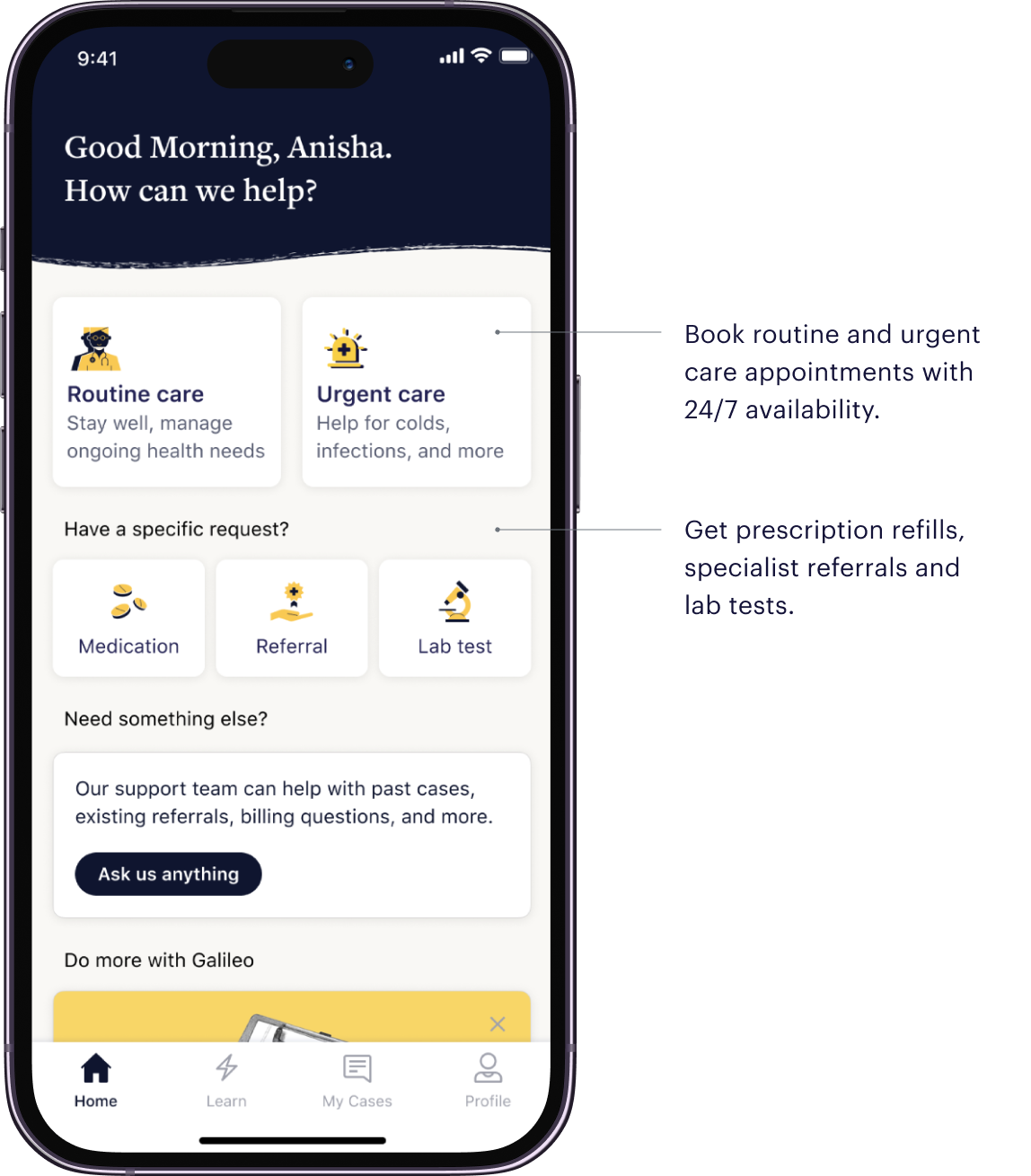
Galileo's primary care team can evaluate and manage menopause symptoms as part of routine care, with access by text, video, or phone, and can route a patient directly into behavioral health support when mood symptoms are part of the picture, all without the employee having to find and enroll in a separate specialty service first.
Workplace Accommodations Extend the Clinical Relationship
Day-to-day comfort matters as much as clinical care, and accommodations land better when a primary care provider can help an employee identify which ones actually apply to her symptoms. Reasonable adjustments include temperature control through desk fans or better ventilation, easy access to water and restrooms, breathable uniforms or relaxed dress codes, and flexible scheduling. A private space for cooling down during a hot flash and time allowances for medical appointments round out the list. These changes are typically low cost and high impact.
Manager Training Closes the Communication Gap
Many supervisors simply don't know how to talk about menopause at work, recognize the symptoms, or understand why an employee suddenly needs schedule flexibility. That gap is common: AARP's research found that nearly four in ten workers and three in ten employers say menopause isn't discussed at work at all.
Training helps managers respond supportively rather than dismissively, which reduces stigma and improves team dynamics, and it works best when it points managers back to the same primary care benefit rather than leaving them to guess at next steps.
Mental Health Support Stays Connected to the Same Care Team
Mood changes, anxiety, and depression commonly accompany menopause. When behavioral health support runs through the same primary care relationship, whether through an integrated visit or a direct referral from a provider who already knows the patient, employees get care for the full symptom picture instead of being routed to a disconnected EAP that starts from zero.
How to Implement Menopause Benefits Successfully
Rolling out menopause support requires thoughtful planning and clear communication rather than a single benefits-fair announcement.
- Start with data: Survey the workforce anonymously to understand current needs, review existing benefits for gaps, and look at demographic trends. If a meaningful share of employees are women in their 40s and 50s, menopause support belongs on the roadmap.
- Evaluate vendors on fit, not familiarity: Weigh ease of access (24/7 availability matters), clinical depth, integration with existing benefits, and cost structure, rather than defaulting to whichever name is most recognizable.
- Train managers: This step is critical. Managers do not need to become medical experts, but they do need to understand what menopause is, how it can affect performance, and what accommodations are available, so they can respond with empathy and point employees to the right resources.
- Communicate clearly: Announce new benefits through multiple channels, be specific about what is covered and how to access it, and normalize the conversation by folding menopause into broader discussions about employee health.
- Measure outcomes: Track utilization, gather employee feedback, and watch retention rates among women over 45, then adjust the program based on what the data shows.
What This Kind of Support Is Worth Over Time
The case for menopause support holds up under scrutiny, not just as a values statement but as a pattern that shows up consistently in the data.
Reduced Absenteeism And Presenteeism Affect Costs Directly
When employees have access to effective symptom management, they miss fewer days and perform better on the days they are at work. Perimenopausal women report an average work-productivity impairment of 22.5%, a figure that climbs past 33% for those managing severe symptoms.
Retention Savings Compound Over Time
Replacing a mid-career professional costs tens of thousands of dollars once recruiting, onboarding, and lost institutional knowledge are factored in. If menopause benefits keep even a handful of experienced employees from leaving, the program covers its own cost several times over.
Integrated Primary Care Delivers The Clearest Return
Galileo has documented an 11.5% reduction in total cost of care within six months of working with employers. That figure reflects its broader integrated model rather than menopause care in isolation, but the underlying logic holds: a primary care partner that manages everyday concerns, chronic conditions, and urgent issues in one place reduces the downstream costs that come from fragmented, single-purpose benefits, menopause support included.
Building Menopause Support Into a Health Strategy
Menopause benefits at work aren't a niche accommodation for a small slice of the workforce. They sit at the intersection of two pressures every benefits leader already feels: rising health care costs and the difficulty of retaining experienced talent.
Treating menopause as a side specialty rather than a part of primary care is part of why so many programs go underused. The data points in one direction, and the cost of waiting compounds the longer employers keep menopause separate from the care relationship employees already trust.
For employers ready to build that support into an existing, menopause-trained primary care benefit rather than bolting on another point solution, Galileo's partner programs for employers are a place to start.

%20(1)%20(1).webp)
.webp)
.webp)

.webp)
.webp)


.webp)











%20(1).webp)
%20(1).webp)











.webp)