- Employees increasingly expect primary care to be accessible, responsive, personalized, and easy to navigate.
- Concierge medicine and Direct Primary Care (DPC) helped demonstrate the value of better access, longer-term clinician relationships, and a more responsive care experience.
- Advanced Primary Care (APC) builds on those attributes with greater clinical depth, proactive care, coordination across services, and longitudinal accountability for a person’s health.
- The distinction is not simply how quickly someone can reach a clinician. It is how much of their health the care model can meaningfully manage over time.
- For employers, a stronger primary care model can influence more than employee experience. By addressing needs earlier and coordinating care more effectively, it can also help reduce avoidable downstream utilization and total cost of care.
- Galileo has demonstrated an 11.5% reduction in total cost of care within six months of working with employers.
Employees want primary care that works when they actually need it. That means timely access, responsive clinicians, personalized support, and relationships with care teams that understand their health over time.
Concierge medicine and Direct Primary Care helped establish many of these expectations. Both pushed back against a traditional primary care experience often defined by long waits, short visits, and fragmented communication.
But better access only solves part of the problem.
Advanced Primary Care takes a broader approach. It combines easier access with deeper clinical capabilities, coordinated care, proactive support, and ongoing responsibility for a person’s health.
For employers, that distinction matters. Giving employees another place to seek care may improve convenience. Giving them a care model that can manage more of their needs, keep track of what happens over time, and coordinate the next step can have a much bigger impact.
Why Better Access Was Only the Beginning
Traditional primary care has long struggled with capacity.
A primary care physician's panel commonly falls in the 1,200 to 1,900 patient range. At that volume, same-day appointments, longer conversations, and regular follow-up can be difficult to sustain.
Concierge medicine emerged partly in response to those constraints. Research published in the Annals of Family Medicine puts typical concierge panels between 200 and 600 patients.
Smaller panels can give physicians more time with each patient. They can also make faster scheduling, longer visits, and more direct communication possible.
Direct Primary Care introduced a different structure, usually through a monthly membership that covers primary care services outside conventional fee-for-service insurance billing.
Both models showed that people place real value on primary care that feels more available, personal, and responsive.
Advanced Primary Care starts from that same expectation, but it asks more of the care model.
The question is no longer just whether someone can reach a clinician quickly. It is whether that clinician, and the team around them, can manage more of the person’s health over time.
What Makes Advanced Primary Care Different?
Advanced Primary Care combines convenient access and strong clinical relationships with the clinical resources needed to manage a wider range of health needs.
That means care does not begin and end with a single visit.
A strong APC model can take into account a person’s history, follow ongoing conditions, identify needs earlier, coordinate across different types of care, and stay involved as those needs change.
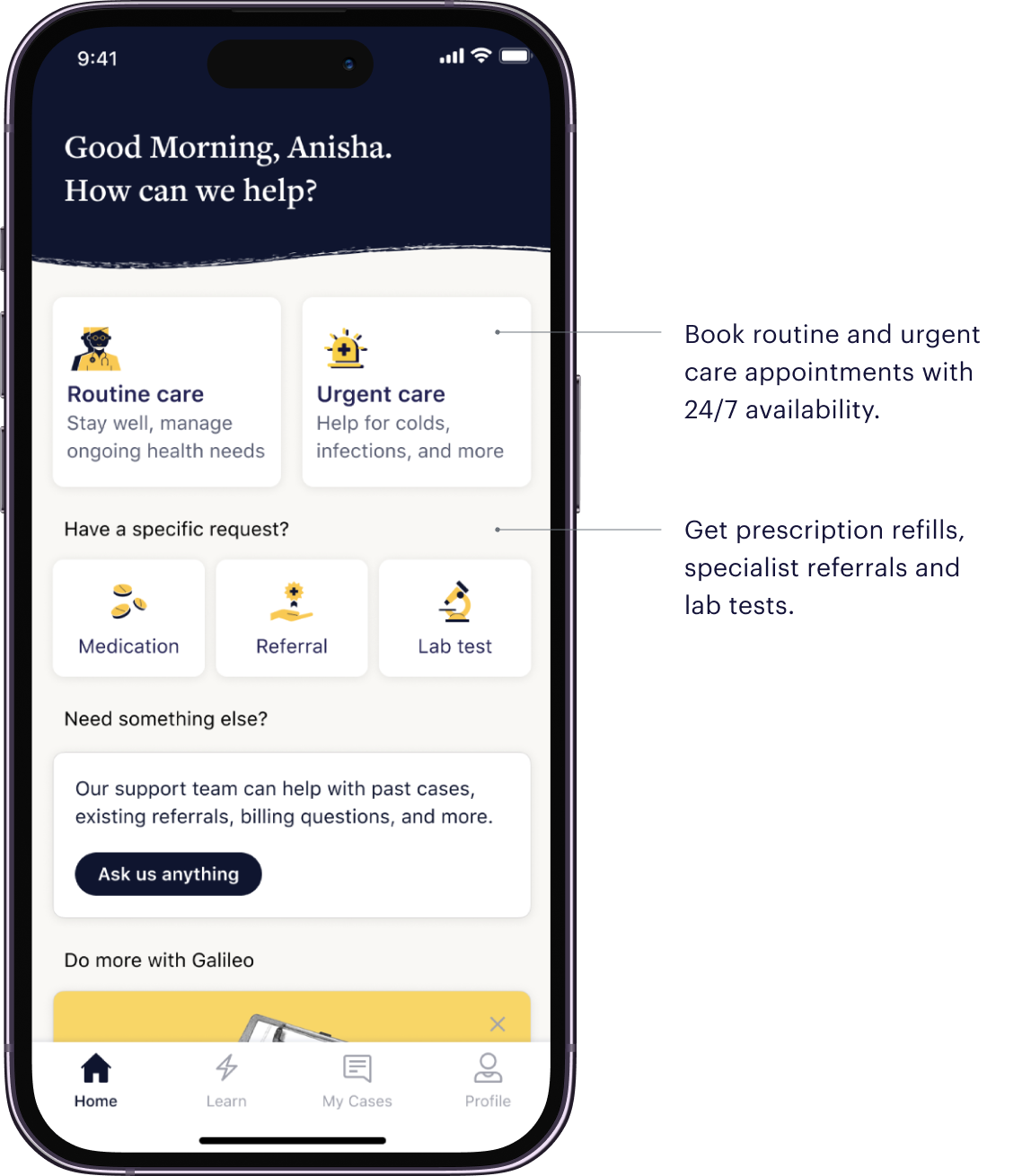
At Galileo, that includes team-based care across more than 20 specialties, delivered virtually and in person and built to work alongside employees' existing insurance.
The value is not simply having more clinicians available.
It is having those clinicians work as part of one care model, with shared context and continued responsibility for what happens next.
An employee might first reach out with an acute concern. That interaction can become part of a larger picture, including medical history, existing conditions, follow-up needs, or specialist support.
That continuity is what separates access alone from a more comprehensive primary care model.
Concierge, Direct Primary Care and Advanced Primary Care Compared
Concierge medicine, DPC, and APC can all improve parts of the traditional primary care experience. The differences become clearer when the comparison moves beyond appointment availability and looks at what each model is equipped to manage.
Concierge and DPC can make primary care easier to access and more personal. APC keeps those strengths, but expands the role of primary care itself.
From Convenient Care to Ongoing Accountability
Convenience matters, but it does not solve fragmentation on its own. An employee might be able to speak with a clinician quickly and still end up navigating separate providers for specialty care, chronic disease management, behavioral health, referrals, and follow-up.
Each handoff creates room for information to be lost, tests to be repeated, follow-up to be missed, or the work of coordinating care to fall back on the employee.
Advanced Primary Care is meant to reduce that burden. Instead of viewing each visit as a standalone interaction, the care team stays connected to the person’s broader health needs.
That might mean treating an acute issue today, following an ongoing condition over time, coordinating specialty care when needed, and using what the team already knows about the person to inform the next decision.
Primary care becomes more useful when it carries context forward.
Why Clinical Breadth Matters
Many health concerns do not fit neatly into a single primary care visit.
A person may start with a straightforward symptom that turns out to need deeper investigation. They may have a chronic condition that needs regular management. Or they may have concerns that overlap with mental health, medication needs, or specialty care.
In a fragmented system, each of those needs can lead to another referral, another provider, another appointment, and another disconnected record. A multidisciplinary APC model can keep more of that care connected.
Galileo's model spans more than 20 specialties, allowing care teams to draw on broader clinical expertise without losing continuity around the employee. The advantage is not simply access to more clinicians. It is access to clinicians who are working from the same picture of the person’s health.
Why Employers Are Investing in Advanced Primary Care
For employers, the value of APC goes beyond convenience and employee satisfaction.
Limited primary care access and fragmented care can push employees toward urgent care and emergency departments, including for concerns that might have been addressed earlier or managed in a lower-cost setting.
A stronger primary care model gives employees another path.
When someone can reach a care team as a concern begins, that team can assess the situation, provide treatment, determine whether escalation is necessary, and coordinate what should happen next.
That combination matters.
Simply making a clinician available does not automatically reduce unnecessary utilization. The care model also needs enough clinical depth and continuity to manage the issue appropriately.
Galileo has demonstrated an 11.5% reduction in total cost of care within six months of working with employers. Galileo has also recorded more than 29% digital engagement among covered populations and a net promoter score above 80.
Those results point to a larger idea behind APC: primary care can create more value when it is responsible for more than completing visits. It can also play a larger role in managing health over time.
Making the Benefit Decision
For employers, the conversation around primary care should go beyond access alone.
Same-day appointments, virtual care, and responsive clinicians are valuable, and concierge medicine and Direct Primary Care helped show why those features matter. But they are only part of what employees need from a modern primary care model.
Advanced Primary Care builds on those strengths with broader clinical capabilities, stronger care coordination, continuity over time, and greater responsibility for managing what happens next.
That distinction matters when employers are evaluating primary care benefits. The goal is not simply to give employees another place to seek care, but to offer a model that can manage more of their health and stay involved across different needs, conditions, and stages of care..
Galileo's Advanced Primary Care model brings those capabilities together through multidisciplinary care, ongoing coordination, and support that works within employees' existing insurance.
Better access may be where the experience starts. Advanced Primary Care is about what the care model can do from there.
Ready to explore what Advanced Primary Care could look like for your workforce? Talk to Galileo.