- Population health management programs often plateau when organizations add outreach and point solutions without addressing the fragmentation underneath.
- Low engagement is usually a signal that care is too hard to access, too disconnected, or too difficult to navigate, not a sign that people lack motivation.
- Care coordination failures are costly: a JAMA-based estimate puts the annual waste from coordination failures alone at $27.2 billion to $78.2 billion.
- Continuity of primary care is associated with lower total costs, fewer hospitalizations, and fewer emergency department visits.
- The strongest population health scorecards measure care resolution, continuity of care, avoided referrals, appropriate utilization, and total cost of care, not activity.
- Galileo's model is built around one coordinated care experience across primary care, urgent care, chronic care, behavioral health, and specialty guidance, brought in only as members need it.
Too often, the conversation starts with engagement: how to get more people to use benefits they already have. But low engagement is rarely the root problem. More often, it's a signal that care itself is too fragmented, with members choosing between vendors, apps, and care pathways with no clear place to start.
The fix isn't more outreach. It's a coordinated care model: one accountable team that anchors everyday and ongoing care, then connects people to additional services, behavioral health, specialty care, chronic condition support, only when they're actually needed, before issues become more complex and expensive.
What Is Population Health Management, Really?
Population health management is a care strategy that uses data, risk stratification, proactive outreach, and coordinated care delivery to improve health outcomes across a defined population, whether that's a workforce, a member group, or a specific risk segment.
NCQA defines population health management as a model that addresses needs across the full continuum of care, and its own accreditation standards make the underlying logic explicit: when a person's path through the health system is fragmented and uncoordinated, the predictable result is higher costs and worse outcomes.
The phrase that matters most in that definition is “across the continuum.” PHM connects insight to action: who needs support, what kind of support, who's accountable for delivering it, and how outcomes get measured, not a data exercise or a collection of condition-specific programs bolted together.
In a fragmented system, a health plan can identify high-risk members and still fail to improve outcomes if those members can't access timely, connected care. An employer can offer a strong benefits portfolio and still see low utilization if people don't know where to begin.
That's the gap an advanced primary care model closes: one accountable care team that connects data to action and brings in behavioral health, specialty care, or chronic condition support only when a member needs it, not as a parallel menu of programs.
Fragmentation, Not Motivation, Is the Real Barrier
Many population health strategies assume people need more nudges, reminders, or incentives to engage. Those tactics can help, but they don't solve the underlying problem if the care experience remains disconnected.
When a member has a primary care provider in one system, a behavioral health benefit in another, a chronic condition vendor somewhere else, and a separate navigation tool to make sense of it all, the burden of coordination falls on the person least equipped to carry it.
For leaders, that's not a motivation problem. It's a care design problem, and an expensive one to leave unaddressed. A JAMA-based analysis of waste in U.S. health spending estimated that failures of care coordination, mostly unnecessary hospital admissions and readmissions, account for $27.2 billion to $78.2 billion in annual waste across the system.
For employers and health plans, that fragmentation shows up as delayed care, unnecessary specialist referrals, avoidable emergency department visits, duplicated services, poor chronic condition control, and rising total cost of care.
Why More Point Solutions Aren't Always the Answer
Point solutions often emerge for good reasons. A population has a diabetes gap, a behavioral health access issue, rising musculoskeletal spend, or a need for more navigation support, so the organization adds a focused solution.
The challenge isn't that point solutions are wrong; it's that they add complexity when they aren't integrated into a broader care model. A member might have a chronic condition, anxiety, a medication question, and a new urgent symptom.
In a fragmented model, those needs get routed to several different places, leaving the individual confused and the organization with a benefits ecosystem that's harder to measure and manage. Some organizations recognize this pattern by name: point solution fatigue, the operational cost of accumulating vendors faster than any single team can coordinate them.
For leaders, this also creates real operational drag: more vendors to manage, more data feeds to interpret, more contracts to review, and more difficulty understanding which programs are actually improving outcomes. A stronger population health strategy asks what can be integrated, not what else can be added. The goal is a care experience that feels coherent to the member and measurable to the organization.
Advanced Primary Care as the Foundation, Not Another Program
Primary care is the natural center of population health because it's where prevention, chronic care, behavioral health needs, urgent concerns, and specialty decisions usually begin.
The National Academies describe high-quality primary care as continuous, person-centered, and relationship-based, and note that without access to it, minor health problems can spiral into chronic disease, chronic disease management becomes harder to coordinate, emergency department visits rise, and health care spending climbs to unsustainable levels.
That's why integrated primary care is more than a front door. It's the organizing layer that helps people move through the health system with less friction and better clinical continuity. The care team sees the person's full context: symptoms, conditions, medications, prior visits, behavioral health needs, and follow-up plans, so a concern that might have become a specialist referral can often be resolved in primary care instead.
A behavioral health need can be addressed alongside physical health, inside the same care team, rather than routed to a separate, standalone benefit, and a chronic condition gets managed continuously instead of episodically.
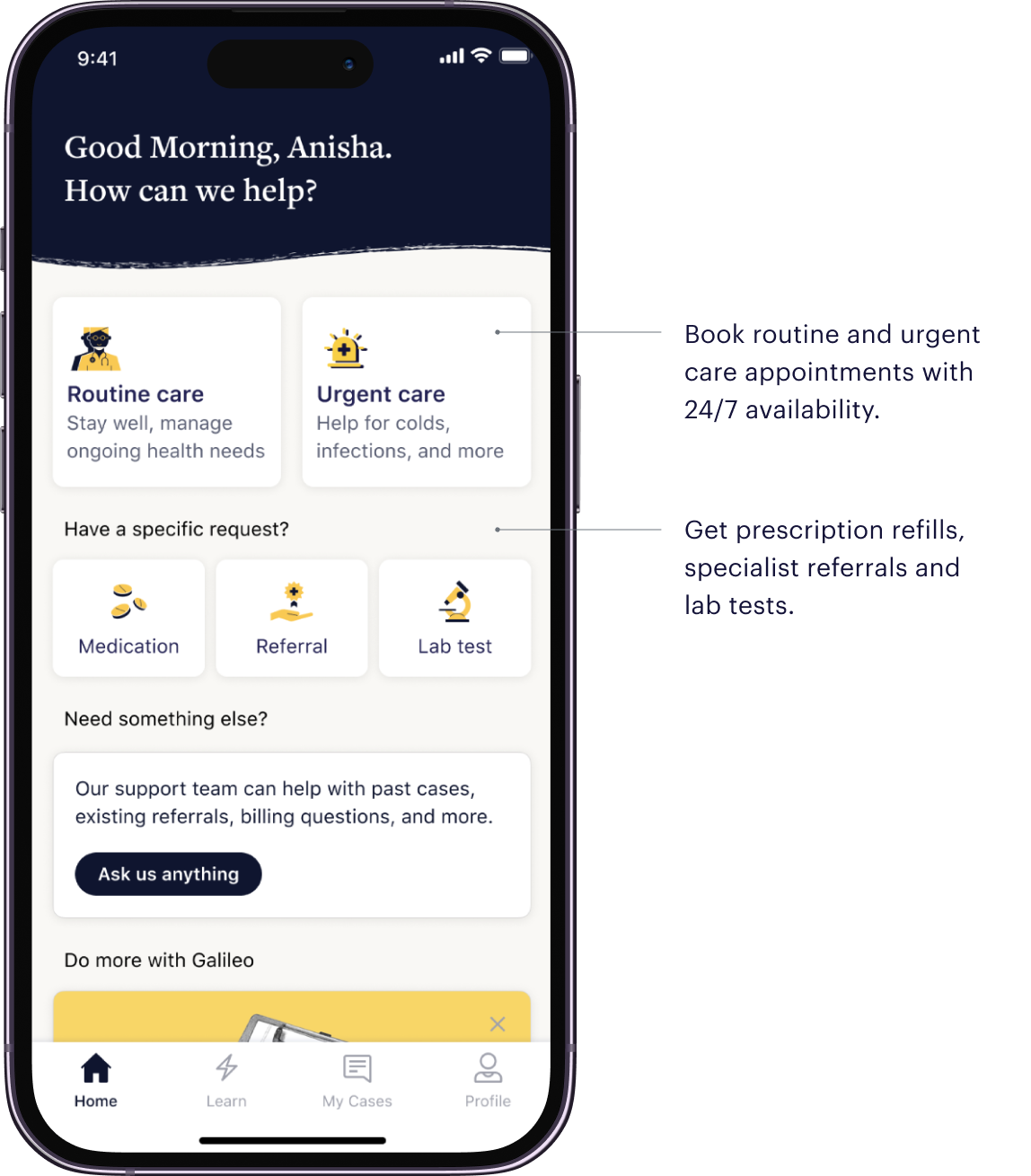
This is where Galileo's model is distinct. Galileo brings primary care, urgent care, chronic care, behavioral health, and specialty guidance into one coordinated clinical experience. The member doesn't have to figure out which door is right. The care team determines the right next step, and other services activate only when the situation calls for them, not by default.
An advanced primary care model doesn't add the capabilities below as separate programs. It uses them as needed:
These capabilities reinforce each other only when they sit inside one model. Risk stratification without access leaves high-risk members identified but unsupported. Outreach without coordination can raise activity without changing outcomes. Chronic care management without behavioral health support misses one of the biggest drivers of physical health.
What an Effective Population Health Model Requires
Effective population health programs aren't measured by how many programs they offer, but by whether fragmentation goes down and outcomes go up.
Unified Data That Leads to Action
Data matters, but data alone doesn't improve health. Employers and health plans need data that helps a care team identify who needs support, what kind of support is most appropriate, and whether the intervention worked.
Useful population health data may include claims, clinical records, pharmacy information, preventive care gaps, chronic condition indicators, and social risk factors, but the value comes from connecting that data to care delivery: a risk score shouldn't just sit in a report; it should trigger the right outreach, care plan, follow-up, or escalation.
Coordinated Care Delivery
Someone needs to be accountable for the whole person, not just the current encounter. That requires a care model where primary care, behavioral health, chronic care, urgent care, and specialty guidance are connected on purpose. Coordination matters most for populations with chronic and mental health conditions, which already account for a disproportionate share of national health care spending and can't be meaningfully addressed through disconnected interventions.
Access That Reduces Friction
Access means more than offering appointments. It means making care easy enough to use before a problem escalates. For many populations, this requires digital-first access through text, phone, or video, plus language support and clinical teams that can resolve a wide range of needs without a referral. The practical test for leaders: can members get trusted clinical guidance quickly, without first needing to understand the structure of the health care system?
Accountability for Outcomes
A population health strategy should be accountable for whether it improves health and reduces avoidable costs, the same logic behind value-based care arrangements: incentives tied to outcomes rather than visit volume.
Measuring Outcomes Instead of Activity
Most population health reporting still relies on activity: enrollments, messages sent, visits completed, logins, and utilization rates. Those metrics show whether people touched the system. They don't show whether the model worked.
For leaders, the better question is whether the care model is helping members reach the right resolution, with less fragmentation and lower avoidable cost, not simply whether they're using it. That's why a stronger PHM scorecard should include care resolution, continuity of care, avoided referrals, ER avoidance, A1C control, behavioral health improvement, member experience, and total cost of care.
This measurement shift is backed by research on continuity specifically. A 2026 study in the Journal of the American Board of Family Medicine found that Medicare beneficiaries with the highest continuity of primary care had 7.4% to 10.4% lower total expenditures than those with the least, along with meaningfully lower odds of hospitalization and emergency department visits, a pattern that held across multiple years of data and lines up with a broader body of research, including systematic reviews, linking continuity to better survival outcomes.
Engagement should be understood as one signal, not the goal. A program can drive high utilization and still fail to reduce avoidable referrals or total cost of care. It can generate visits without creating continuity and increase app activity without resolving the underlying problem.
What PHM Done Well Looks Like
The strongest population health strategies connect better access to measurable outcomes: not just whether members use a benefit, but whether the care model resolves needs earlier, reduces avoidable escalation, and lowers the total cost of care.
Galileo's model is built around that standard, and the results reflect it: across its employer and health plan partnerships, members are over 70% less likely to need a specialist, ER, or urgent care visit, with an 11.5% reduction in total cost of care within six months, over 40% digital engagement, and an 80-plus Net Promoter Score.
Those proof points show what population health looks like when care is integrated from the start, not layered on top of fragmentation: easier access drives engagement, coherent care drives satisfaction, and earlier resolution drives down cost. That's the difference between a benefits strategy organized around activity and a care strategy organized around outcomes.
Building a Strategy Around Coordination
A Galileo-aligned population health strategy starts with a different question.
Not, how do we get people to use more benefits? But what's making care so hard to access, navigate, and resolve in the first place?
From there, the strategy gets clearer:
- Start with your data: Audit the current benefits and care ecosystem. Identify which programs are underused, where there's overlap, and where members are still falling through the cracks.
- Stratify the population by risk and need: Some people need intensive clinical support. Others need chronic condition management, behavioral health support, preventive care, or simply a more reliable place to start.
- Define one coordinated care model: Primary care, behavioral health, chronic care, urgent care, and specialty guidance, with one team accountable for the full picture, not a separate vendor for each piece.
- Evaluate partners based on integration, not features: The strongest partners simplify the experience, connect data, coordinate care, and add capacity without adding complexity.
- Set accountability for outcomes: Track care resolution, continuity, A1C control, ER avoidance, behavioral health improvement, member experience, and total cost of care on a regular cadence.
Treat the Cause, Not the Symptom
Low engagement is rarely the disease. It's usually the symptom of a healthcare experience that asks too much of people at the moment they most need support.
Population health management works when leaders reduce that burden through better care design, not more of it: one team, one record, one trusted place to start, with everything else connected only when it's actually needed.
For Galileo, population health isn't a separate engagement layer bolted onto fragmented care. It's the result of care that's accessible, continuous, and coordinated from the start.
Ready to rethink population health around outcomes? Galileo's partner programs help employers and health plans build that kind of integrated care model: one that improves access, resolves needs earlier, and reduces avoidable costs.

%20(1)%20(1).webp)
.webp)
.webp)

.webp)
.webp)



.webp)












%20(1).webp)
%20(1).webp)











.webp)