- Fee-for-service pays providers for each visit, test, or procedure, while value-based care links payment to quality, outcomes, utilization, or total cost of care.
- Value-based care is not one contract type. Models range from quality incentives to shared savings, two-sided risk, bundled payments, and capitation.
- Employers can benefit when providers are financially accountable for prevention, care coordination, chronic condition management, and unnecessary high-cost utilization.
- Advanced primary care is a practical entry point because it can influence care before employees require emergency, hospital, or specialist services.
- A credible value-based contract needs clear attribution, benchmarks, quality measures, risk adjustment, data sharing, and reconciliation terms.
That's the engine behind years of rising costs and fragmented care. Value-based care links payment to whether providers meet defined goals for quality, patient experience, utilization, or total cost.
For employers and health plans, this is more than a reimbursement question. Payment mechanics influence how providers invest in access, prevention, follow-up, and care coordination. Understanding those mechanics helps leaders distinguish genuine accountability from a traditional arrangement with a small performance bonus attached.
What is Fee-for-Service Healthcare?
Fee-for-service, or FFS, is a payment model in which a provider bills separately for each eligible service. A physician visit, laboratory test, imaging study, procedure, and hospital stay can each generate its own payment.
FFS offers a familiar claims process and gives patients broad access to separately billable services. The limitation is that provider revenue generally increases with service volume. Pure fee-for-service healthcare does not make the provider financially accountable for the patient's total cost of care or for what happens across other care settings.
Why Fee-for-Service Falls Short for Employers
None of this makes fee-for-service inherently wasteful. The problem for employers is structural: it pays for completing services, not for keeping people healthy, and that plays out in a few predictable ways:
- Rewards volume, not health. Revenue rises with the number of visits, tests, and procedures, whether or not they move the patient's health forward.
- No owner for total cost. Each provider is paid for their piece, so no single organization is accountable for the cost or the outcome of the whole patient journey.
- Fragmentation by default. Disconnected providers repeat tests and referrals because no one coordinates the full care plan.
- Unpredictable spend. Claims climb as volume and prices rise, with little tying that spending to better health.
That gap is what value-based care is meant to close, and it's where Galileo positions itself: a modern, value-based alternative to legacy fee-for-service, built so one accountable care team owns the cost and the outcome of the whole journey.
What is Value-Based Care?
CMS describes value-based programs as arrangements that connect provider payment with the quality of care delivered. Depending on the contract, providers may also be accountable for patient experience, utilization, clinical outcomes, and total cost of care.
Value-based care, or VBC, can supplement or replace parts of fee-for-service reimbursement. Some contracts continue paying individual claims but add quality bonuses or shared savings. More advanced arrangements use prospective population-based payments, such as capitation, and may require providers to repay losses when spending exceeds an agreed benchmark.
The common objective is to align financial incentives with the outcomes employers and health plans want: accessible care, stronger prevention, coordinated treatment, fewer avoidable high-cost services, and better population health.
For an employer, that's the whole point: value-based care pays a provider for keeping employees healthy rather than for running up services, which is exactly how Galileo's model is built to work.
Comparing Fee-for-Service and Value-Based Care Models
The two models pull in opposite directions: one pays for activity, the other pays for results. Here is where that difference lands.
The models are not always mutually exclusive. Many value-based arrangements retain a fee-for-service claims foundation while adding accountability for quality and cost.
Why Modern Employers Are Moving Toward Value-Based Care
Healthcare Costs Continue to Rise
The Business Group on Health 2026 Employer Health Care Strategy Survey found that employers projected a median healthcare cost increase of 9% for 2026, or 7.6% after plan design changes.
Cost pressure is pushing benefits leaders to ask a sharper question: is their health spend actually buying better health, or just paying for more claims? Under fee-for-service, a plan can spend more every year and have little to show for it, because the model bills for activity, not results.
Self-Funded Employers Feel Claims Performance Directly
According to the KFF 2025 Employer Health Benefits Survey, 67% of covered workers were enrolled in self-funded plans, rising to 80% among workers at firms with at least 200 employees.
Because self-funded employers pay covered claims from their own assets, reductions in avoidable utilization can flow more directly into plan performance.
Risk-Based Payment Is Expanding
For employers, the direction of travel matters more than any single number: the market is steadily moving toward contracts where providers share real financial risk for cost and quality, not just collect fees.
The Health Care Payment Learning and Action Network reported that 28.5% of U.S. healthcare payments flowed through alternative payment models with downside risk in 2023, up from 24.5% in 2022. Within commercial healthcare specifically, the share increased from 16.5% to 21.6%.
The takeaway here for a benefits leader: risk-bearing models are going mainstream, and the employers who adopt them are getting providers to stand behind outcomes instead of volume. Adoption and results still vary by market and contract, so how the model is designed matters as much as the label on it.
Employers Want Better Alignment
Under fee-for-service healthcare, an employer benefits financially when better primary care prevents an avoidable emergency visit, but the primary care provider may receive no share of those savings. Value-based arrangements can correct that disconnect by rewarding providers for improving quality and reducing total spending across an attributed population.
How Value-Based Primary Care Can Reduce Employer Healthcare Costs
Value-based primary care does not reduce costs simply because the contract uses a different label. Savings depend on whether the care model changes access, clinical behavior, and downstream utilization.
Earlier Access and Intervention
When employees can reach primary care promptly, manageable concerns are less likely to escalate or default to more expensive settings. Extended hours, virtual access, and proactive outreach can help employees obtain appropriate care before an issue requires urgent or emergency treatment.
Better Chronic Condition Management
Diabetes, hypertension, asthma, and mental health conditions require ongoing management rather than isolated visits. A provider accountable for population outcomes has a financial reason to close care gaps, monitor progress, adjust treatment, and follow up between encounters.
More Appropriate Sites of Care
Value-based providers can benefit when members receive care in the appropriate setting rather than the most expensive one. Primary care teams can resolve many needs directly and guide members toward high-quality, in-network specialists, testing, or facilities when additional care is necessary. Galileo's model shows the effect in practice: its members are over 70% less likely to need a specialist or an ER or urgent care visit.
Less Duplication and Fragmentation
Disconnected providers may repeat tests, referrals, or assessments because information is unavailable or no one coordinates the full care plan. Integrated records and accountable care teams can reduce duplication while helping employees navigate the system more efficiently.
Aligned Financial Incentives
In a well-designed arrangement, the provider earns more when quality remains strong, and total cost performs favorably. This gives the provider a business reason to invest in services that may receive limited support under pure FFS, including care coordination, outreach, medication follow-up, and between-visit management.
Evidence should still be evaluated model by model. For example, Medicare Shared Savings Program ACOs saved Medicare $2.5 billion relative to benchmarks in performance year 2024.
That result demonstrates the potential of accountable payment, but employers should require evidence tied to the commercial populations and services covered by their own contracts.
Common Value-Based Care Contract Models
Value-based care isn't one contract but a spectrum of how much accountability a provider accepts, from a small quality bonus to full population risk.
CMS defines a bundled payment as a single payment for eligible services and supplies delivered during a defined episode of care. Bundles can be useful for procedures, but population-based primary care arrangements are generally better suited to continuous health needs that do not fit a single episode.
Value-Based Primary Care Models Employers Should Know
Of the models below, advanced primary care is where most employers should start, and it's the model Galileo is built on.
Advanced Primary Care
Advanced primary care combines accessible, longitudinal care with multidisciplinary teams, proactive population management, integrated data, and accountability for quality and cost. Payment may include a per-member fee, shared savings, performance guarantees, or risk-based components.
This model can be a practical starting point for distributed workforces because primary care influences preventive services, chronic condition management, referrals, prescriptions, and site-of-care decisions across the population.
Integrated Primary and Specialty Care
Primary care can't cover every clinical need.
An integrated model connects primary, behavioral, and specialty clinicians through shared records and coordinated workflows, not to cut appropriate specialist care but to reduce unnecessary handoffs and keep referrals appropriate and followed through.
Capitated Primary Care
Under capitation, a provider receives a prospective per-member payment for a defined scope of care. This can create predictable spending and fund services that are difficult to bill individually, such as messaging, outreach, and care coordination.
It also requires safeguards: employers and plans should define covered services, access standards, quality requirements, risk adjustment, and referral responsibilities so cost control never comes at the expense of necessary care.
How Employers and Health Plans Should Evaluate VBC Partners
Most vendors will call themselves value-based. These questions separate real accountability from a fee-for-service arrangement with a bonus attached.
Employers should be cautious when a vendor markets itself as value-based but cannot explain its benchmark, quality gate, financial accountability, or measurement methodology.
How Self-Funded Employers Can Move Toward Value-Based Care
1. Establish the Baseline
Review total cost, emergency and urgent care utilization, hospital admissions, specialist use, preventive care completion, chronic condition prevalence, member experience, and access gaps.
2. Choose a Defined Starting Point
Employers do not need to convert the entire medical plan at once. Advanced primary care, a high-cost condition, a center of excellence, or a specific workforce population can provide a manageable starting point.
3. Select the Appropriate Risk Model
Match the contract to the maturity of the provider and the reliability of available data. An employer may begin with quality incentives or one-sided shared savings, then introduce downside risk after benchmarks and operations are validated.
4. Define Attribution and Measurement Before Launch
Document who is included, which claims count toward the total cost, how risk is adjusted, which quality measures act as gates, and how savings or losses will be calculated. Ambiguity becomes expensive during reconciliation.
5. Build the Data and Implementation Plan
Align eligibility feeds, claims access, clinical data, employee communications, privacy requirements, escalation pathways, and reporting timelines. VBC depends on information reaching the care team early enough to change outcomes.
6. Review Performance Throughout the Contract
Track leading indicators such as activation, access, care-gap closure, and member experience alongside lagging indicators such as hospital utilization and total cost. Use regular reviews to improve implementation rather than waiting for annual reconciliation.
7. Expand Only After the Model Is Proven
Scale the population, service scope, or risk level when the data show that the provider can deliver access, quality, and financial performance consistently.
How Galileo Approaches Value-Based Primary Care
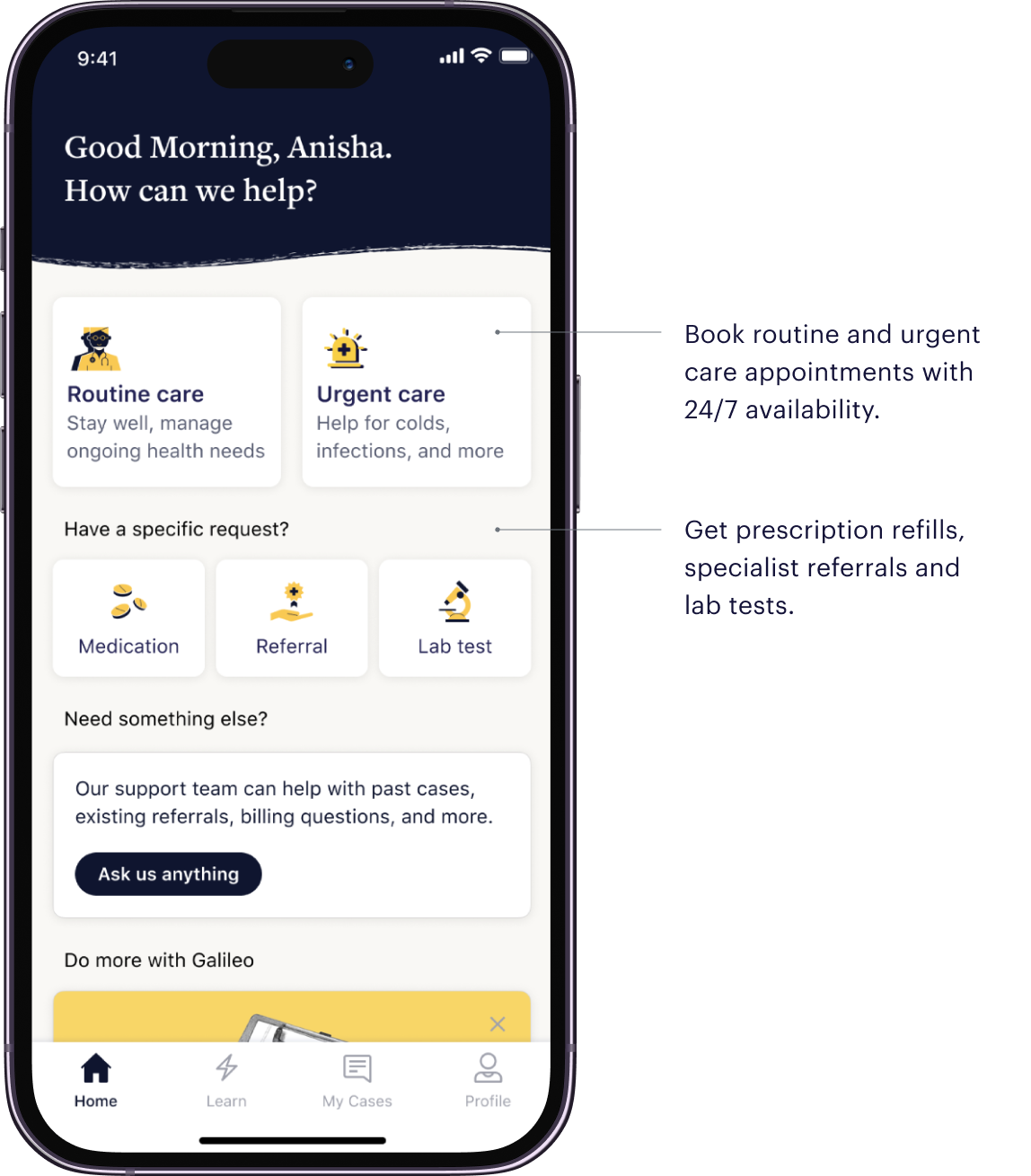
Galileo's value-based care model gives employees and health plan members 24/7 access to a multidisciplinary care team across urgent, preventive, chronic, and mental health needs. Care is available through phone, video, and chat, with in-home, mobile, and in-person options available in select markets.
The model is designed to support continuity rather than isolated consultations. Galileo clinicians coordinate through shared medical information, provide ongoing follow-up, and help members navigate referrals and additional services when necessary.
Galileo reports an 11.5% reduction in total cost of care within six months of working with employers. For benefits leaders and CFOs, that result provides a concrete example of what aligned primary care can deliver when accessible care, longitudinal relationships, and cost accountability operate together.
Choose a Payment Model That Rewards the Outcome
Fee-for-service remains useful for paying individual healthcare claims, but it does not automatically create accountability for the full patient journey. Value-based care adds that accountability by connecting provider economics to quality, coordination, and cost performance.
For employers and health plans exploring a practical transition, advanced primary care offers a way to influence health earlier and across more of the care journey.
Connect with Galileo to learn how a value-based primary care model can improve access and deliver measurable outcomes for your population.

%20(1)%20(1).webp)
.webp)
.webp)

.webp)
.webp)




.webp)















%20(1).webp)
%20(1).webp)













.webp)