- Workforce health strategies that rely solely on ancillary perks tend to underperform on both engagement and total cost of care. The most effective programs are built on a clinical foundation.
- Advanced primary care, available around the clock, addresses acute illness, chronic condition management, preventive care, and behavioral health within a single, coordinated member experience.
- Integrated care models demonstrate measurable advantages over point-solution approaches: lower absenteeism, stronger productivity, and sustained reductions in total cost of care.
- Program design should begin with claims data analysis and employee needs assessment, then layer in targeted solutions across physical, mental, and financial health.
- The programs that drive meaningful outcomes meet employees in high-acuity moments, not just during annual open enrollment.
Finding employee wellness program ideas that actually reduce costs and improve outcomes comes down to one thing: real healthcare access, not perks. Here's what modern workplace wellness looks like.
Even well-resourced employers with thoughtfully designed benefits packages face a persistent challenge: care fragmentation. Employees may have access to multiple point solutions, yet struggle to navigate them when it matters most.
Employers making measurable progress on workforce health and total cost of care tend to share a common structural advantage: a coordinated care model that serves the full range of employee needs, across acute, chronic, preventive, and behavioral health, any hour of the day.
Why Traditional Workplace Wellness Programs Fall Short
Despite significant employer investment in employee health benefits, fragmentation remains one of the most persistent structural challenges in workforce health management.
Many traditional programs offer a portfolio of disconnected point solutions rather than a unified care experience. An employee managing a chronic condition may use one platform for disease monitoring, another for behavioral health, and yet another for care navigation, with no clinical thread connecting them. Their primary care provider may have no visibility into any of it.
This architecture creates meaningful clinical and financial risk:
- Employees encountering an acute health concern after hours often default to urgent care or the emergency department, even for conditions addressable through a virtual clinical encounter.
- Without longitudinal care relationships, chronic conditions go undermanaged between episodic visits, contributing to avoidable complications and higher downstream costs.
- Employers see utilization and claims data that reflects the gaps in their care model: rising spend without corresponding improvements in workforce health or productivity.
The result is a wellness initiative that performs well on surface-level engagement metrics while absenteeism, turnover, and total cost of care remain stubbornly flat. Importantly, this is not a failure of employer intent. It reflects the structural limitations of fragmented, point-solution benefit design.
Advanced Primary Care as the Clinical Foundation
Building your wellness program ideas around virtual primary care gives everything else a solid base. When employees can reach a licensed clinician anytime, they're far more likely to address concerns early, before they turn into emergency visits or missed workdays.
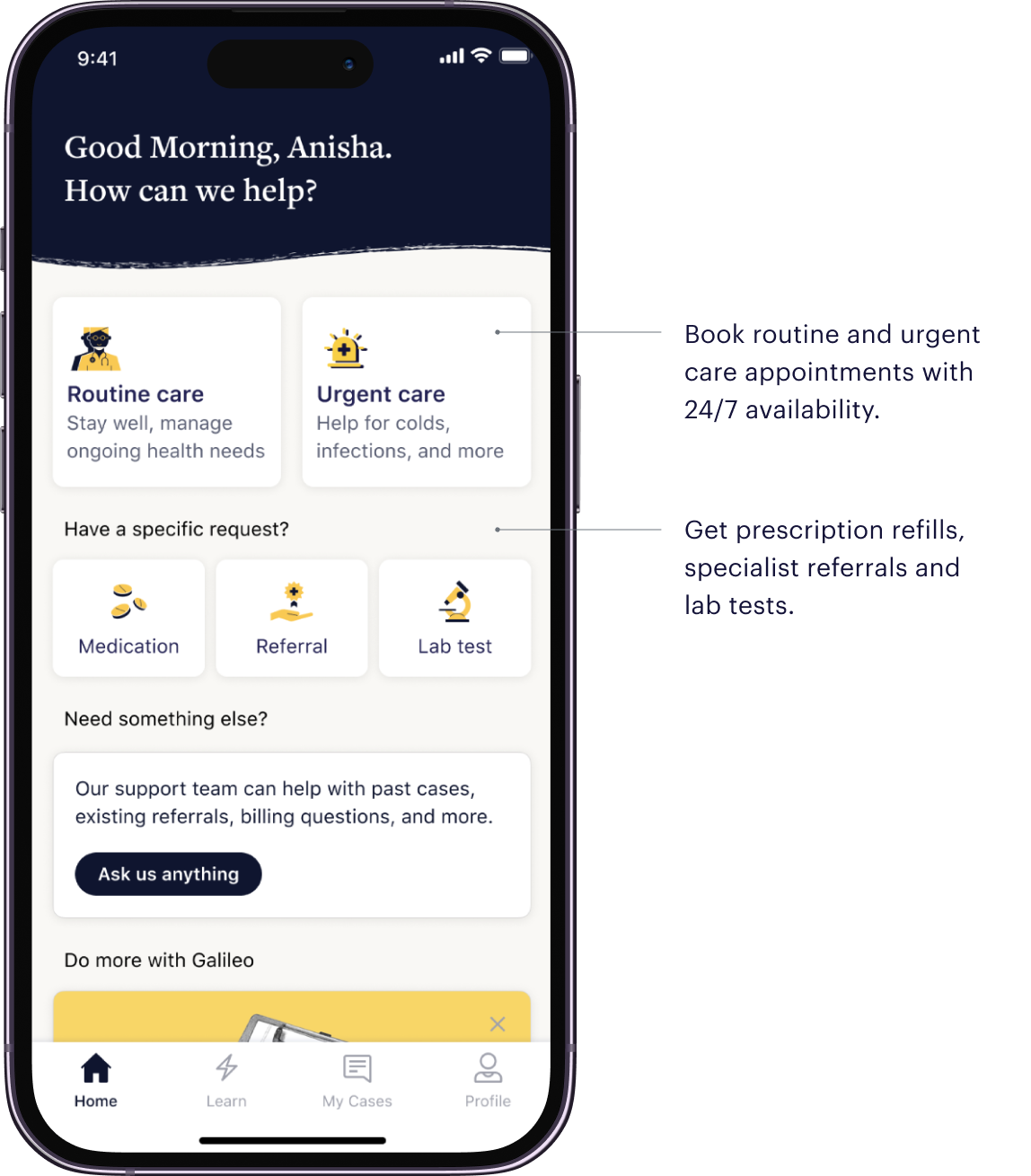
A 24/7 advanced primary care membership typically includes:
- Urgent care for cold, flu, UTIs, allergies, and other acute issues
- Preventive medicine, screenings, and annual visits
- Prescription renewals and referral coordination
- Ongoing chronic condition management
- Mental health support from the same care team
Visits usually run 20 to 30 minutes, and the best programs operate in multiple languages to serve diverse workforces. Galileo, for example, delivers this kind of integrated virtual care in English and Spanish nationwide, with care extended into the home and community in key markets. Some employer partners have reported meaningful reductions in total cost of care within the first six months of rollout.
For populations with high chronic disease burden, this model is particularly consequential. Employees managing diabetes, hypertension, or thyroid conditions benefit from continuous clinical relationships that monitor symptom progression, optimize medication regimens, and intervene before complications escalate.
The table below illustrates how a coordinated advanced primary care model compares to more common benefit design approaches across key employer priorities:
Mental Health Support That Scales
Mental health has moved from a nice-to-have to a business imperative. Anxiety, depression, and burnout directly affect productivity, retention, and healthcare spend, and employers who take mental health seriously tend to see measurable returns.
Effective mental health support inside an employee health and wellness program needs multiple access points. Some employees want therapy with a licensed counselor. Others benefit from coaching or self-guided tools. Many need medication management as part of their treatment plan.
A layered stack tends to work best:
- Clinical therapy and coaching: Specialty mental health benefits that provide access to licensed therapists and counselors give employees a direct pathway to structured clinical support.
- Digital self-care: Lower-barrier tools for mindfulness, stress regulation, and sleep support provide an accessible entry point for employees not yet ready for formal clinical engagement.
- Medication and coordination: Virtual primary care ties it all together, handling prescriptions and coordinating with specialists.
This approach helps employees manage stress and reduce stress triggers before they turn into clinical issues, which is exactly what supports day-to-day work-life balance. Normalizing mental health conversations at work removes stigma and encourages employees to use the benefits you've already paid for.
Chronic Condition Management Programs
Chronic conditions like diabetes, hypertension, and musculoskeletal issues drive a disproportionate share of healthcare spending. Targeted management programs can bend that cost curve while improving quality of life.
These programs work best when they're integrated with primary care. A standalone diabetes app has value, but that value multiplies when the employee's care team has visibility into their progress. Without that thread, you end up paying for parallel systems that never share data.
Healthy Habits and the Daily Work Environment
The strongest workplace wellness initiatives shape the everyday work environment, not just the benefits portal. Small, consistent changes often outperform one-off perks.
- Offer healthy eating options on-site: a well-stocked healthy snack shelf beats a quarterly catered lunch.
- Built-in movement: walking meetings, standing desks, and step challenges encourage employees to move without adding mandatory programming.
- Protect focus time: meeting-free blocks and clear calendar norms help employees manage stress and protect work-life balance.
- Create space for mindfulness: a brief guided break in the afternoon can reduce stress more than a generic wellness webinar.
These shifts reinforce the clinical side of your program and make healthy choices the default, not the exception.
Financial Wellness and the Full Picture of Well-Being
Health and money are deeply connected. Financial stress drives poor sleep, missed appointments, and burnout, which loops right back into rising medical claims.
A financial wellness program covering budgeting, student loan support, and retirement planning is an underrated pillar of physical and mental well-being.
Pair it with care navigation services to help employees actually use the benefits you've already invested in. Most wellness programs fail not because the benefits are bad, but because employees can't find them when they need them.
Building Your Effective Wellness Strategy
The most effective wellness program ideas share a few traits: they're integrated rather than fragmented, they meet employees where they are, and they measure outcomes rather than activity.
A practical build order:
- Start with data: Run an annual employee survey alongside a claims data review to understand what your population actually needs.
- Anchor with virtual primary care: A 24/7 care team covers acute, chronic, preventive, and mental health needs in one experience.
- Layer in specialty mental health support: Add therapy, coaching, and mindfulness tools for depth.
- Target chronic conditions: Pick one or two programs that match your highest-cost conditions.
- Add financial wellness: Tie in budgeting and planning resources for the full picture of well-being.
- Wrap it with navigation: Give employees one clear front door so they actually use what you've bought.
Done well, a program like this can reduce absenteeism, support retention, and help employees feel supported in the moments that matter.
Make Your Wellness Program Actually Work
The difference between a wellness initiative that wins awards and one that lowers your total cost of care is integration. Point solutions solve one problem at a time. A connected care team solves for the person.
Galileo partners with employers to deliver 24/7 virtual primary care, chronic condition management, and mental health support in one member experience, in English and Spanish nationwide. If you're rebuilding your wellness strategy this year, start with the foundation, then layer in the rest.

%20(1)%20(1).webp)
.webp)
.webp)

.webp)
.webp)


.webp)







%20(1).webp)
%20(1).webp)












.webp)