- Value-based care (VBC) pays providers based on patient outcomes, not service volume, directly inverting the incentives of fee-for-service.
- For self-funded employers, VBC reduces wasteful spending, lowers unnecessary ER and urgent care utilization, and improves workforce health over time.
- Risk-sharing models range from shared savings to full capitation, each shifting a different degree of financial accountability to the provider.
- Effective VBC implementation requires claims data integration, eligibility feeds, quality reporting, and a care team model built for proactive population management.
- Advanced primary care is the most scalable entry point for employer-sponsored VBC programs.
Value-based care pays providers based on the quality of outcomes delivered, not the volume of services rendered. For employers and health plans navigating rising benefit costs, advanced primary care solutions built on value-based principles offer one of the most evidence-supported paths to improving population health while reducing total cost of care.
This guide explains what value-based care solutions are, how they compare to traditional fee-for-service, what risk-sharing models actually look like in practice, and how self-funded employers can evaluate and implement a VBC strategy that delivers measurable results.
What Is Value-Based Care?
Value-based care rewards providers for keeping patients healthy, managing chronic conditions, and preventing avoidable hospitalizations. Under fee-for-service (FFS), providers are paid for each service delivered regardless of outcome. More volume equals more revenue. Value-based care breaks that equation by tying payment to quality measures, patient outcomes, and cost efficiency.
Why This Matters Now
According to the Health Care Payment Learning and Action Network (HCPLAN), 28.5% of U.S. healthcare payments flowed through alternative payment model contracts with downside financial risk in 2024, up from 24.5% in 2022.
The 2025 KFF Employer Health Benefits Survey puts average employer-sponsored family premiums at $26,993, a 6% year-over-year increase. For self-funded employers with direct claims exposure, the pressure to move toward value-aligned arrangements is accelerating.
Value-Based Care Solutions for Employers
Self-funded employers are the natural constituency for VBC. Rather than absorbing whatever utilization a fee-for-service system generates, they can partner with care providers whose financial incentives are explicitly tied to reducing unnecessary utilization and improving member health.
How VBC Incentives Work
Provider accountability in a VBC arrangement is operationalized through three mechanisms:
- Quality metrics: Preventive screening rates, chronic disease control (HbA1c, blood pressure), medication adherence, and patient-reported outcomes.
- Utilization metrics: Reductions in avoidable ED visits, preventable hospitalizations, and unnecessary specialist referrals.
- Cost benchmarks: Total cost of care for an attributed population measured against a pre-established target, with the gap determining shared savings or shared risk payments.
The Role of Primary Care
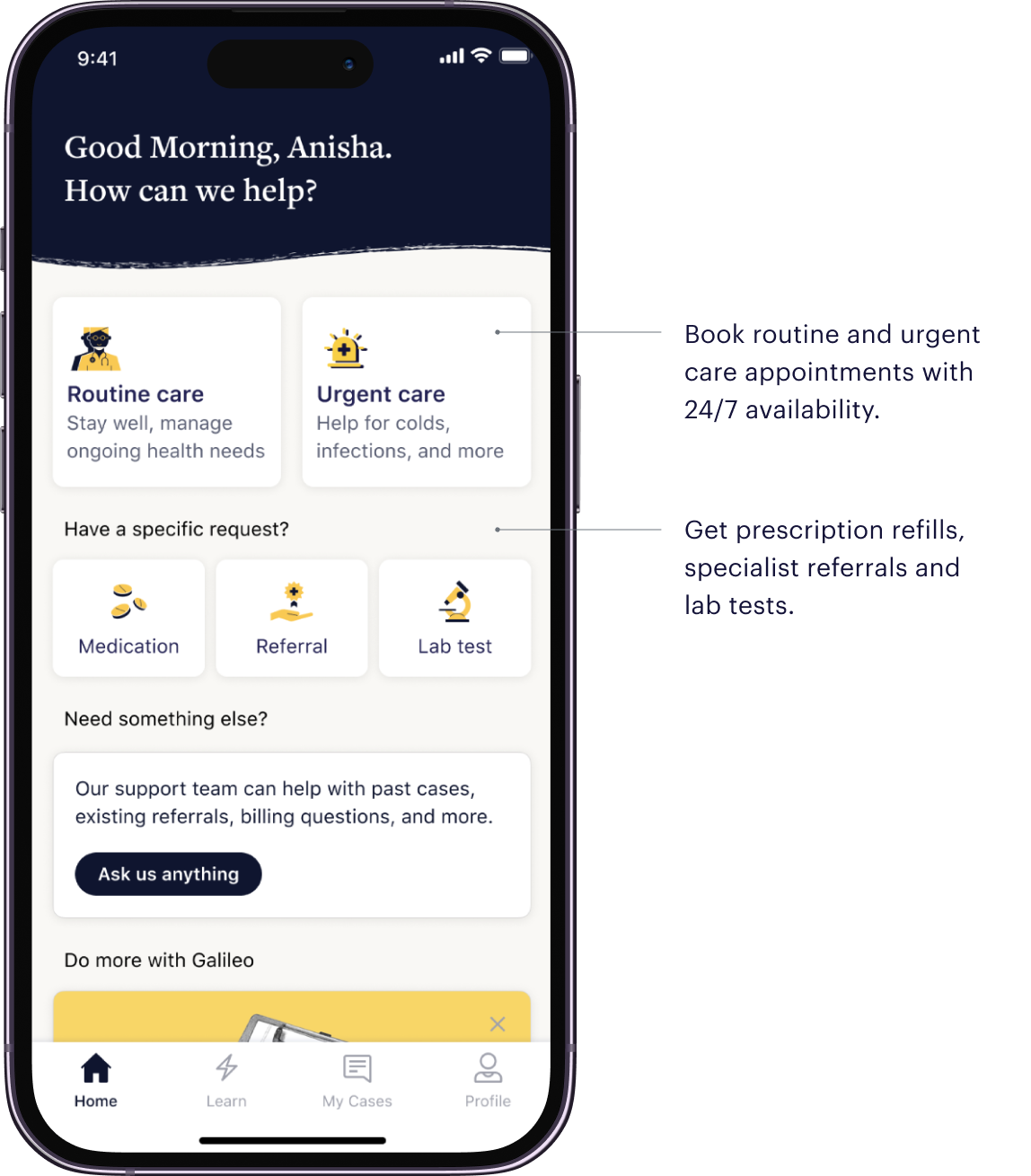
Primary care is the highest-leverage intervention in any employer VBC strategy. Galileo's data shows that 78% of patients choose Galileo over urgent care centers, ERs, or specialist providers, and 87% of cases are resolved without an in-person visit. That kind of access-driven deflection directly reduces claims spend for self-funded employers.
Value-Based Care vs. Fee-for-Service: Cost Reduction Compared
Why Fee-for-Service Drives Unnecessary Spending
Every unnecessary urgent care visit, duplicated lab, or avoidable specialist referral flows directly through to self-funded employer claims. Fee-for-service creates no financial incentive to suppress those costs.
Where Value-Based Care Creates Savings
- Preventive care: Providers accountable for population outcomes have a financial reason to invest in screenings and early intervention.
- Chronic condition management: Continuous management of diabetes, hypertension, and behavioral health disorders reduces the acute episodes that drive high-cost claims.
- Utilization deflection: Accountable care teams resolve issues at the lowest appropriate acuity level, keeping members out of the ED.
- Care coordination: Multidisciplinary in-house care reduces fragmentation, duplicated testing, and unnecessary referrals.
How Payers and Providers Share Risk
Risk-sharing arrangements sit on a spectrum from minimal provider accountability to full financial risk assumption.
1. Pay-for-Performance: Fee-for-service base with additional payments or penalties tied to quality metrics. The lowest-risk VBC entry point, requiring minimal operational change.
2. Shared Savings (Upside Only): Providers earn a share of savings when they manage population costs below a pre-established benchmark. No penalty if costs exceed the target. The most common starting point for employers.
3. Two-Sided Shared Savings: Adds downside accountability. Providers may face reimbursement reductions if costs exceed the benchmark. Stronger incentives for proactive care management, commonly used in ACO arrangements.
4. Capitation: Providers receive a fixed, risk-adjusted payment per patient per period regardless of services delivered. Full capitation carries the highest provider risk and the greatest potential for incentive alignment.
Risk-Sharing Models at a Glance
Implementing Value-Based Care: What Employers Need
Data Integration
VBC cannot function without reliable, integrated data. The core streams required:
- Medical claims feeds: Population attribution, utilization tracking, and cost benchmarking.
- Eligibility and enrollment data: Ensures care management reaches currently enrolled members.
- Clinical quality data: Diagnostic codes, lab values, medication lists, and preventive care completion.
- Pharmacy claims: Required to track medication adherence for members with chronic conditions.
Care Team Model
A fragmented, episodic care model cannot sustain the proactive management VBC requires. Effective delivery needs:
- Multidisciplinary teams managing primary care, behavioral health, and chronic disease in one integrated environment.
- Longitudinal care relationships so members are attributed to a consistent team over time.
- Proactive outreach to close care gaps before they generate high-acuity claims.
- 24/7 access to reduce reflexive ED and urgent care utilization.
Advanced Primary Care vs. Direct Primary Care
For distributed workforces, advanced primary care is the more scalable and insurance-integrated option.
Measuring Outcomes
A credible VBC partner should report regularly on:
- ED visit rates, urgent care utilization, and avoidable hospitalizations.
- Preventive care completion and chronic condition control metrics.
- Member activation rates and care plan adherence.
- Total cost of care relative to benchmark with actuarial attribution of savings.
Galileo achieves over 40% engagement in populations where more than half of members carry chronic conditions, using proprietary software and data flows to support consistent, accurate clinical decision-making.
Build a Value-Based Care Strategy That Works
Value-based care requires a care delivery partner with the clinical model, data infrastructure, and accountability structures to execute. Galileo operates as an advanced primary care solution for employers and health plans, with a multidisciplinary care team, 24/7 virtual access across all 50 states, and integrated data capabilities built for value-based performance reporting.
Connect with Galileo's employer partnerships team to learn how an advanced primary care model can deliver measurable quality and cost outcomes for your population.

%20(1)%20(1).webp)
.webp)
.webp)

.webp)
.webp)




.webp)













%20(1).webp)
%20(1).webp)













.webp)