- Low engagement with health benefits is rarely a motivation problem. It's usually a symptom of fragmented care: too many vendors, too many entry points, too much for an employee to figure out alone.
- Adding more benefits or point solutions tends to make the underlying problem worse, not better, by adding another system employees have to navigate.
- An integrated primary care experience, one accountable team across everyday, urgent, chronic, and mental health needs, removes the navigation burden directly instead of asking employees to engage harder with a fragmented system.
- The right scorecard tracks care resolution, continuity of care, avoided referrals, and total cost of care, not utilization or login counts.
- Galileo's integrated care model has delivered an 11.5% reduction in total cost of care within six months for employer partners, a result tied to coordination rather than engagement tactics.
When employees don't use the benefits available to them, the standard response is more communication: more emails, more reminders, more campaigns explaining what's covered. That response assumes the problem is that people don't know or don't care. More often, the real problem is that the system asks too much of them to find out.
A workforce with a primary care plan in one place, a behavioral health vendor in another, and a chronic condition program somewhere else isn't disengaged. It's navigating a maze with no clear entry point. An integrated primary care model fixes that by giving employees one place to start, which is a structural fix, not an awareness campaign.
Why Engagement Campaigns Miss the Real Problem
Most benefits strategies start from the wrong diagnosis. They treat low utilization as a motivation gap and respond with outreach: more emails, clearer FAQs, another webinar. Those tactics can move a number temporarily, but they don't address why the number was low in the first place.
The actual pattern looks different up close. An employee with a question about a medication, a flare-up of a chronic condition, and rising stress at work is, in a fragmented system, expected to figure out which of three or four vendors handles which problem, each with its own login, its own intake form, and no shared record between them. That's not a willingness problem. It's a design problem, and it gets worse, not better, every time another point solution gets added to address a gap the last one didn't close.
This is the case for building benefits engagement around one coordinated care experience instead of a longer list of options. When primary care, urgent needs, chronic condition management, and mental health support sit inside the same care team, the employee doesn't have to do the coordination work themselves, and engagement tends to follow as a result rather than as the thing being chased directly.
Why Employee Engagement in Health and Benefits Matters More Than Ever
The connection between engaged employees and better health outcomes shows up consistently in workplace performance data, not just in intuition, and it touches everything from day-to-day productivity to whether your best people stay.
Affordability And Trust Shape Whether Employees Engage At All
Cost concerns and a lack of trust in how benefits will be used both suppress engagement, even among employees who technically have generous coverage. People disengage when they are not sure what something will cost them, or when they doubt that seeking care, particularly for mental health, will stay confidential. Closing that trust gap is as much a communication problem as a benefits-design one.
Engagement Is Directly Linked To Productivity, Retention, And Morale
Engaged employees report higher job satisfaction, lower stress, and greater loyalty to their employers, and the data backs this up at scale. Gallup's Q12 meta-analysis of more than 183,000 business units found that top-quartile engagement units see 23% higher profitability than bottom-quartile units, with turnover differences ranging from 21% lower in high-turnover organizations to 51% lower in low-turnover ones.
When health benefits are part of that engagement equation, the impact compounds: Galileo has documented an 11.5% reduction in total cost of care within six months of working with employers, a result tied to designing access that is easy enough to become second nature.
Common Barriers to Employee Engagement in Healthcare
Understanding why employees do not engage with their health benefits is the first step toward fixing it. Most barriers fall into a few predictable categories, and each one has a fairly specific fix, summarized in the table below.
Access Challenges
Traditional healthcare requires taking time off work, driving to an appointment, and waiting twice, once in the lobby and again in the exam room. For hourly workers, parents juggling childcare, or anyone with a demanding schedule, those friction points add up quickly, and many people simply decide the hassle is not worth it for anything short of an emergency.
Complexity And Confusion
Health insurance terminology reads like a foreign language to most people: deductibles, copays, coinsurance, prior authorizations, in-network versus out-of-network. When employees do not understand how their benefits work, they often default to doing nothing rather than risk an unexpected bill. Employees who understand their benefits are roughly four times more likely to feel confident in the health plan choice they made, according to a 2024 HealthEquity survey, which is a meaningful gap given how much confidence predicts follow-through.
Language Barriers
In a diverse workforce, employees who are not comfortable communicating in English may avoid seeking care altogether. Bilingual support is not a nice-to-have feature here. It is a precondition for engagement among a meaningful share of any large workforce.
Fear And Stigma
Mental health needs often go unaddressed because employees worry about confidentiality or judgment, and chronic conditions get ignored because people do not want to face a difficult diagnosis. Creating an environment where seeking care feels safe and ordinary is as much a part of the engagement equation as the benefit design itself.
Notice that none of these fixes are a new point solution. They're properties of one connected care model, which is the distinction that tends to get lost when the response to low engagement is simply adding another benefit.
What a Coordinated Care Model Requires
Building engagement around coordination rather than addition means investing in a short list of structural capabilities, not a longer benefits menu.
One Point of Entry Across Every Need
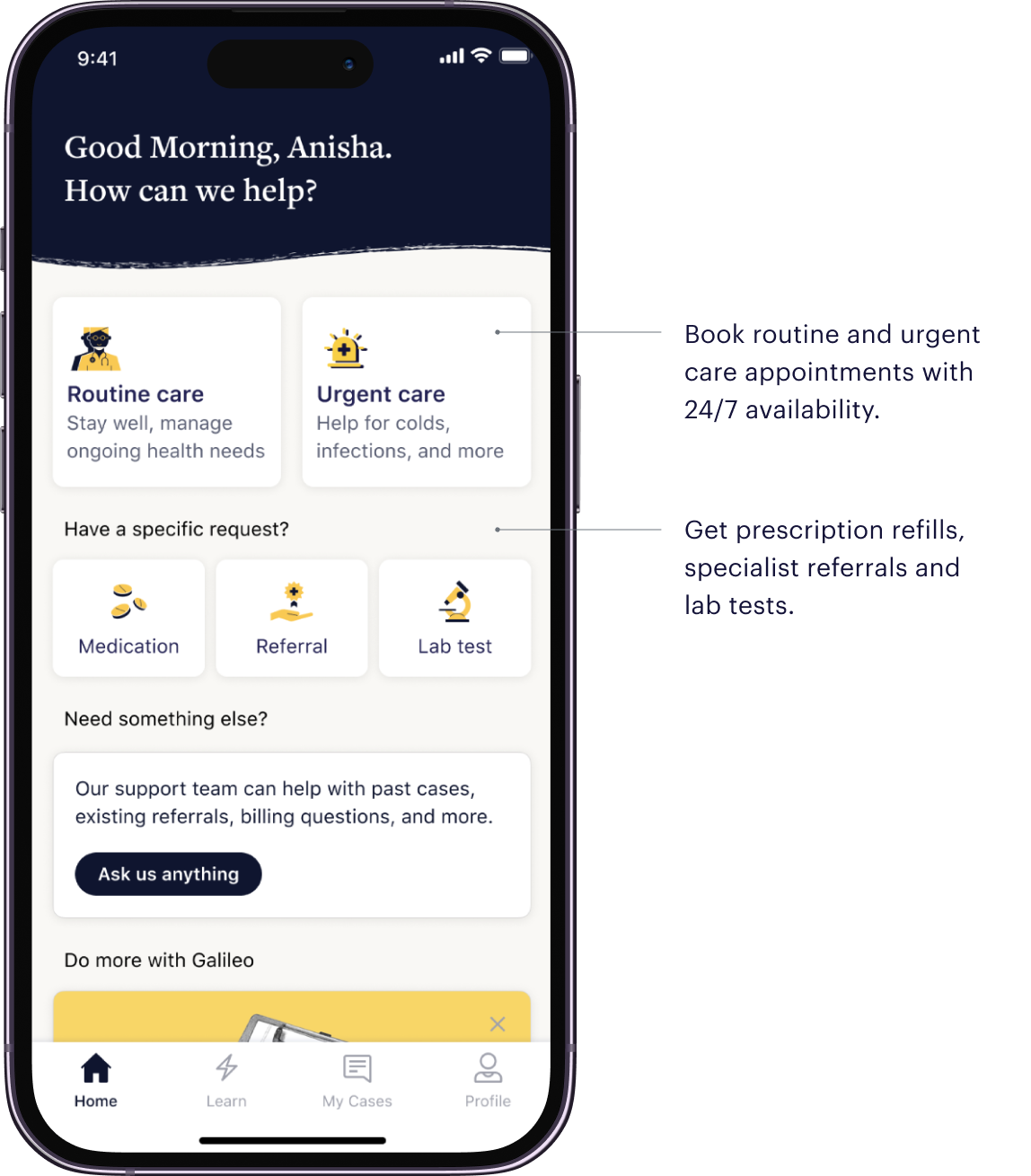
The easier it is to get care, the more people use it, and that's most true when employees don't have to decide in advance which door to walk through. Galileo, for example, offers a voice, video, and chat-enabled app with clinical intelligence and unified records, providing 24/7 virtual care nationwide, with in-home, mobile, and in-person clinic options layered in across select markets.
The same care team handles a quick text about a medication question and a video visit for something more complex, so the employee never has to triage their own problem before getting help.
Mental Health Inside Primary Care, Not Beside It
Mental health is health, and treating it as a separate category sends the wrong message. When mental health support is built into the same care team handling everyday and chronic needs, rather than routed to a standalone vendor, employees are more likely to seek help when they need it, since they're not navigating an entirely separate system to do so.
Chronic Condition Management Without a Separate Vendor
Employees managing diabetes, hypertension, or other ongoing conditions need consistent follow-up, not a single annual checkup. Programs that fold chronic care into everyday primary care, rather than routing it through a separate disease-management vendor, see higher follow-through because the same care team already has the full picture.
Care Navigation Built Into the Relationship, Not Bolted On
Even a well-designed benefit goes unused if employees can't figure out where to start. Coordinated, in-network specialist access built into the primary care relationship means employees don't have to research and self-refer, which is often where engagement quietly stalls. The navigation problem disappears when the same team that handles a routine visit is also the one deciding whether a referral is the right next step.
Measuring Outcomes Instead of Engagement Activity
Utilization rates, login counts, and webinar attendance describe whether people touched the system. They don't describe whether the system worked. A program can drive high engagement numbers and still fail to reduce avoidable cost or improve a single clinical outcome.
A more useful scorecard tracks:
- Care resolution. Was the concern actually addressed at the point of contact, or did it bounce to a referral, an ER visit, or another vendor?
- Continuity of care. Does the same care team and record follow the employee across visits and conditions, or does each encounter start from zero?
- Avoided referrals and utilization. How much specialist, urgent care, and emergency department use did coordinated primary care prevent, not just how much utilization happened?
- Total cost of care. What's the full per-employee spend across every setting over time, not just the spend inside one vendor's reporting?
Preventive care completion and absenteeism, retention, and engagement survey movement still matter as supporting signals: they tell you whether people are taking proactive steps and whether sentiment is shifting. But on their own, they don't show whether the underlying care experience got less fragmented. A program can score well on activity while specialist referrals and total cost of care keep climbing in the background.
This is where Galileo's own results are instructive: the 11.5% reduction in total cost of care within six months reflects what happens when care resolution and continuity improve directly, not when engagement is chased as a standalone target.
Building a Culture of Health Engagement
Sustainable engagement depends on culture as much as care design. When health and well-being are woven into how an organization operates day to day, engagement tends to follow without much extra effort.
Leadership Sets The Tone
When executives and managers visibly prioritize their own health and encourage their teams to do the same, it signals that engagement is expected rather than optional. Leaders who openly share their own experience using a benefit normalize the behavior far more effectively than a policy document does.
Removing Stigma Takes Intentional Effort
Creating an environment where taking time for a doctor's appointment or discussing a mental health need is unremarkable requires real, ongoing effort, especially in high-pressure cultures where taking time for health can read as weakness. That shift doesn't happen by accident.
Incentives Should Reinforce Coordination, Not Just Activity
Consider whether your incentive structures support genuine engagement or quietly reward activity that doesn't change outcomes. Wellness programs with meaningful rewards, HSA contributions tied to engagement activities, or simple recognition can nudge behavior in the right direction, but they work best layered on top of a care model that's already easy to use, not as a substitute for one.
Building a Strategy Around Coordination, Not Addition
A benefits strategy built around this perspective starts with a different question than most organizations ask. Instead of asking how to get people to engage more, the more useful starting question is what's making engagement this hard to begin with.
- Audit before adding. Review utilization, identify where vendors overlap or leave gaps, and pull together whatever feedback employees have already given you, before evaluating anything new.
- Name the actual barrier. Is it access, complexity, language, or stigma? Each traces back to fragmentation, but the specific fix differs.
- Consolidate around one coordinated care model, rather than adding another point solution to address the gap the last one didn't close.
- Communicate the model, not just the menu. Explain what employees can actually do (“you can text a doctor at 3 a.m. if your kid has a fever”) rather than listing covered services in insurance language.
- Set accountability to outcomes. Track care resolution, continuity, avoided utilization, and total cost of care on a regular cadence, and adjust based on what the data shows.
Treat Low Engagement as a Symptom, Not the Problem
Employee engagement in health and benefits isn't really about getting people to use what's already there. It's about removing the reasons they couldn't easily use it in the first place.
Unified access, integrated mental and chronic care, and outcomes-based measurement address that root cause directly. Engagement, retention, and lower total cost of care tend to follow once that structural problem is solved, rather than the other way around.
For employers ready to replace a patchwork of point solutions with one connected model, Galileo's integrated care platform is built around exactly that outcome.

%20(1)%20(1).webp)
.webp)
.webp)

.webp)
.webp)

.webp)









%20(1).webp)
%20(1).webp)












.webp)