- Healthcare consumerism is often described as patients shopping for care like any other service, comparing cost, convenience, and quality, but that retail framing only tells half the story.
- Rising deductibles ($1,735 on average for single coverage in 2023) pushed employees into that shopping mindset in the first place.
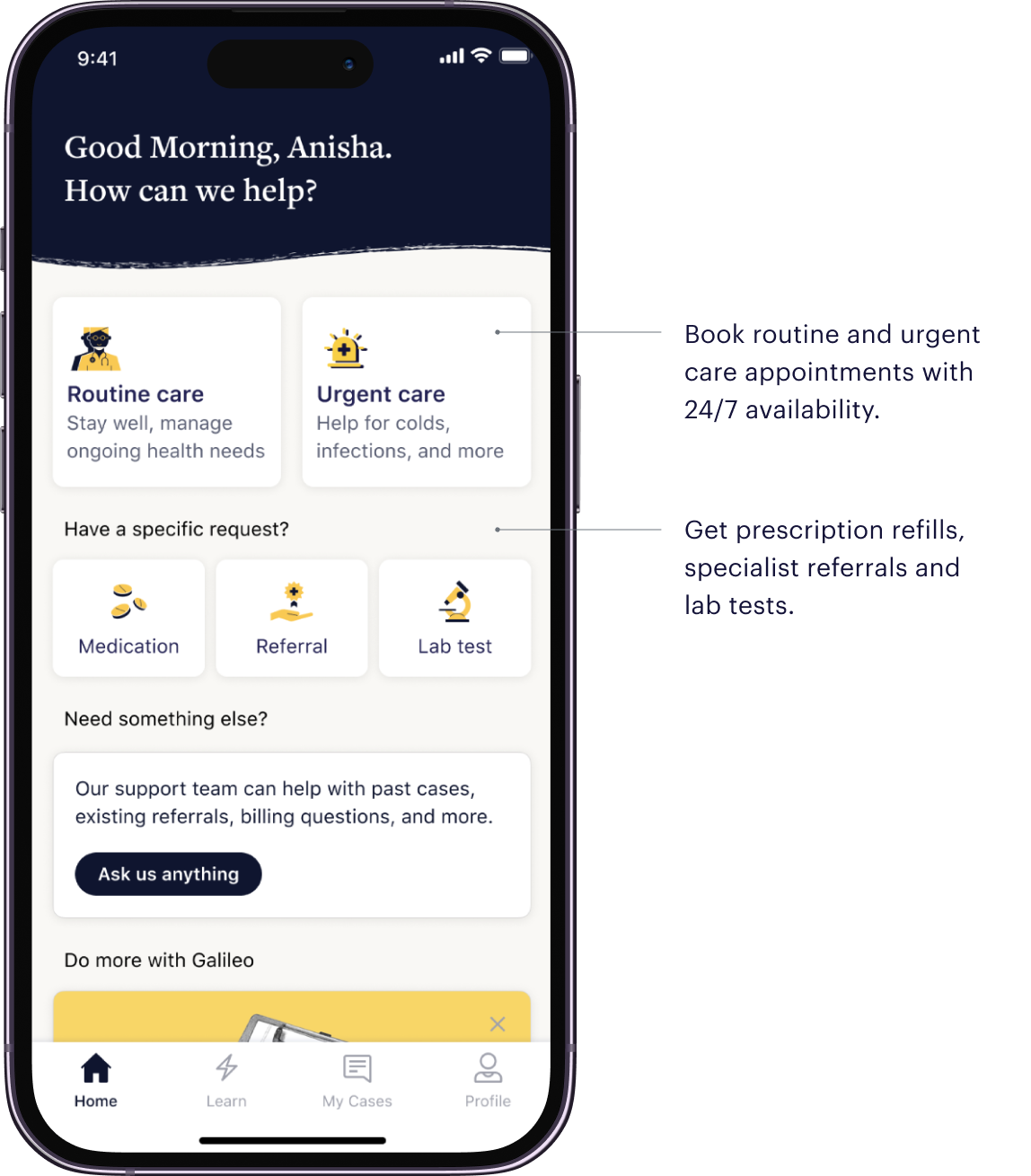
- Employees expect 24/7 virtual access, one app, and one connected care team, not a maze of providers.
- Fragmented point solutions and disconnected providers recreate the exact navigation burden consumerism is supposed to solve.
- Benefits built around a single, coordinated primary care team reduce avoidable ER and urgent care use and cut total cost of care. Galileo has shown an 11.5% reduction within six months.
- The employers who win talent will be the ones who design benefits around the patient's experience, not around the number of vendor logos on a benefits guide.
Ask most benefits leaders what healthcare consumerism means and the answer sounds like retail: employees comparing prices, reading reviews, expecting an app for everything. That description is not wrong, but it is incomplete. Cost, convenience, and digital access explain why employees started acting like consumers. They do not explain what would actually satisfy them.
Galileo's position is that the next stage of healthcare consumerism is not more shopping. It is primary care built around the patient, instead of around the referral chains, disconnected records, and separate logins that currently make the patient do the coordinating work themselves. Understanding this distinction is no longer optional for benefits leaders. It is central to designing packages that attract talent, improve health outcomes, and control costs, and it changes what "good" benefits design actually looks like.
What Is Healthcare Consumerism?
Healthcare consumerism describes patients taking an active, informed role in their care decisions rather than deferring entirely to a provider's recommendation. The comparison to retail, comparing options, research costs, choosing based on convenience, captures the surface behavior but not the underlying want.
What employees are actually responding to is friction: disconnected providers, opaque pricing, and a system that assumes they will do the coordinating themselves. Reducing that friction, not simply adding more choice, is what benefits design has to solve for.
This shift did not happen overnight. For decades, healthcare operated on a largely paternalistic model: physicians made the decisions, insurance was selected by the employer, and patients had little visibility into what care actually cost. That model was sustainable in large part because a third party, typically the employer or insurer, absorbed most of the expense.
The structure began to shift in the early 2000s. Rising costs pushed employers toward high-deductible health plans, which transferred more financial responsibility onto employees. With meaningful cost exposure, employees began asking different questions: whether a given test was necessary, or why the same procedure was priced so differently across providers in the same market.
The growth of price transparency tools, patient review platforms, and digital health services accelerated the trend. Employees could finally see cost information and factor it into their decisions, and the expansion of virtual care options gave healthcare a delivery model that increasingly resembles retail on the surface. But the employers getting the most value from this shift are not the ones offering the flashiest app. They are the ones removing the coordination work employees have historically had to do themselves.
What Is Driving Consumerism in Healthcare?
Several forces are converging to drive this shift: financial pressure, technology, regulation, and generational change. Understanding each helps leaders anticipate where the market is headed.
The High-Deductible Health Plan Effect
High-deductible health plans have been the single largest catalyst for consumer behavior in healthcare. According to KFF's 2023 Employer Health Benefits Survey, the average deductible for single coverage reached $1,735 that year, a figure that has climbed steadily over the past decade. When employees carry that level of direct financial exposure, they begin treating healthcare spending the way they would any other significant budget line: comparing prices, questioning necessity, and seeking lower-cost alternatives where appropriate.
They ask about generic alternatives, question the necessity of a specialist referral, and increasingly use cost-estimator tools before scheduling non-urgent procedures.
Technology and Digital Access
Smartphone-enabled care has reset expectations across the board. Patients can now consult a clinician by video, refill a prescription, review lab results, and message a care team without visiting a clinic in person.
That access matters, but access alone is not the differentiator it once was. Most digital health tools now offer some version of virtual scheduling or messaging. What separates a genuinely useful benefit from a rebranded telehealth line is whether that access connects to a continuous relationship: the same care team, holding the same record, coordinating across text, video, and phone, and in some markets, in-person and in-home options as well. When those elements are coordinated, the result is typically higher-quality care and lower downstream utilization of costlier care settings.
Transparency Regulations and Tools
Federal price transparency requirements now direct hospitals to publish standard pricing information online. Under the Hospital Price Transparency rule established by the Centers for Medicare & Medicaid Services, hospitals have been required since January 2021 to make pricing data available both as a machine-readable file and in a consumer-friendly, shoppable format. Compliance has been uneven, but the regulatory direction is clear, and tools such as cost estimators and provider comparison platforms are becoming standard features of a modern benefits package.
Generational Expectations
Millennials and Gen Z now make up a growing share of the workforce. Having grown up with on-demand digital services in retail, banking, and transportation, this workforce expects a comparable standard of convenience from its healthcare, including digital scheduling, text or app-based communication with providers, and rapid response times.
The Pandemic Acceleration
The COVID-19 pandemic compressed years of digital health adoption into about eighteen months. According to McKinsey research, telehealth utilization spiked to as much as 78 times pre-pandemic levels in April 2020 before stabilizing at roughly 38 times pre-pandemic levels in the following year. Many patients discovered a genuine preference for virtual care in routine, low-acuity situations, a preference that has persisted well beyond the public health emergency itself.
The Modern Healthcare Consumer: What Employees Actually Want
Designing effective benefits requires understanding what today's healthcare consumers actually value. The expectations are not complicated, but they do require rethinking traditional approaches to plan design.
- Fast, reliable access: Employees expect to reach a clinician outside standard business hours, whether for an urgent concern or a routine prescription renewal, without taking time off work to do so.
- A seamless digital experience: Scheduling, messaging, prescription management, and results should live in a single application rather than across several disconnected portals.
- Comprehensive, coordinated care: Fragmented care, where employees navigate separately between urgent care, specialists, and the emergency room, is both frustrating and expensive. A single, coordinated care team that manages everyday concerns, chronic conditions, and behavioral health tends to produce better outcomes at lower cost.
- Transparency and predictable value: Employees want to understand what a visit or procedure will cost before committing to it, and they respond well to benefits that include cost-estimator tools.
- Respect for their time: Redundant intake forms and administrative friction erode trust in a benefit, regardless of how comprehensive it looks on paper.
Galileo is built differently: members work with a consistent care team that already knows their history, not a new stranger on every call, and that team coordinates with existing medical records and clinical data to support faster, more consistent diagnoses. Programs that designed around this kind of access are increasingly the standard employees measure other benefits against.
Consumer-Driven Healthcare: Implications for Benefits Design
The table below contrasts the traditional benefits model with a more consumer-driven approach across the dimensions that matter most to employers.
Beyond the comparison above, a few practical shifts matter most for benefits design:
- Prioritize virtual-first primary care as the front door, not the whole solution: Look for a partner offering genuine around-the-clock access, not just extended urgent-care hours, along with the ability to manage ongoing chronic conditions rather than episodic issues alone. Galileo has reported an 11.5% reduction in total cost of care within six months of implementation for employers using its advanced primary care model, which layers this kind of virtual access on top of, rather than in place of, existing health plan coverage.
- Integrate mental health and chronic care: Behavioral health and physical health are closely linked, and benefits that treat them as separate silos tend to see weaker engagement. A single care model that addresses both areas together generally performs better on both outcomes and cost.
- Offer transparent pricing tools: Cost estimators, quality ratings, and provider comparison features give employees the information they need to make informed decisions and should be considered standard, not optional.
- Make mobile the default: Employees will access their benefits primarily from a phone. A platform that requires a desktop computer, or feels clunky on mobile, introduces friction that suppresses engagement.
- Measure outcomes that reflect value: Engagement rates, time to care, member satisfaction, and total cost of care each tell part of the story. Traditional utilization metrics alone do not capture whether a benefit is actually working.
Why Primary Care Is the Foundation of Healthcare Consumerism
Primary care is usually the first healthcare interaction an employee has, and it sets the tone for everything downstream. A better consumer experience does not start with a better price-comparison tool. It starts with easier access to a clinician who already knows the patient's history, so a visit does not begin with re-explaining a medication list from scratch.
Fragmented point solutions work against this. When primary care, urgent needs, chronic condition management, and mental health support each sit with a different vendor, the employee absorbs the coordination cost that a real care team should be carrying instead. Fragmented point solutions create more navigation challenges, not fewer, no matter how modern any individual piece looks on its own.
A coordinated primary care model helps employees make informed decisions throughout the healthcare journey, rather than navigating it alone. That is closer to what employees actually mean when they say they want healthcare to work like other services they use. It is not the price tag or the app store rating. It is not having to do the coordination work themselves.
Healthcare Consumer Trends Shaping the Future
A few emerging trends will keep shaping what employees expect:
- Proactive, preventive care: The shift from reactive treatment to proactive wellness is accelerating, with employees favoring partners that flag potential concerns and prompt screenings before problems escalate.
- Personalization at scale: Generic, one-size-fits-all wellness programs are giving way to care tailored to individual needs, including language preference, for organizations with linguistically diverse workforces.
- Data security and privacy: As more care moves to digital channels, employees increasingly expect clear commitments around how their health data is protected.
- Community-based care: Not every need can or should be addressed virtually. Where available, in-person and in-home options extend reach to populations who might otherwise face access gaps.
Design Benefits Around the Patient, Not the System
Responding to healthcare consumerism is not about chasing every emerging trend or adding another point solution to the stack. It is about auditing current offerings against a few core questions: Can employees reach a clinician outside standard hours? Is the digital experience unified? Are mental health and chronic care integrated into one model? Do employees have the transparency tools to make informed choices? And underneath all of it: does the design put the coordination burden on the care team, or does it still fall on the employee?
Employers that design benefits around that last question, rather than legacy assumptions about how care should be delivered, are better positioned to attract talent, improve workforce health, and manage cost over time.
Explore how Galileo's employer and health plan partnerships put that principle into practice.

%20(1)%20(1).webp)
.webp)
.webp)

.webp)
.webp)


.webp)









%20(1).webp)
%20(1).webp)











.webp)