- An integrated care model connects primary, urgent, chronic, behavioral, and specialty care through one coordinated clinical team.
- Effective integration requires shared workflows, longitudinal records, clear clinical ownership, and technology that supports communication and follow-up.
- Better access and coordination can improve chronic disease management, identify mental health needs earlier, and reduce unnecessary referrals or high-cost care.
- Employers should measure engagement, clinical quality, specialist and emergency utilization, member experience, and total cost of care together.
- Pricing commonly combines a per-member fee with quality guarantees, shared savings, or other value-based accountability.
An integrated care model in primary care brings multiple health needs into one coordinated system. Instead of asking members to navigate separate providers for urgent care, chronic conditions, mental health, and specialist questions, a multidisciplinary team shares information and remains responsible for the care journey.
For employers and health plans, integration matters because fragmented care creates duplicated work, delayed treatment, unnecessary referrals, and a frustrating member experience. A well-designed model can make care easier to access while giving the organization clearer accountability for quality, utilization, and cost.
Why the Traditional Model Falls Short
Before defining integrated care, it's worth naming what it replaces. Traditional primary care wasn't built to fail, but the way it's delivered today leaves employers paying for the gaps between providers:
- Referral leakage. Rushed primary care visits push patients out to specialists, and each handoff adds cost and delay without always changing the plan.
- ER and urgent care overuse. When members can't get a timely appointment, they default to the most expensive setting for problems primary care could have handled.
- Point-solution fatigue. Another app for mindfulness, another for musculoskeletal, another for navigation: each one adds cost and splinters the member's data further.
- No clear owner. Records sit in separate systems, follow-up depends on the patient, and no single team is accountable for the outcome.
None of this comes down to motivation. Employees aren't failing to engage, they're navigating a system that was never connected.
Put one coordinated team in charge and the pattern changes: Galileo members are more than 70% less likely to need a specialist or an emergency visit.
What Is an Integrated Care Model?
An integrated care model is a team-based approach that coordinates services across clinical disciplines, settings, and stages of care. Primary care acts as the central access point, but the model may also include urgent care, preventive services, chronic condition management, behavioral health, specialist consultation, pharmacy support, and care navigation.
Integration means more than offering several services through the same app or vendor. Clinicians must work from shared information, follow common workflows, communicate across disciplines, and maintain responsibility for follow-up.
AHRQ defines integrated behavioral health as primary care and behavioral health clinicians working with patients and families through a systematic, patient-centered, and cost-effective approach. Behavioral integration is one part of the broader integrated primary care model.
Integrated Care vs Traditional Primary Care
Traditional primary care can be coordinated and of high quality. The difference is that an integrated model makes coordination a defined operating responsibility rather than relying on individual providers and patients to connect separate systems themselves.
How an Integrated Primary Care Model Works
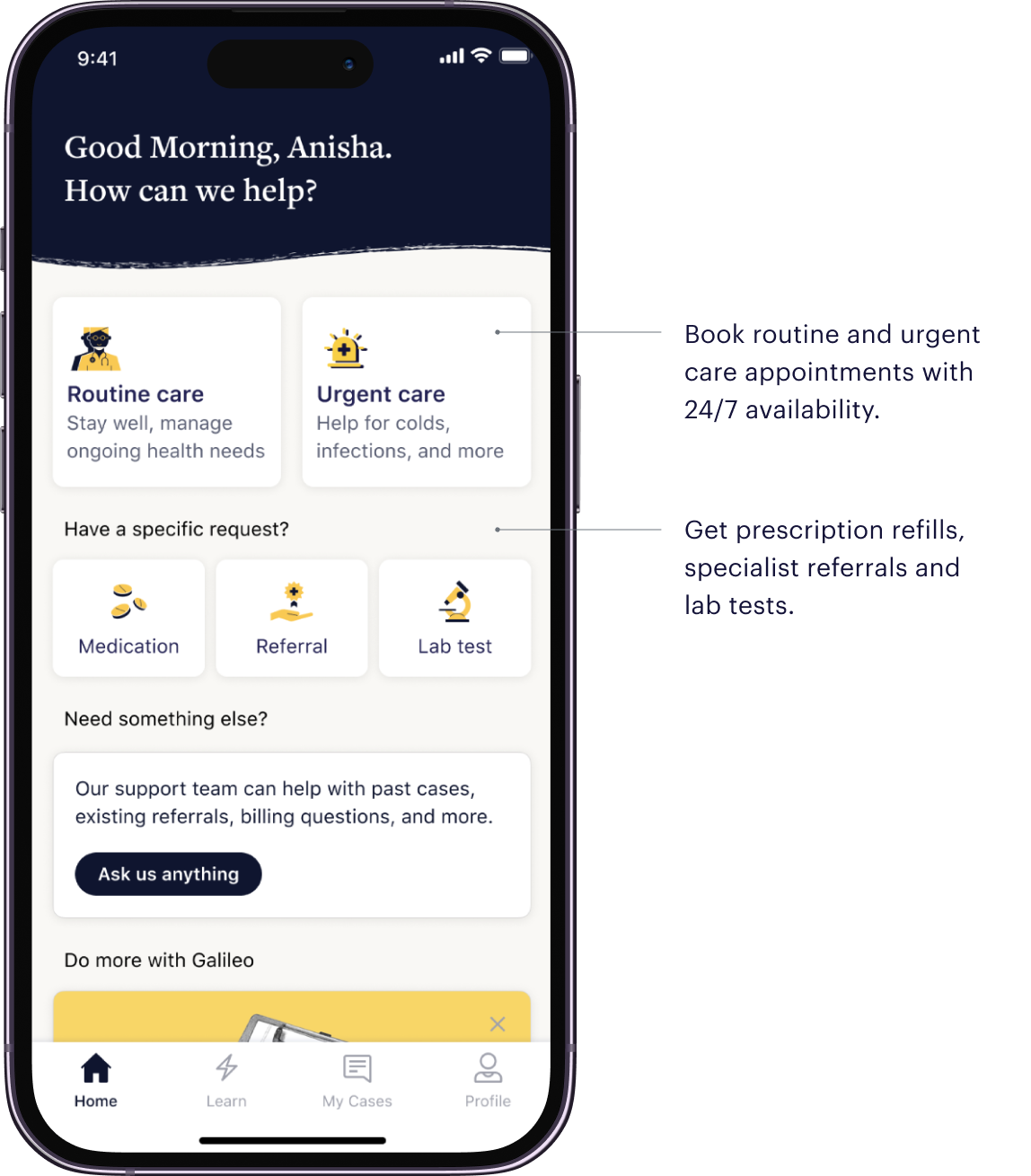
- One entry point: The member begins with a primary care team rather than choosing among condition-specific vendors.
- Clinical matching: The team involves the right primary, behavioral, or specialty clinician without requiring the member to identify the appropriate silo.
- Shared context: Clinicians can review relevant diagnoses, medications, results, care plans, and prior interactions.
- Coordinated next steps: The team arranges and tracks prescriptions, testing, in-person care, and referrals when needed.
- Longitudinal follow-up: The same team monitors treatment response, chronic conditions, and preventive care gaps over time.
Continuity is where Galileo stands out. Members work with a dedicated care team that knows their history and follows them over time, so problems get caught earlier instead of slipping through the gaps between one-off visits.
The Role of Behavioral Health Integration
Physical and mental health frequently affect one another. Depression may make diabetes self-management harder, anxiety can intensify physical symptoms, and chronic pain can affect mood, sleep, and function.
In an integrated model, primary and behavioral health clinicians use shared workflows to identify these connections and coordinate treatment. The care team may use screening, brief interventions, medication management, coaching, therapy, or referral based on clinical need and program scope.
This approach can reduce the friction of entering a separate mental health system. A systematic review of integrated depression care found that most trials reported positive effects, although outcomes depended on how the model was designed and implemented.
How Integrated Care Can Improve Patient Outcomes
Integrated care creates the conditions for better outcomes, but results are not automatic. Team design, access, data quality, follow-up, member engagement, and financial incentives all affect performance.
Stronger Chronic Disease Management
Members with diabetes, hypertension, asthma, and other chronic conditions need repeated monitoring and treatment adjustments. Integrated teams can coordinate laboratory testing, medications, behavioral factors, specialist input, and follow-up through one care plan.
A recent systematic review and meta-analysis found small but significant improvements in access and continuity. Broader effects on health outcomes, hospital use, and cost were mixed, reinforcing the need to evaluate each model by its actual capabilities and results.
Earlier Mental Health Support
Behavioral health integration allows mental health concerns to be identified during routine care and managed alongside physical conditions. Earlier support can improve treatment engagement and reduce the risk that symptoms remain unaddressed until they become more disruptive.
Fewer Unnecessary Specialist Visits
A broad, multidisciplinary primary care team can resolve more needs internally and use specialist input selectively. The objective is not to avoid necessary specialty care but to reduce referrals that add cost and delay without changing treatment.
Galileo reports that 87% of care is resolved without a referral, so more needs to stay inside the primary care relationship instead of being routed out.
Lower Total Cost of Care
Integrated primary care can influence costs through earlier intervention, chronic condition control, fewer duplicated services, appropriate referrals, and use of lower-cost care settings. The financial effect depends on the population, benefit design, engagement, and scope of accountability.
Galileo has reported an 11.5% reduction in the total cost of care within six months of working with employers.
Benefits of Integrated Primary Care for Employers
The case for employers comes down to one thing: replace a stack of disconnected point solutions with a single team that's accountable for the whole person.
- Simpler member experience: Employees have one starting point and spend less time selecting vendors, repeating information, or coordinating separate appointments.
- Support for distributed workforces: Virtual access provides a consistent entry point across locations, while home, mobile, and clinic options can support hands-on needs.
- Stronger engagement: Clear access and a broad clinical scope make the benefit easier to understand and use.
- Less vendor fragmentation: One integrated partner may reduce overlap among urgent care, mental health, chronic condition, and navigation programs.
- Greater accountability: Employers can measure access, quality, experience, utilization, and total cost across more of the care journey.
Employer Metrics That Matter
Measure outcomes, not activity. Logins and enrollment counts tell you a benefit is being used, not that it's working.
Galileo reports more than 29% digital engagement and a Net Promoter Score above 80 with partners. Employers should review these measures alongside utilization, clinical quality, and total cost to avoid mistaking activity for impact.
Technology Required for Integrated Care
Technology only matters here to the extent it makes coordination real. Technology should support clinical coordination rather than operate as a separate layer for members and clinicians to navigate.
An effective infrastructure generally includes:
- Longitudinal medical records accessible across the care team
- Secure messaging, phone, and video workflows
- Clinical decision support and evidence-based protocols
- Eligibility and claims feeds for population management
- Care-gap identification and risk stratification
- Referral, testing, and follow-up tracking
- Employer and health plan reporting for quality, utilization, experience, and cost
Employers should ask how quickly outside claims and specialist information reach the care team. A polished member interface does not create meaningful integration when the underlying clinical data remain fragmented.
How to Evaluate an Integrated Care Partner
Most vendors will call themselves integrated. These questions separate real coordination from a bundle of point solutions with one login:
How Integrated Primary Care Is Priced
Compare pricing against the total cost of care a model can move, not the sticker fee.
Pricing depends on clinical scope, population size, access channels, geographic coverage, and the amount of financial accountability accepted by the provider. Common structures include:
- Per-member-per-month fees: A prospective payment covers defined access and care services.
- Fee-for-service plus coordination payments: Individual services are billed, while an additional payment funds outreach and care management.
- Performance guarantees: A portion of fees depends on access, engagement, quality, or experience targets.
- Shared savings: The provider earns a percentage of validated savings when quality requirements are met.
- Risk-based arrangements: The provider may share financial responsibility when costs exceed an agreed benchmark.
Employers should compare the total included service scope, not the headline fee alone. Contracts should define attribution, covered services, quality gates, benchmarks, data requirements, reconciliation, and responsibility for external care.
How Galileo Delivers Integrated Care
Galileo's employer care model connects urgent, preventive, chronic, mental health, and specialty needs through a multidisciplinary clinical team. Members can access care 24/7 by phone, video, or chat, with in-home, mobile, and in-person options available in select markets. Because Galileo works through employer and health plan benefits, what a member pays depends on their specific plan.
Clinicians work through shared medical information and team-based review, helping maintain continuity across needs that would otherwise be divided among separate providers. When external specialty or in-person services are necessary, the care team can coordinate the next step rather than leaving the member to navigate alone.
The model combines broad clinical scope, continuous access, shared information, and value-based accountability so employers can evaluate experience and engagement alongside clinical and financial outcomes.
Build One Connected Path to Care
Integrated primary care works when clinical services, teams, data, and accountability operate as one system. Simply placing multiple benefits under one brand does not eliminate fragmentation.
For employers and health plans seeking a more connected model, Galileo combines broad clinical scope, 24/7 access, longitudinal care, and value-based accountability.
Connect with Galileo to explore an integrated care strategy for your population.

%20(1)%20(1).webp)
.webp)
.webp)


.webp)
.webp)




.webp)















%20(1).webp)
%20(1).webp)












.webp)