- Most vendor RFPs measure the wrong things: network size, feature lists, and satisfaction scores predict very little about whether a vendor actually improves health outcomes or lowers total cost of care.
- A strong evaluation framework rests on seven criteria: clinical scope, access and availability, technology and data integration, outcomes measurement, security and compliance, language accessibility, and service-level accountability.
- Resolution rate is one of the clearest signals of clinical quality. Galileo's own model resolves 90% of care without a referral, a benchmark most point solutions and network-only vendors can't approach.
- Total cost of care, not the vendor's own service fees, is the number that determines value. A vendor that lowers its own visit costs while pushing more members to the ER hasn't saved anything.
- The RFP questions that matter most are the ones vendors are least prepared to answer: first-contact resolution rate, condition-specific outcome data, and the actual methodology behind any savings claim.
Clinical excellence is a business decision, not just a quality one. The vendor that resolves more issues on the first contact, catches problems earlier, and coordinates care instead of fragmenting it is also the vendor that costs less over time. Most procurement processes miss that connection because they're built to compare access and features.
Choosing the right healthcare vendor isn't about finding the biggest network or the most polished app. Network size and interface design are the easiest things to compare and the weakest predictors of whether a vendor will help your population get healthier. The evaluation criteria below are built around the harder, more useful question: does this vendor make people healthier while reducing unnecessary spending?
Why Traditional Vendor Comparison Falls Short
Most procurement processes ask questions like "How many providers are in your network?" or "What's your member satisfaction score?" Those numbers are easy to gather, which is exactly why they dominate most RFPs, but they say almost nothing about whether a vendor's care resolves problems. A network of 50,000 providers isn't better than one of 5,000 if the larger network isn't delivering coordinated, high-quality care.
Traditional selection criteria also tend to treat primary care as a commodity, as if care from one vendor is interchangeable with care from another and the deciding factor should just be price. That assumption ignores real variation in how vendors approach coordination, chronic condition management, and clinical decision-making. A vendor built around a unified clinical record and a genuine care team will produce different outcomes than one that simply routes patients to a loose network of independent providers.
The fix is asking for outcomes data during vendor selection, and being willing to walk away from vendors who can't produce it.
The 7 Essential Criteria for Healthcare Vendor Evaluation
Each of the following criteria predicts something different about how a vendor will perform. The exact weighting should depend on your population's needs, but all seven belong in a serious evaluation.
- Clinical Scope and Multi-Specialty Coverage
A vendor that only handles urgent care issues is useful, but it won't help you manage the chronic conditions that drive most of your healthcare spending. Look for coverage across urgent care, primary care, mental health, and chronic disease management, and ask what share of cases the vendor resolves within its own care model versus escalating to outside specialists.
Galileo's own data shows 87% of care resolved without a referral, which is a useful benchmark for what a genuinely comprehensive clinical model can achieve; every referral adds friction, delay, and often duplicate testing, so a vendor escalating most cases is closer to a triage service than a care model.
Preventive care belongs in this category too. Annual wellness visits, screenings, and proactive outreach for high-risk members catch problems while they're still cheap to treat.
- Access and Availability
Healthcare concerns don't wait for business hours, and neither should a care team. Look for 24/7 access through at least text, video, and phone at minimum, and press on first-contact resolution specifically: when a member reaches out at 2 a.m., can the vendor actually resolve the issue, or does it just triage and ask them to call back later?
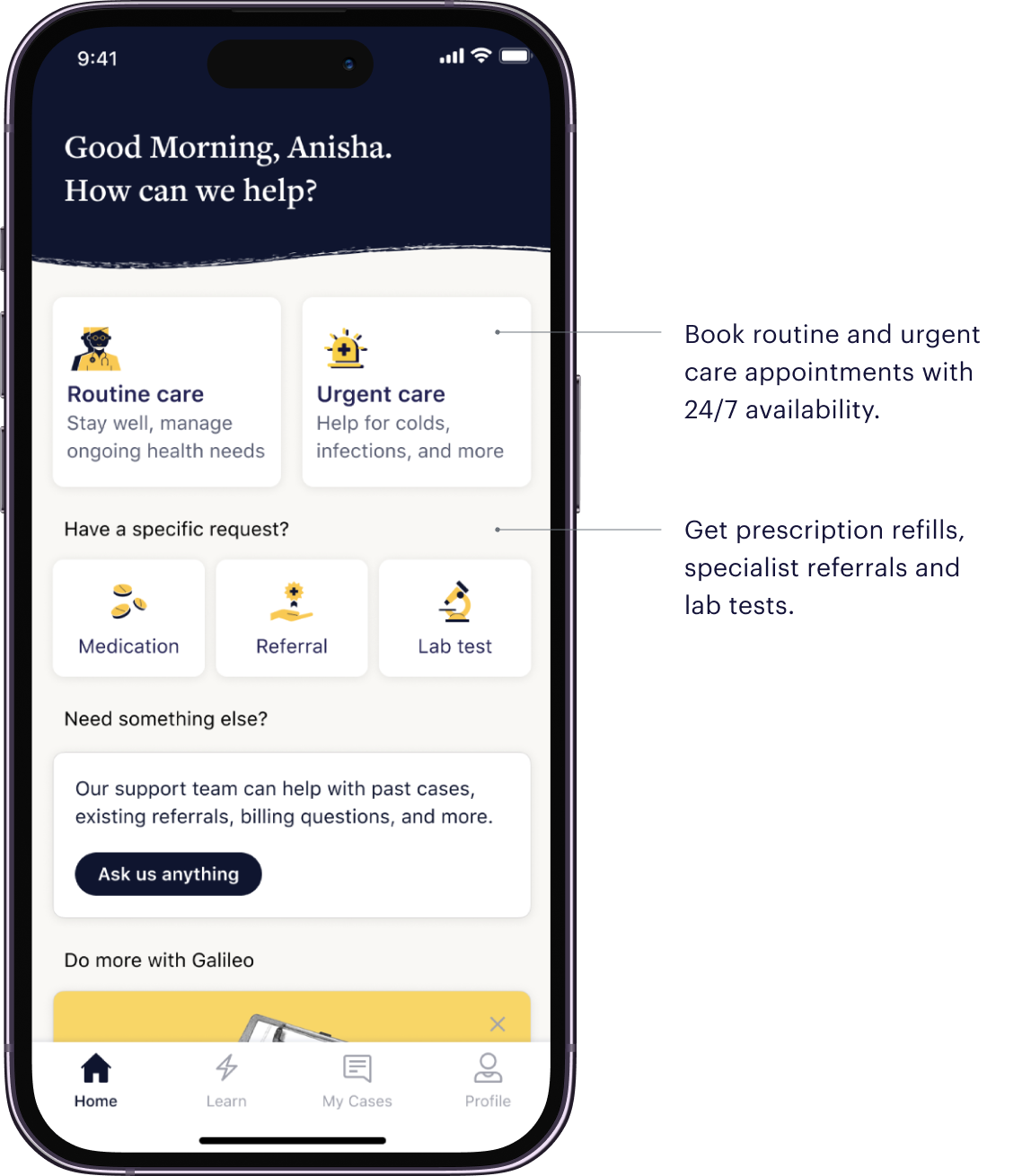
In-home and clinic options matter for cases that need hands-on evaluation, lab work, or procedures. Galileo extends care from virtual care in all 50 states into in-person and in-home visits in select markets, which is the kind of continuity that keeps a member with one care team instead of routing them elsewhere the moment a case gets complex.
- Technology Infrastructure and Data Integration
A polished app matters less than what’s underneath it: whether the vendor’s technology supports coordinated care. A vendor operating in a data silo can't see a member's full health history, which leads to redundant testing, missed diagnoses, and decisions made without the full picture.
Ask how a vendor integrates with existing claims data and EHR systems. A clinician who can see a member's medications, past diagnoses, and recent labs makes faster, more reliable decisions than one working from a blank slate every visit.
Integration only gets a vendor the data. What separates a genuine care model from a data pipe is what happens next: synthesizing that data across a shared record, flagging emerging risk before it becomes a claim, and surfacing evidence-based options to a clinician at the point of care.
Galileo's clinical intelligence tools are built for that second step, not just the first. That distinction shows up most clearly as identification versus intervention: a vendor that can flag a rising-risk member but has no clinical team positioned to act on it has sold you a report, not care. When evaluating this criterion, ask what actually happens after a flag fires. Who sees it? How quickly? And what are they able to do about it, beyond generating another alert for someone else to chase down?
- Outcomes Measurement and Reporting
This is where most vendor evaluations fall apart. Plenty of vendors can report visit counts and satisfaction scores. Few can show whether their care actually changed a health outcome. Ask for chronic condition control rates, changes in downstream utilization, and total cost of care impact, and ask how each number was calculated. A vendor that can show a real, methodologically sound reduction in total cost of care is offering something categorically different from one that can only point to satisfaction scores.
Galileo, for example, can point to condition-specific control rates alongside a documented 11.5% total cost of care reduction, with the underlying methodology available to review, not just a headline figure.
- Security, Compliance, and Certification
Every vendor you consider should meet baseline requirements for HIPAA compliance and data security. But baseline compliance isn't enough. Look for independently audited certifications like SOC 2 Type II and HITRUST, which indicate a vendor takes data protection seriously and can help reduce risk for your organization.
Compliance also extends to include clinical licensure: confirm the vendor's clinicians are properly licensed in every state where they'll be treating your population.
- Language and Cultural Accessibility
A workforce that includes non-English speakers needs more than an English-only vendor. Bilingual support, at minimum English and Spanish, should be a baseline requirement for most U.S. employer populations, since language barriers affect everything from symptom reporting to medication adherence. Beyond language, consider whether the care model works for members with varying health literacy and comfort with technology, not just members who can navigate a polished app.
- Support and Service Level Agreements
Strong clinical capabilities don't matter much if the support team is unresponsive or the implementation process is chaotic. Review response-time commitments for urgent versus routine issues, how escalation from virtual to in-person care works, and what accountability exists if the vendor misses its own service levels. A service-level agreement with no consequence for missing it is a marketing promise, not a commitment.
Galileo ties its own response-time commitments to reporting employers can actually see, rather than leaving accountability implied by the relationship.
5 Questions to Ask Every Healthcare Vendor During Your RFP
These five questions cut through the marketing language faster than almost anything else in an RFP.
- What is your first contact resolution rate, and how do you measure it?
First contact resolution is the percentage of member interactions that are fully resolved without requiring a follow-up visit, referral, or escalation. Ask for the specific percentage, the methodology used to calculate it, and how it varies across different types of clinical issues.
- What percentage of cases are resolved virtually versus escalated to in-home or clinic visits?
This question reveals the vendor's true clinical capabilities. A vendor escalating half its cases to outside providers isn't really providing comprehensive care; it’s providing triage with a nicer interface. Look for vendors who can handle most common issues within their own care model while seamlessly coordinating escalations when truly needed.
- Can you share clinical outcomes data by condition, along with your savings methodology?
Generic outcomes claims are easy to make. Condition-specific data is harder to fake. Ask for outcomes data on chronic conditions like diabetes, hypertension, and depression. Ask how the vendor attributes improvement to its own care rather than other factors, since that methodology is what separates a real result from an inflated one.
- How do you integrate with claims data and EHR systems, and what languages do you support?
This gets at whether a vendor can coordinate care or will operate in a silo. Ask about specific integration capabilities and how quality holds up in non-English interactions.
- What security certifications do you hold, and what are your response-time SLAs?
Ask for specific certifications and audit dates. Review the accountability mechanisms if the vendor misses its own response-time commitments.
How to Evaluate Total Cost of Care Impact
Total cost of care is the number that matters most in healthcare procurement decisions, and it’s also the most commonly misunderstood. It covers everything from primary care visits to specialist referrals to ER visits, hospitalizations, and pharmacy costs. A vendor that lowers its own visit costs while driving more members to the ER hasn't saved anything; it's shifted the cost elsewhere.
The real signal is downstream utilization. Strong primary care means fewer ER visits for issues that could have been handled earlier, fewer hospitalizations for poorly managed chronic conditions, and more problems caught while they're still cheap to treat. Ask vendors directly whether ER visits, hospitalizations, and pharmacy costs changed among their member population, and treat time to diagnosis as its own metric: faster, more accurate diagnoses mean earlier treatment and fewer repeat visits caused by a wrong or delayed initial call.
Engagement and satisfaction aren’t soft metrics, they’re indicators that determine whether a vendor's downstream cost numbers hold up, since a benefit nobody uses can't reduce ER visits or hospitalizations. Ask for real engagement numbers, not just an access claim: Galileo reports more than 29% digital engagement and a Net Promoter Score above 80 across its employer partners.
Traditional Vendor Evaluation vs. Outcomes-Based Evaluation
Building Your Vendor Comparison Matrix
A structured vendor comparison matrix turns impressions into objective evaluation. Build it around all seven criteria above, weighting outcomes and total cost of care impact most heavily for most employer populations, followed by clinical scope and access.
Define what a score of 1, 3, and 5 looks like for each criterion before evaluating any vendor, so a strong sales presentation can't override weak performance on the metrics that actually matter.
Include both the numbers that compare directly, like first contact resolution rate and total cost of care reduction, and the qualitative factors that still belong in the decision, like cultural fit and reference checks.
Keep a record of every question asked and every answer received. That documentation protects you if a vendor doesn't deliver on its claims, and it sharpens your criteria for the next procurement cycle.
Clinical Excellence Is the Business Case
The healthcare vendor comparison criteria that predict a good vendor decision aren't the ones that dominate most RFPs. Network size, satisfaction scores, and feature lists are simple to measure and weak predictors of actual value. Resolution rates, outcomes data, and total cost of care impact are harder to evaluate and far more important, and most vendors will struggle to produce them, not because the data doesn't matter to them, but because their care model was never built to generate it.
Galileo is built around the criteria in this framework rather than around them: multi-specialty clinical scope, 24/7 access across virtual, in-person, and in-home care, and outcomes data that includes an 90% in-house resolution rate and an 11.5% reduction in total cost of care within six months for employer partners.
If your current vendor can't answer the five RFP questions above with real numbers, talk to Galileo's employer team about what an outcomes-based evaluation of your benefits stack might reveal.