- Behavioral health integration means putting mental health clinicians right inside primary care, not behind a separate referral.
- 137 million Americans, 40% of the population, live in a mental health provider shortage area. Referrals alone can't close that gap.
- Two models lead the field: Collaborative Care (ongoing management) and Primary Care Behavioral Health (fast, same-day access).
- Galileo blends both instead of picking one, with behavioral health built in from day one.
- The result: an 11.5% drop in total cost of care within six months, and 70% fewer specialist or ER visits.
Behavioral health integration embeds mental health clinicians into primary care itself, closing the gap that traditional referral-based models leave open.
Most conversations about integration start with the problem: workforce shortages, fragmented handoffs, referrals that never convert into care. Those problems are real. But the more interesting question is why so few organizations have built integration the way the evidence recommends.
What Is Behavioral Health Integration?
Behavioral health integration refers to the systematic coordination of mental health and substance use services within primary care, rather than treating physical and mental health as separate concerns handled by disconnected providers.
Consider how care traditionally works: a patient sees their primary care doctor for diabetes management, the doctor notices signs of depression, and refers the patient to a separate behavioral health specialist. That referral might take weeks to schedule, and the patient might never follow through. Meanwhile, the depression makes diabetes harder to manage, and the cycle continues.
"It can be challenging for people to figure out not only when to seek out mental health care, but also which level of service is appropriate for their current symptoms," says Kristen Scarlett, Galileo's behavioral health lead. That's the gap integration is meant to close: making mental health support available during, or immediately after, the primary care visit itself, with a team that already shares the patient's records and context rather than starting from zero.
The stakes are significant. Nearly 75% of mental health patients also have a physical comorbidity, according to Galileo's own clinical data, which means treating the two through separate benefit silos isn't just clinically fragmented; it's more expensive. And according to the American Academy of Family Physicians, up to 75% of primary care visits already include a mental or behavioral health component, whether that's a chronic disease connection, stress, or substance use. Practices that ignore this reality end up managing symptoms instead of addressing root causes.
A behavioral health integration program typically includes a few core elements:
- Universal screening for common conditions like depression and anxiety, done routinely rather than only when a patient raises a concern.
- Same-day access to behavioral health support to keep patients engaged rather than waiting on a separate appointment.
- Shared treatment planning between medical and behavioral clinicians to ensure coordination rather than parallel, disconnected care.
- Ongoing measurement that tracks patient progress over time instead of treating a single visit as the end of the story.
For health plans and employers, integration addresses the downstream costs that pile up when mental health goes untreated: emergency department visits, hospitalizations, and lost productivity.
Why Behavioral Health Integration Closes Access Gaps
The behavioral health workforce shortage is well documented and getting worse, not better. As of December 2025, 40% of the U.S. population, roughly 137 million people, lives in a designated Mental Health Professional Shortage Area, according to HRSA's most recent workforce report. Rural areas face steeper challenges still, with some counties having no psychiatrists at all.
Traditional referral-based models assume patients can access specialty care on their own. That assumption fails for millions of people: long wait times, geographic barriers, stigma, and cost all get in the way. By the time someone finally sees a specialist, their condition may have worsened considerably.
This is the structural problem integration is built to solve, by meeting patients where they already are. Most Americans see a primary care provider at least once a year, and that visit becomes an opportunity to screen for behavioral health conditions and initiate treatment without requiring a separate appointment at a different location. It also reduces stigma: many patients feel more comfortable discussing mental health concerns with their regular doctor than seeking out a psychiatrist directly.
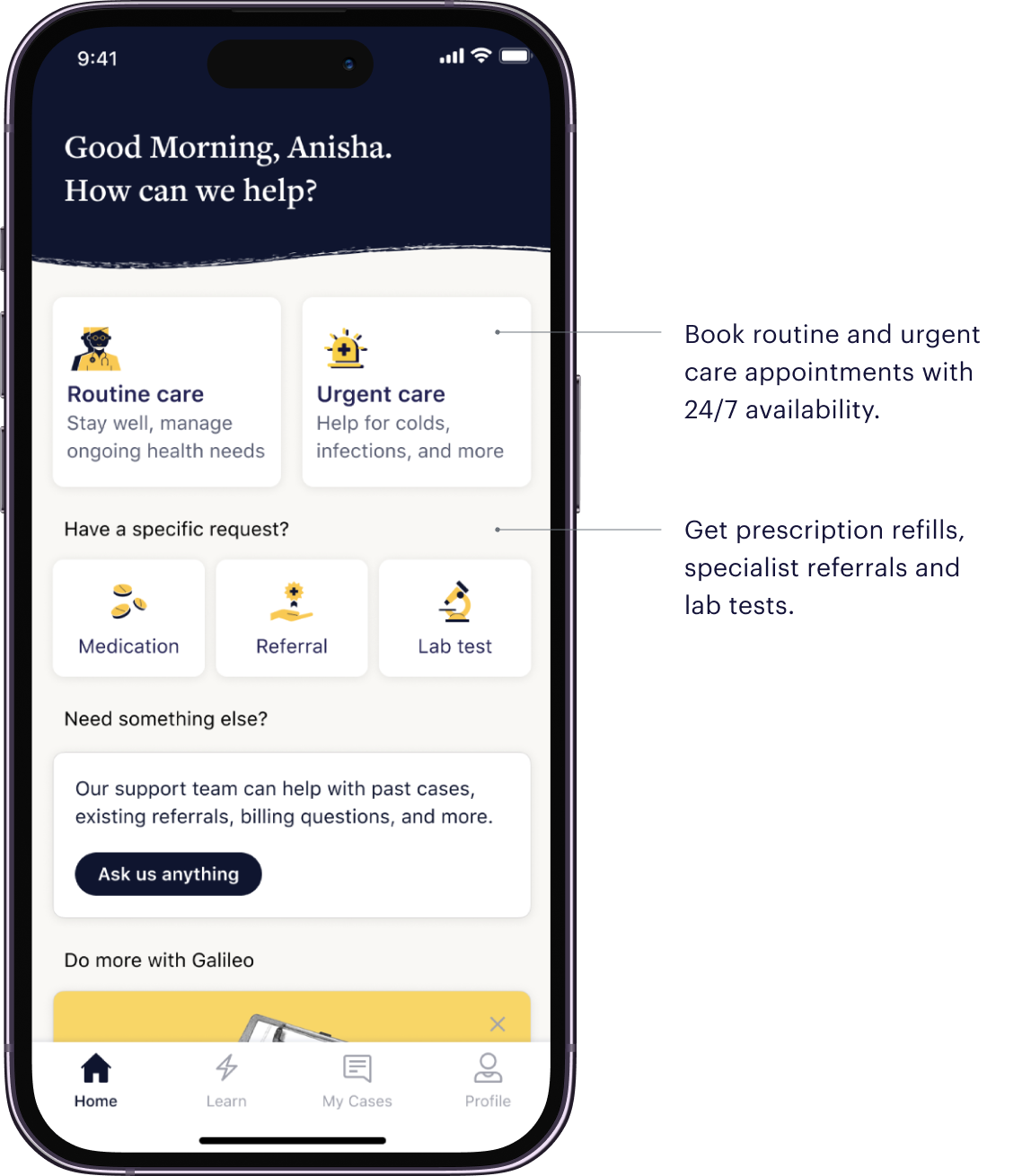
Virtual care extends this access further. Patients in underserved areas can connect with behavioral health clinicians through text, video, or phone without traveling hours to see a specialist. This is a big part of why Galileo built its behavioral health support directly into its 24/7 virtual care model rather than treating it as a referral network layered on top.
Closing these access gaps translates to measurable improvements: employees get help sooner, which means less absenteeism and presenteeism, and health plans see fewer crisis-driven utilization patterns. Earlier intervention simply costs less than emergency care.
What Effective Integration Requires in Practice
Good intentions aren't enough. The programs that actually work share a few specific, tactical commitments.
Warm Handoffs
A warm handoff happens when the primary care provider directly introduces the patient to the behavioral health clinician during the same visit, rather than handing over a referral slip and hoping the patient follows through.
This single design choice is one of the biggest levers in the entire model: removing the burden of a separate appointment, a new phone call, and a new provider to explain yourself to. In a virtual setting, this looks like a clinician sending a secure message to the behavioral health team mid-visit and transitioning the patient directly to a video call. The immediacy is the point.
Measurement-based Care
Standardized tools like the PHQ-9 and GAD-7 track patient symptoms over time and guide treatment decisions. A patient whose PHQ-9 score drops from 18 to 8 over three months is clearly improving. A patient whose score holds steady needs a different approach. Without this data, a care team might not recognize an approach isn't working until much later than it should.
Virtual and Co-located Access, Used Together
Co-located behavioral health has real advantages: it facilitates warm handoffs and builds visible relationships between team members. But it's also limited by geography and clinic hours. Virtual integration extends access to patients who face transportation barriers, childcare constraints, or schedules that make in-person visits difficult. We don't see this as an either/or. The most effective programs combine both, in-person for patients who prefer or need it, virtual for 24/7 availability and reach.
Universal Screening
Many patients don't recognize their own symptoms as depression or anxiety, and others feel embarrassed to raise the subject unprompted. Effective screening is routine rather than exceptional: a brief questionnaire before the visit, or screening questions built into intake, with positive screens triggering follow-up and a connection to behavioral health resources. Making screening universal is what catches conditions that would otherwise go undetected.
How Galileo's Integrated Model Puts This Into Practice
Galileo built behavioral health into its virtual primary care model from the ground up. It wasn't an afterthought or an add-on service, and that design choice shows up in the outcomes.
The multi-specialty care teams include behavioral health clinicians alongside primary care providers, nurses, and care coordinators, all of whom share comprehensive medical records and communicate in real time.
When a patient texts about anxiety symptoms at 2 a.m., the clinician who responds already has full context on that patient's medical history, current medications, and prior interactions. Patients can connect through text, video, or phone, 24 hours a day, because mental health concerns don't confine themselves to business hours.
For employers and health plans, this integrated approach contributes to measurable outcomes. Galileo has demonstrated an 11.5% reduction in total cost of care within six months of working with employer populations, with members over 70% less likely to require a specialist appointment or ER visit. That reduction comes from addressing problems earlier, avoiding unnecessary emergency department visits, and managing chronic conditions more effectively when behavioral health factors are addressed alongside physical health rather than separately.
Measuring Behavioral Health Integration Outcomes
Demonstrating value requires tracking the right metrics, spanning both clinical outcomes and operational efficiency.
Clinical Outcomes
Symptom improvement rates show whether patients are actually getting better, typically tracked as the percentage of patients whose PHQ-9 or GAD-7 scores improve by a clinically meaningful margin (commonly a 50% reduction or a score below the clinical threshold). Remission rates measure full symptom resolution; for depression, that generally means a PHQ-9 score below 5. Time to improvement captures how quickly patients respond, since faster improvement means less suffering and lower downstream cost.
Operational Metrics
Screening rates show how effectively a practice identifies patients who need support. Engagement rates measure how many patients who screen positive actually receive behavioral health services, a strong signal of whether warm handoffs are actually working. Referral rates track how often patients still need specialty care outside the integrated team; lower rates suggest the model is handling most needs internally.
Cost and Utilization
Emergency department utilization for behavioral health conditions should decrease as patients get earlier, more appropriate care. Inpatient psychiatric admissions, the highest-cost behavioral health services, should decline with effective integration. Total cost of care across all services captures the full financial picture, and it's the metric that matters most to health plans and employers evaluating ROI.
Behavioral Health Isn't an Add-On
Start by assessing your current gaps: what specifically stops patients from accessing mental health support today. A workforce with high rates of anxiety and depression may need rapid-access PCBH.
A population with complex chronic conditions may need collaborative care's systematic management, or, as we'd argue, both at once, the same logic behind building medical, behavioral, and social care into one coordinated program instead of separate benefits. Pilot with one population before rolling out organization-wide, and measure results before scaling.
Integrated models outperform referral-based care: patients engage more, and clinicians catch root causes instead of just symptoms. The organizations getting this right aren't choosing between frameworks. They're building behavioral health into primary care from the start.
Galileo's approach does exactly that: 24/7 access, bilingual coverage, and a care team designed around behavioral health from day one, not bolted on after the fact.