- Navigation only delivers full value when it's built into primary care delivery, not added as a separate advocacy layer.
- Standalone vendors triage and refer. An integrated care team can diagnose, treat, and close the loop directly.
- Galileo treats care coordination as a core capability of Advanced Primary Care, not a standalone program.
- Employer-sponsored family health premiums reached $26,993 in 2025, a 6% year-over-year increase.
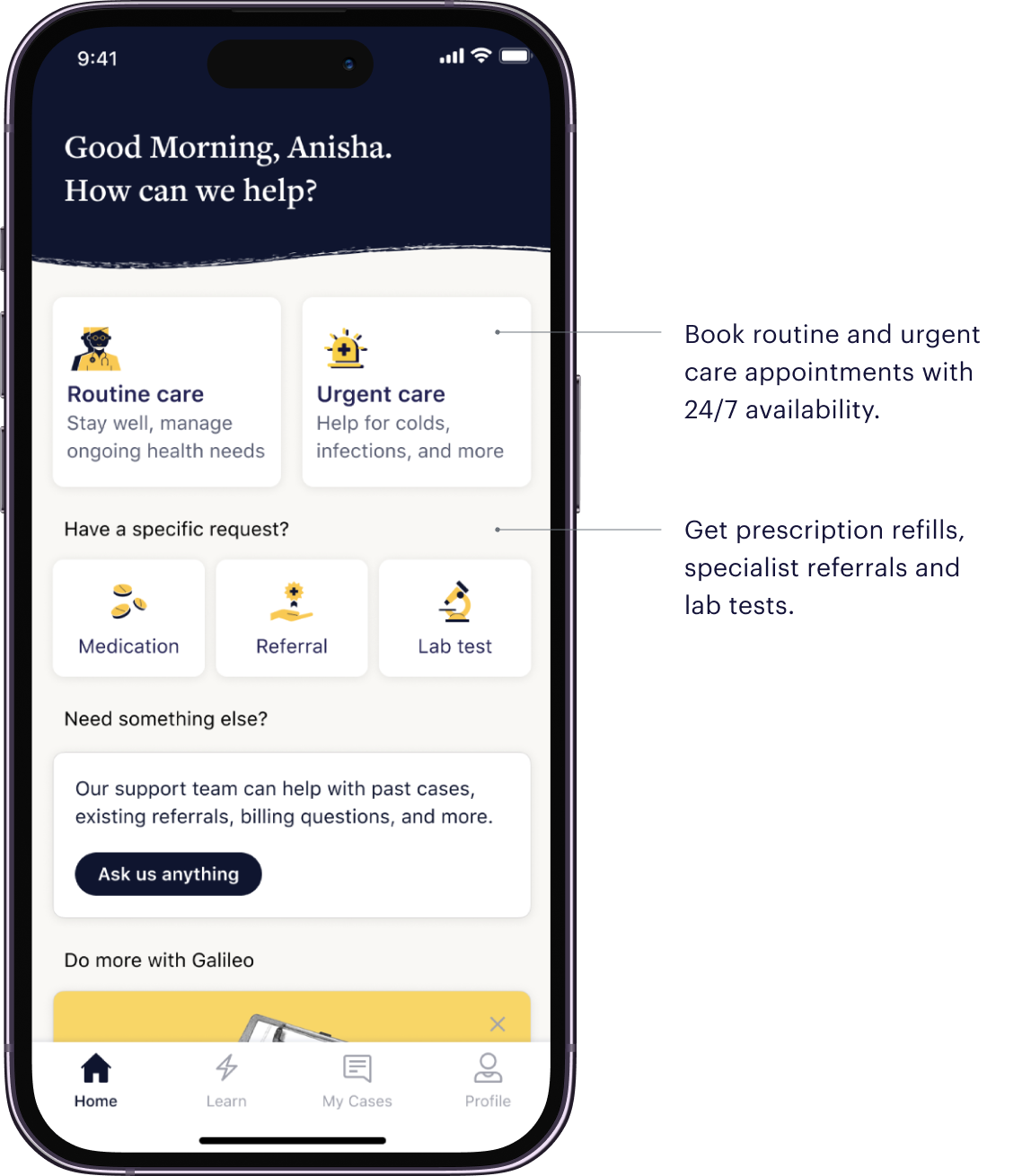
- Galileo reports more than 29% digital engagement and a Net Promoter Score above 80 with partners, a sign the model gets used, not just offered.
- The right vendor question isn't whether it points people to care. It's whether it resolves the need.
Healthcare navigation services help employees find the right care and use their benefits correctly. For employers, the real test is simple: does it lower cost, and does it actually get used? Most vendors answer with a call center or app that routes employees toward in-network providers.
Galileo takes a different position: navigation isn't a service added next to primary care; it's a function of primary care itself. That's why Galileo is built as a single clinical model for employers rather than a point solution layered onto existing benefits.
What Are Healthcare Navigation Services?
Healthcare navigation services connect people with the right care while helping them understand their benefits, find providers, and avoid unnecessary costs. The value of navigation depends heavily on where it sits relative to care delivery.
A standalone vendor operates outside the clinical relationship: it fields calls and schedules appointments but can't diagnose, treat, or see a patient's medical history. A vendor with navigation built into primary care operates inside that relationship, using shared records and clinical judgment to route (or resolve) care directly. The table further down breaks down what that difference means in practice.
Why Navigation Is a Capability of Advanced Primary Care, Not a Standalone Program
Care coordination means organizing patient care activities and sharing information among everyone involved in a patient's treatment. Most vendors sell this as a discrete product: a coordination platform, an advocacy line, a referral-management tool. Galileo's coordination works best as an outcome of how care is delivered, not a feature layered on top of it.
Most navigation vendors track referrals between providers who remain disconnected from one another: where a patient was sent and whether the appointment happened, but not whether the issue actually got resolved.
This also changes what risk identification is worth. Flagging a member at risk of a costly episode only matters if a clinical team can act on it quickly. A point solution that identifies risk but can't intervene just adds another alert to an already fragmented benefits stack.
Galileo's Advanced Primary Care model is built to close that gap: the same team that identifies a need is positioned to resolve it directly, using the clinical intelligence built into its shared record to guide a same-day virtual visit, a coordinated specialty referral, or a behavioral health consult folded into an existing care plan.
Why Do Employers Need Healthcare Navigation?
The U.S. healthcare system is notoriously difficult to navigate, and the underlying benefits landscape keeps getting more complex. SHRM's 2025 Employee Benefits Survey now tracks more than 220 distinct types of employee benefits, up from roughly 175 just two years earlier. As benefits packages expand, employees are often less certain which one applies to their situation or how to access it, and they delay care as a result: unsure what's covered, unsure where to start, or unable to find an in-network provider. Small problems become expensive ones.
For HR and benefits teams, navigation supports two priorities at once: cost control and employee engagement. When employees understand and use their benefits, healthcare costs become more predictable. Organizations see fewer avoidable ER visits, better chronic disease management, and higher satisfaction scores.
The financial case has grown harder to ignore. KFF's 2025 Employer Health Benefits Survey put annual premiums for employer-sponsored family health coverage at $26,993 in 2025, a 6% increase over 2024 and well ahead of the 4% growth in workers' wages over the same period. Against that backdrop, navigation that reduces avoidable healthcare costs by routing employees to appropriate care and managing conditions proactively isn't a nice-to-have.
Galileo reports an 11.5% total cost-of-care reduction within six months through integrated partnering with employers, a figure it attributes to its integrated navigation and delivery model rather than navigation alone.
Engagement follows the same pattern: Galileo reports more than 29% digital engagement and a Net Promoter Score above 80 with its partners, a proof point that speaks directly to whether navigation actually gets used, not just offered.
Key Features of Effective Healthcare Navigation Solutions
Not all navigation services are built the same way, and the differences show up in utilization and outcomes. In Galileo's model, the four capabilities below aren't separate product features. They operate as one platform.
Continuous Access Across Multiple Channels
Healthcare needs don't follow business hours. The best healthcare navigation models offer access through text, video, and phone around the clock, meeting employees where they are, whether that's an employee messaging about a migraine at midnight or someone booking a visit over lunch. When someone can reach a licensed clinician overnight, they get real clinical support instead of defaulting to the emergency room out of uncertainty.
Integrated Medical Records and Clinical Intelligence
A navigator who can't see a patient’s medical history is working blind. Effective navigation requires integrated records so the clinical team understands your full picture, not just the immediate complaint.
When the navigator and the treating clinician share the same information and the same diagnostic tools, coordination stops being a manual, error-prone process and becomes a byproduct of how the platform is built.
Bilingual Support and Cultural Competence
For diverse workforces, language access is essential. Navigation services should offer bilingual support in English and Spanish at minimum, so every employee can navigate healthcare effectively regardless of their primary language.
Virtual Plus In-Home Options
Digital tools are great for many situations, but some care requires hands-on attention. The most comprehensive navigation solutions include virtual visits, in-home care for complex needs, and connections to in-person clinics, all coordinated through one integrated care model so the clinical team makes the modality call instead of leaving the employee to guess.
Navigation Built Into Primary Care vs. Standalone Vendors
The difference between standalone navigation and navigation built into primary care comes down to who answers the request and what they can actually do about it.
This distinction drives real differences in outcomes. Emergency department visits fall 23% overall, and 32% among high-risk patients, when people are connected directly to primary care, evidence that resolving a need directly, rather than just tracking a referral, is what actually keeps people out of costlier care settings. They're not just routing you somewhere else.
Galileo’s model reflects this directly: its care teams handle urgent, primary, and mental health needs through text, video, and phone, and the clinicians guiding a member are the same ones treating them, with continuity carried across every visit.
Top Healthcare Navigation Services for Employer Benefits
When comparing the best healthcare navigation services for employees, several names come up consistently. Each has different strengths depending on your organization's size, needs, and existing benefits infrastructure.
The differences that matter most aren't between categories. They're between how much each vendor can resolve directly versus how much it routes elsewhere.
How to Evaluate Healthcare Navigation Vendors
Choosing a navigation solution means looking past marketing claims and into the operational details that determine whether employees actually use the benefit.
- Response time and availability: How quickly can employees reach someone, and is off-hours handled by automated systems?
- Clinical depth: Can the service diagnose and treat, or only triage and refer?
- Integration with existing benefits: Does the platform work with your current health plan and provider network, or does it create another silo to manage?
- Data and reporting: What metrics will you receive? Look for platforms that provide data on utilization patterns, cost trends, and improving health outcomes.
- Employee experience: Is the platform easy to use? Will employees actually adopt it? The best navigation service is worthless if no one uses it.
- Language and accessibility: Does it serve your entire workforce, including non-English speakers and employees in different time zones?
Smaller employers typically prioritize simplicity and cost. Larger organizations weigh scalability and integration with existing systems more heavily. Either way, the objective is the same: help employees navigate healthcare without adding another layer of complexity for HR to manage.
The Real Test: Does Navigation Resolve Care, or Just Point to It?
Healthcare navigation services have grown from a basic benefits hotline into a strategic decision with real cost implications. The model still comes down to one structural choice: is navigation delivered by the same clinical team providing care, or by a separate layer sitting on top of a fragmented system?
Galileo answers that coordination can't be purchased as an add-on to a fragmented delivery system. It has to be built into the clinical model from the start: a shared record, a multidisciplinary team, and the clinical authority to close the loop rather than just document it.
The question worth asking of any vendor: does it deliver care, or does it just point to it?Galileo's Advanced Primary Care model is built to resolve care, not just route it.