- A healthcare ecosystem is the full network of people, organizations, and technology involved in a patient's care. Most employers already have one; the real question is whether it works as a connected system or a pile of disconnected vendors.
- Most large employers are running more health-related vendors than they can coordinate, and few of those vendors share data with each other, which is the core mechanism behind point solution fatigue.
- Employers are already reallocating benefits spend to address rising costs: WTW's 2025 survey found 63% of employers plan to reallocate or rebalance spend within three years, up from just 8% the year before. Fragmentation is one reason the existing stack often isn't delivering that value.
- Primary care is a natural coordination layer for a healthcare ecosystem, not because it replaces specialists or point solutions, but because it's the one relationship positioned to see the whole patient.
- Galileo's integrated model resolves 90% of care without a referral and has driven an 11.5% reduction in total cost of care within six months for employer partners.
For employers and health plans, the challenge isn't adding more vendors. It's making the pieces that already exist work together.
A healthcare ecosystem includes every player involved in delivering, paying for, and supporting patient care, and most employer health plans already have a large one: a medical plan, a pharmacy benefit manager, a behavioral health carve-out, and a growing list of point solutions for things like diabetes or musculoskeletal care. The question isn't whether that ecosystem exists. It's whether it functions as one system or as a collection of parts that never talk to each other.
Primary care is where the answer starts, not another point solution layered on top of the rest. That's the premise Galileo's model is built around: when one clinical team can see a patient's full history, coordinate what specialists and vendors are doing, and act as a consistent front door, an employer's existing investments start working the way they were supposed to in the first place.
What Is a Healthcare Ecosystem?
The healthcare ecosystem refers to the interconnected network of people, organizations, technology, and financing mechanisms that work together to deliver care: patients, clinicians, hospitals, insurers, employers, pharmacies, and the systems that connect them.
For employers, that ecosystem includes every benefit that touches health, from the core medical plan to the pharmacy benefit manager, specialty vendors, and disease management programs. Most benefits stack up through accumulation rather than design. A mental health app gets added one year, a diabetes program the next, a virtual urgent care vendor after that.
Each one solves a specific problem, but few of them were built to talk to each other. Records stay siloed, care gets duplicated, and employees are left to navigate between vendors with no one coordinating the journey.
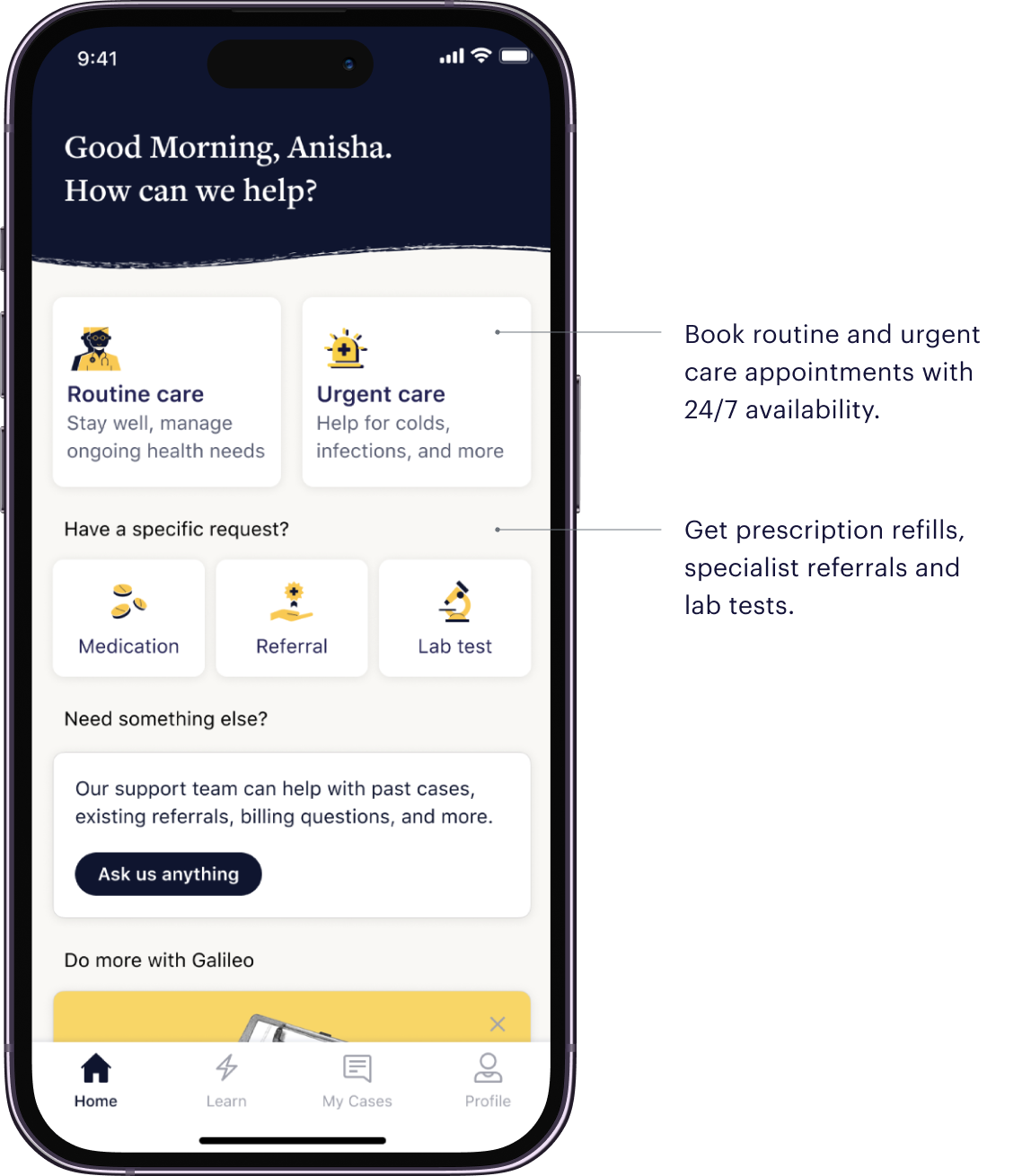
A well-designed healthcare ecosystem puts primary care at the center, not as another point solution, but as the connective layer that coordinates everything else. Galileo integrates advanced primary care into an employer's healthcare ecosystem as a 24/7 front door through text, video, and phone, combining virtual, in-person, and in-home care in select markets, while keeping records unified across the whole team.
Why Fragmentation Is Breaking Employer Benefits
Each of those additions solves a narrow problem well. Together, they create a predictable set of failure modes.
Employees Don't Know Where To Go
When someone has a health concern, they face a menu of options: the telehealth app, the mental health vendor, their primary care doctor, or the ER. Without clear guidance, many default to the most expensive option, or skip care altogether.
Care Teams Can't See The Full Picture
When a behavioral health vendor doesn't know about a patient's diabetes, or a specialty program can't see the primary care notes, each is working with partial information. The data exists somewhere in the ecosystem; it just isn't reaching the people who need it.
Vendors Optimize For Their Own Metrics
A disease management program can report improved A1C levels while missing that the same patient is dealing with untreated depression. Without integration, no single vendor is accountable for the whole person, only for their own slice of the problem.
The Financial Impact is Real
This isn't just an employee-experience issue. Fragmented care drives duplicated healthcare services, avoidable ER visits, and delayed treatment for conditions that get more expensive the longer they go unmanaged. Employers are already responding to cost pressure broadly: TW's survey data found 63% of employers plan to reallocate or rebalance benefits spend within three years, up from just 8% the year before, and 73% plan to switch to better-value vendors. Fragmentation is one reason the existing stack often isn't delivering that value: most large employers are running more health-related point solutions than they can realistically coordinate, and few of those tools share data with each other.
An integrated model changes that calculation directly. Employers using Galileo's integrated primary care model have seen an 11.5% reduction in total cost of care within six months, a result tied to coordination and in-house resolution rather than to any single point solution's performance.
The fix isn't to eliminate point solutions. Many of them deliver real, specific value. It's building a layer that makes them work together instead of in isolation.
Advanced Primary Care as the Connective Layer
Picture how a health concern usually plays out today: an employee searches online, checks a benefits portal, finds a confusing list of options, and either guesses or gives up. If they do reach a vendor, that vendor solves the immediate issue without much visibility into anything else going on.
Now picture a version where the employee texts their primary care team instead. A clinician responds within minutes, already able to see the specialist notes, past ER visits, and current medications on file, and either handles the issue directly or coordinates a warm handoff to the right resource. That second version is what a primary-care-anchored ecosystem is supposed to deliver, and a few specific capabilities make it possible:
- 24/7 availability across channels: When employees can reach their care team anytime by text, video, or phone, they're less likely to default to the ER for an after-hours concern, since they can get guidance from someone who already knows their history.
- Integrated behavioral health: Mental and physical health are closely connected, and a care team that includes behavioral health specialists can treat the whole person instead of managing conditions in isolation.
- Real care navigation: Instead of leaving an employee to self-triage, the care team consolidates the medical history and guides the person to the right next step, whether that's an urgent concern, chronic disease management, or a specialist referral.
- Comprehensive shared records: When a care team can see records across the ecosystem, from specialist visits to lab results, they avoid redundant testing, catch drug interactions before they happen, and close gaps that would otherwise go unnoticed.
Making Technology Connect the Ecosystem
Technology is supposed to make healthcare work better. Too often, it does the opposite. Electronic health record systems that don't talk to each other, apps that create new silos instead of removing old ones, data that exists but can't be accessed when it matters.
A healthcare ecosystem that actually functions needs technology built to connect, not fragment. That means a patient's chat with their care team should pull from their full medical history, a specialist referral should carry the relevant records with it, and a care team managing a chronic condition should have visibility into what every other provider is doing.
Galileo's clinical intelligence tools are built around that principle: they support the clinical team by surfacing patterns and flags across a unified record, not by replacing the judgment of the people using them. Strong privacy and security practices matter just as much here. Sharing data across an ecosystem only works if patients can trust that their information is protected, and the goal is always better-informed care.
Practical Steps in Building a Connected Healthcare Ecosystem
Fixing a fragmented benefits stack doesn't mean tearing it down and starting over. It means adding the coordination that makes the investments already in place work better.
Step 1: Anchor on Advanced Primary Care
Choose a primary care platform built to integrate with the rest of the ecosystem, one that can coordinate referrals, track outcomes, and connect to existing point solutions rather than adding another disconnected one. Galileo is built to serve as that foundation: our model resolves 90% of care without a referral, which is what "coordinating referrals" looks like in practice.
Step 2: Evaluate Your Current Stack
Map every health-related vendor and program currently in place. Identify which ones deliver clear value, which overlap, and which operate in complete isolation from the rest.
Step 3: Demand Interoperability
When evaluating new vendors or renegotiating existing contracts, prioritize partners that will share data with the primary care platform. Employers and health plans have leverage here, and using it to require connectivity is often the single highest-value negotiating point in a renewal.
Step 4: Measure the Whole Ecosystem, Not Individual Programs
Track total cost of care, how early employees engage with care, whether chronic conditions are being managed effectively, and whether ER visits and hospitalizations are trending down. A program can look successful in isolation while total cost of care and referral patterns keep moving in the wrong direction in the background.
Step 5: Simplify the Employee Experience
However sophisticated the backend integration gets, employees still need one simple front door: one place to start, one team that knows their history, and one source of guidance when they're not sure what to do next. That simplicity shows up in the numbers: Galileo has seen 29% digital engagement and a Net Promoter Score above 80 in employer populations, well above what fragmented, multi-vendor benefits stacks typically produce.
Fragmented Point-Solution Stack vs. Primary-Care-Anchored Ecosystem
A Connected Ecosystem Starts With Primary Care, Not Another Vendor
Every employer already has a healthcare ecosystem. Most just haven't built it to function as one. The fix isn't fewer benefits or a bigger technology budget. It's a coordination layer that makes the pieces already in place work together, with one team accountable for the whole picture instead of each vendor optimizing for its own slice of it.
Advanced primary care offers a path forward. Galileo serves as the connective layer that coordinates care across the full ecosystem, reducing costs, improving outcomes, and delivering the experience that employees actually want.
If your benefits stack has grown faster than your ability to coordinate it, talk to Galileo's employer team about what a primary-care-anchored ecosystem could look like for your workforce.