- Total rewards combines compensation, benefits, wellbeing, recognition, and development into one strategy, and healthcare is the single largest lever inside it.
- Family premiums are projected to reach $26,993 in 2025, and 88% of employers rank health benefits as their top priority, according to KFF and SHRM.
- Most total rewards programs still treat healthcare as a stack of disconnected point solutions rather than a coordinated model of care.
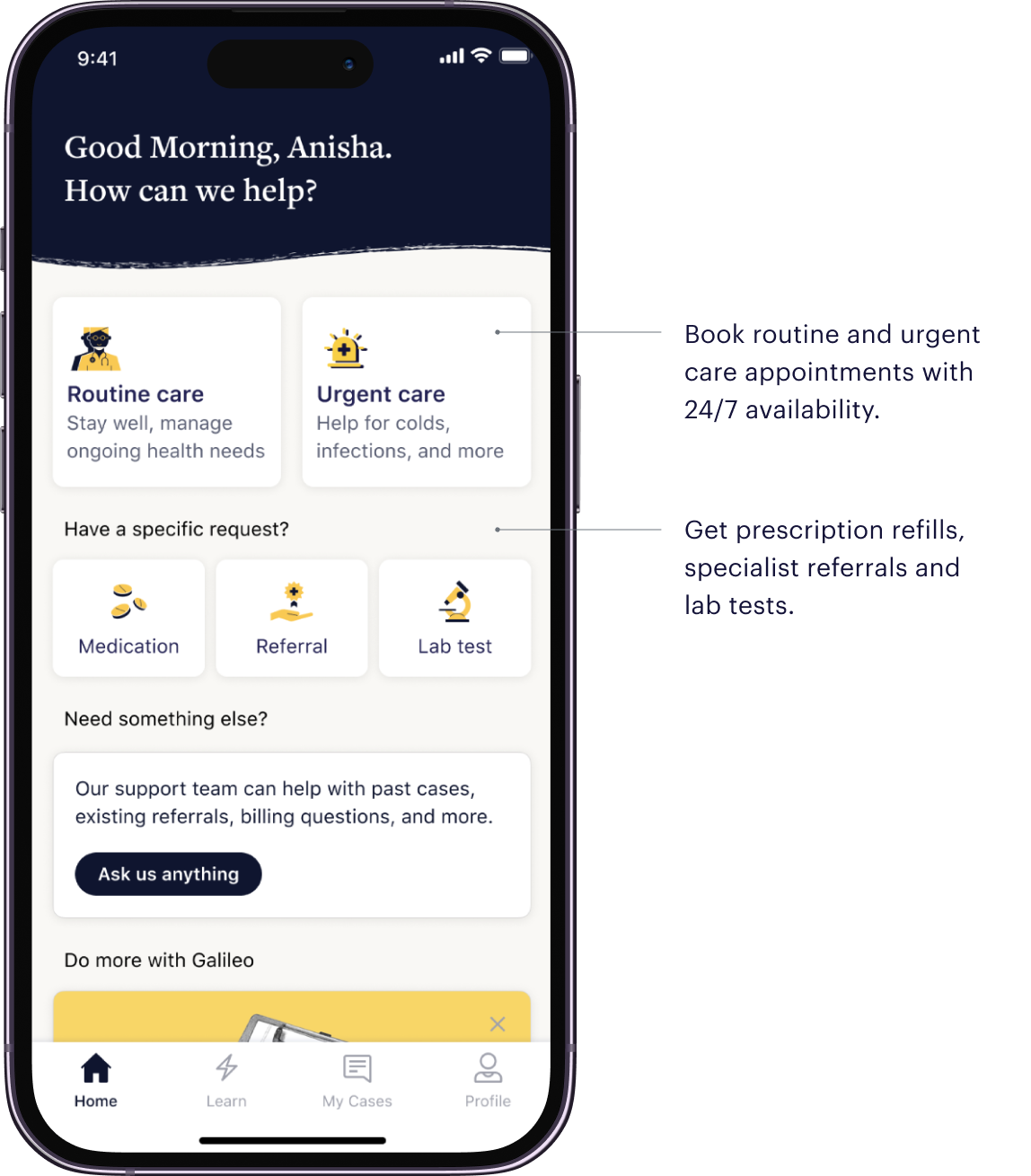
- Galileo treats advanced primary care as the organizing structure of a total rewards strategy, not an add-on benefit layered over a fragmented system.
- A connected clinical team, shared medical record, and clinical intelligence platform let Galileo resolve most needs directly, rather than simply routing employees to the next provider.
Most total rewards have five pillars: compensation, benefits, wellbeing, recognition, and development. Healthcare is one of the most significant of the five. It's the cost employers scrutinize hardest, and the benefit employees notice first.
In practice, a benefit that offers a 24/7 video visit and stops there leaves employees to find and pay for everything that visit doesn't resolve. Advanced primary care, a coordinated team that treats urgent, everyday, and chronic needs directly instead of routing employees to more providers, is what makes healthcare worth its cost in a total rewards strategy.
Galileo builds its model to that standard: advanced primary care delivered as one connected system, not a benefit layered on top of disconnected providers. Here's what total rewards includes, why healthcare has to be built around advanced primary care, and how Galileo puts that into practice.
What Are Total Rewards Benefits, Really?
Total rewards represent everything an organization offers employees in exchange for their work, the complete picture of what makes working somewhere worthwhile, not just the paycheck.
The framework typically breaks into five core pillars:
Healthcare sits at the center of this framework as both the highest-cost and highest-impact lever in any total rewards strategy. Employer-sponsored family health coverage reached $26,993 in 2025, according to KFF, up 6% from the year before. That's a massive investment, and it deserves strategic attention rather than a routine renewal.
A strong total rewards package should include advanced primary care access via text, video, or phone, covering preventive care, women's health, mental health support, and chronic disease management. In select markets, in-home visits and mobile clinics extend that access further. Nationwide availability ensures more employees can get care when they need it. Traditional medical, dental, and vision coverage remains essential, alongside EAP services, HSA/FSA options, and wellness stipends.
Why Advanced Primary Care, Not a Point-Solution Stack
Most employers respond to that priority by adding benefits rather than coordinating care: a virtual visit vendor here, a diabetes app there, a separate behavioral health point solution, each procured and evaluated on its own. The result looks comprehensive on a benefits guide but leaves employees navigating disconnected providers who do not share records, context, or accountability for outcomes. This is point solution fatigue, and it raises costs and frustration instead of lowering them.
What makes primary care "advanced"?
Advanced primary care is a team-based model built to treat everyday, urgent, and chronic needs directly, not to identify a need and hand it off. Research on care fragmentation backs this up: when patients see many disconnected providers without a coordinating clinical relationship, the result is more duplicated testing, more unnecessary utilization, and higher total cost, regardless of how sick the patient is.
Galileo builds its model around the right-hand column deliberately. Its clinical teams, shared medical record, and clinical intelligence platform work as one connected system, not software layered on top of a fragmented network of providers. That structure is what lets the care team intervene early and resolve a need directly, instead of documenting that it exists and referring it elsewhere.
Building a Competitive Total Rewards Package
Structuring an effective package starts with understanding what a workforce needs, not what's traditionally been offered.
Start by segmenting your employee population. A 25-year-old software engineer has different healthcare priorities than a 55-year-old operations manager managing a chronic condition:
- Younger employees often prioritize mental health access and convenient virtual care.
- Employees with families need robust coverage and support that extends to dependents.
- Older employees typically need more chronic disease management and preventive screenings.
A comprehensive package combines holistic pay with genuine wellbeing support: base salary and performance bonuses, medical, dental, and vision coverage, and virtual care access for urgent needs, preventive care, and ongoing conditions.
Behavioral health services, chronic disease management, and paid leave round out the health-focused elements. Retirement contributions, learning opportunities, workplace flexibility, recognition programs, and meaningful perks complete the picture.
The Galileo Difference: Resolution, Not Just Access
Access alone is no longer a differentiator. Most vendors in this category offer a 24/7 virtual visit. What matters is what happens after: whether the need gets resolved or just logged and passed along.
Galileo's model is built around resolution. Its multidisciplinary care team, whole-person care approach, and integrated technology platform put identifying a need and acting on it inside the same relationship, not across a chain of handoffs:
- Members are over 70% less likely to require a specialist appointment, ER visit, or urgent care visit after engaging with Galileo's care team.
- Employers working with Galileo have seen an 11.5% reduction in total cost of care within six months.
- Engagement exceeds 40%, even in populations where more than half of members are managing chronic conditions, well above typical benefit utilization rates.
None of that is a software feature bolted onto a benefits catalog. It is the output of a clinical model, a shared record, and a technology platform built together from the start, not point solutions asked to coordinate after the fact. That is also what separates rising employer healthcare costs driven by fragmented utilization from costs that come down because care actually gets resolved.
Total Rewards That Employees Actually Use
A total rewards package built around advanced primary care isn't just a nicer employee experience. It's a measurable business decision. Employers who anchor their strategy in a connected care model see less fragmented utilization, fewer avoidable ER visits, and a workforce that engages with the benefits it's already paying for instead of letting them go unused.
Galileo's case to employers is direct: healthcare should not be one more line item competing for attention inside a total rewards strategy. It should be the coordinating structure the rest of the strategy is built around.
Partner with Galileo to see how an advanced primary care model changes what your total rewards package can deliver.

%20(1)%20(1).webp)

.webp)











%20(1).webp)
%20(1).webp)












.webp)