- Employee health benefits shape retention, workforce productivity, and total healthcare expenditure in ways that extend well beyond HR policy.
- Coverage alone is insufficient. Employees require care that is accessible, navigable, and available on their schedule.
- 24/7 virtual primary care can meaningfully reduce avoidable emergency department and urgent care utilization.
- High-performing benefit strategies integrate primary care, urgent care, chronic condition management, and mental health support within a connected care model.
- Employers should evaluate benefits not only on coverage breadth, but on employee access, utilization rates, and demonstrated cost impact.
Employee health benefits are a key part of how employers support their workforce. They also shape retention, absenteeism, and healthcare costs in ways that directly affect the business.
Employees now expect more than insurance coverage. They want care that is easy to access, easy to understand, and available when they need it. For employers, that shift has made the design of health benefits more important than ever.
That is why 24/7 virtual care has become more important in employer benefits strategy. It helps employees get care faster and gives employers another way to improve access without adding more friction.
This guide explains what employee health benefits include, why they matter, and how 24/7 virtual care can strengthen a benefits package.
What Are Employee Health Benefits?
Employee health benefits are employer-sponsored programs that help workers access and pay for medical care. For most organizations, health insurance remains the foundation. But a benefits package built for today's workforce extends considerably further.
A modern benefits offering may encompass primary care, urgent care, preventive care, chronic condition support, integrated mental health services, and on-demand virtual care access. Some employers also provide in-person and in-home care options in select markets to serve populations with more complex or geographically specific needs.
The goal is not just to offer coverage. It is to ensure that employees can actually access care without unnecessary delays, administrative friction, or care fragmentation.
Why Employee Health Benefits Matter for Employers
Benefits design is a strategic function, not an administrative one. How employees experience their health benefits, particularly in moments when they need care, shapes their perception of organizational support and directly affects business outcomes.
The Retention Dimension
Employees take note of benefits that are difficult to use. Fragmented care pathways, extended wait times, and limited access are not neutral inconveniences. Over time, they erode satisfaction and inform retention decisions. Organizations that invest in genuinely accessible care signal a meaningful commitment to workforce well-being.
The Productivity Dimension
The financial burden of workforce absenteeism is well-documented.
Productivity losses from employee absenteeism cost U.S. employers $225.8 billion annually or approximately $1,685 per employee, according to CDC Foundation research. When employees can access care efficiently and in the appropriate setting, they are less likely to delay treatment until conditions worsen or to spend working hours navigating an inaccessible care system.
The Cost Dimension
Health benefits carry direct financial consequences for the total cost of care. Poor benefit design, specifically fragmented access, delayed treatment, and overreliance on high-cost care settings, translates into avoidable expenditure that compounds over time.
The Main Types of Employee Health Benefits
Most employer-sponsored health benefits fall into several distinct categories. Understanding each clarifies where access gaps most commonly emerge.
Health and Clinical Benefits
This includes primary care, urgent care, preventive screenings, chronic condition management, prescription support, women’s health, and mental health services. Many employers now include virtual primary care so employees can connect with licensed clinicians by phone, video, or chat without scheduling delays or geographic constraints.
Insurance Protections
Medical insurance remains the structural base of most benefits programs. However, insurance coverage does not resolve access. Employees still require a practical, low-friction pathway to timely care, particularly for needs that arise outside traditional office hours or in locations with limited provider availability.
Financial and Retirement Benefits
Financial stress and physical health are closely correlated. Benefits that support financial well-being, including retirement planning, debt management resources, and income protection, also reinforce overall workforce health.
Paid Time Off and Leave
Employees need time to recover from illness, attend appointments, and address caregiving responsibilities. Thoughtfully designed leave policies ensure that the clinical benefits an employer provides can actually be used.
What Health Benefits Should Employers Offer?
The appropriate benefit mix varies by workforce, but most employers require more than a conventional insurance plan to meet the full range of employee health needs.
At a minimum, employees need reliable access to primary care, urgent care, preventive care, mental health support, and chronic condition management. Employers with geographically distributed teams face the additional complexity of ensuring that access is consistent across locations and time zones, not just available on paper.
The more fundamental question is whether employees can practically use the care being offered. A benefits package may appear comprehensive in plan documents and perform poorly in utilization.
Access barriers, whether related to wait times, geographic limitations, or benefit navigation complexity, erode the return on every dollar invested in health benefits.
Why 24/7 Virtual Care Matters
24/7 virtual primary care represents a structural improvement in how employees access care, particularly for needs that arise outside standard office hours. Rather than waiting days for an appointment or defaulting to an emergency department for a manageable acute condition, employees can connect with a licensed clinician by phone, video, or chat within minutes.
For employers, the value extends well beyond convenience. Improved access to timely primary care can reduce avoidable utilization of high-cost care settings while improving the consistency of care employees receive.
The best virtual primary care models are distinguished not by the technology platform, but by the clinical model behind it. Advanced primary care, characterized by a multidisciplinary team-based approach, 24/7 availability, and continuity across acute, preventive, and chronic care, delivers substantively different outcomes than a standard on-demand video visit.
This distinction matters particularly for employees managing ongoing conditions who need coordinated support rather than episodic, disconnected encounters.
How Better Benefits Can Help Control Costs
Healthcare costs escalate when employees delay care, use the wrong care setting, or receive treatment across disconnected providers without continuity.
An employee who presents to the emergency department with a condition that could have been addressed through a timely virtual primary care visit generates substantially higher costs than necessary, for both the employee and the plan.
Employees who defer preventive care because access feels difficult accumulate unmanaged risk over time. Those who see multiple specialists without primary care coordination often receive duplicative or contradictory treatment.
Better benefit design addresses each of these patterns. When employees can access the right level of care at the right time, the downstream cost implications are meaningful.
This dynamic is especially consequential for chronic conditions. Diabetes, hypertension, and asthma are expensive when they are not actively managed. A connected care team that monitors employees between visits, adjusts treatment plans as needed, and intervenes before conditions escalate generates measurably different outcomes than a fragmented point-solution model.
Building a Benefits Strategy That Works
A practical sequencing framework:
- Assess current utilization patterns: High emergency department use, low preventive care engagement, or poor follow-up rates indicate specific access gaps in the current benefit design.
- Anchor the strategy in advanced primary care: A 24/7 care model that addresses acute, preventive, chronic, and mental health needs within a single, continuous member experience reduces fragmentation at the structural level.
- Evaluate the accessibility of existing benefits: Simplicity and navigability determine utilization. Employees are more likely to engage with benefits that are easy to understand and straightforward to access.
- Invest in clear benefit communication: Employees cannot use what they cannot find. Proactive communication ensures that benefit awareness is high before employees need care, not after.
- Measure outcomes, not activity: Engagement metrics alone do not reflect program value. Track indicators such as emergency department diversion, chronic condition adherence, and total cost of care trends.
Why Employers Choose Galileo
Galileo is an advanced primary care provider built to address the structural limitations of conventional benefit design. Unlike point solutions that manage a single condition or access type in isolation, Galileo delivers care through a multidisciplinary team-based model that spans acute, chronic, preventive, and mental health needs within a single, continuous member experience.
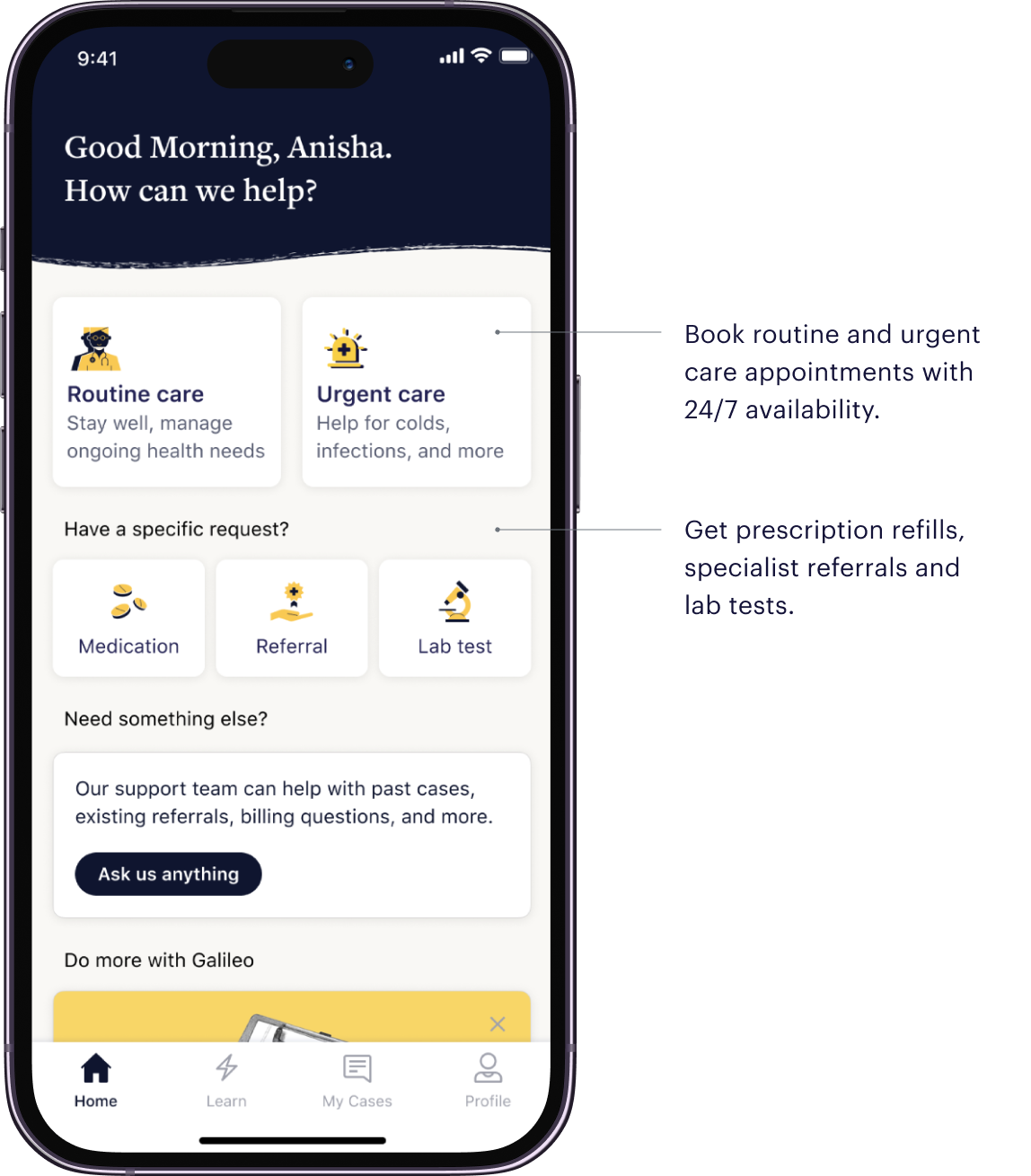
Employees receive 24/7 access to licensed clinicians by phone, video, and chat. Visits are structured to run 20 to 30 minutes, with care available in English and Spanish nationwide. That team-based clinical approach is what distinguishes advanced primary care from conventional virtual care: rather than routing employees through separate platforms for separate needs, Galileo's care teams maintain continuity across the full scope of a member's health.
From an employer's perspective, the value is operational as well as clinical. Better primary care access can reduce avoidable utilization of emergency departments and urgent care, improve the employee care experience, and give benefits leaders a more coherent alternative to the fragmented point-solution stack that many organizations have accumulated over time.
Galileo is structured for workforce realities. Care is available nationwide, with in-person and in-home options in select locations, giving employers a practical way to support distributed teams without sacrificing care quality or continuity.
Why This Matters for Your Benefits Strategy
The strongest benefit programs integrate primary care, urgent care, chronic condition management, and mental health support within a connected care model grounded in advanced primary care principles. That integration is what translates benefit investment into measurable outcomes: reduced absenteeism, improved retention, and lower total cost of care.
Partner with Galileo to build a care model that improves access, supports workforce health, and reflects the full complexity of your employee population.

%20(1)%20(1).webp)

.webp)








%20(1).webp)
%20(1).webp)











.webp)