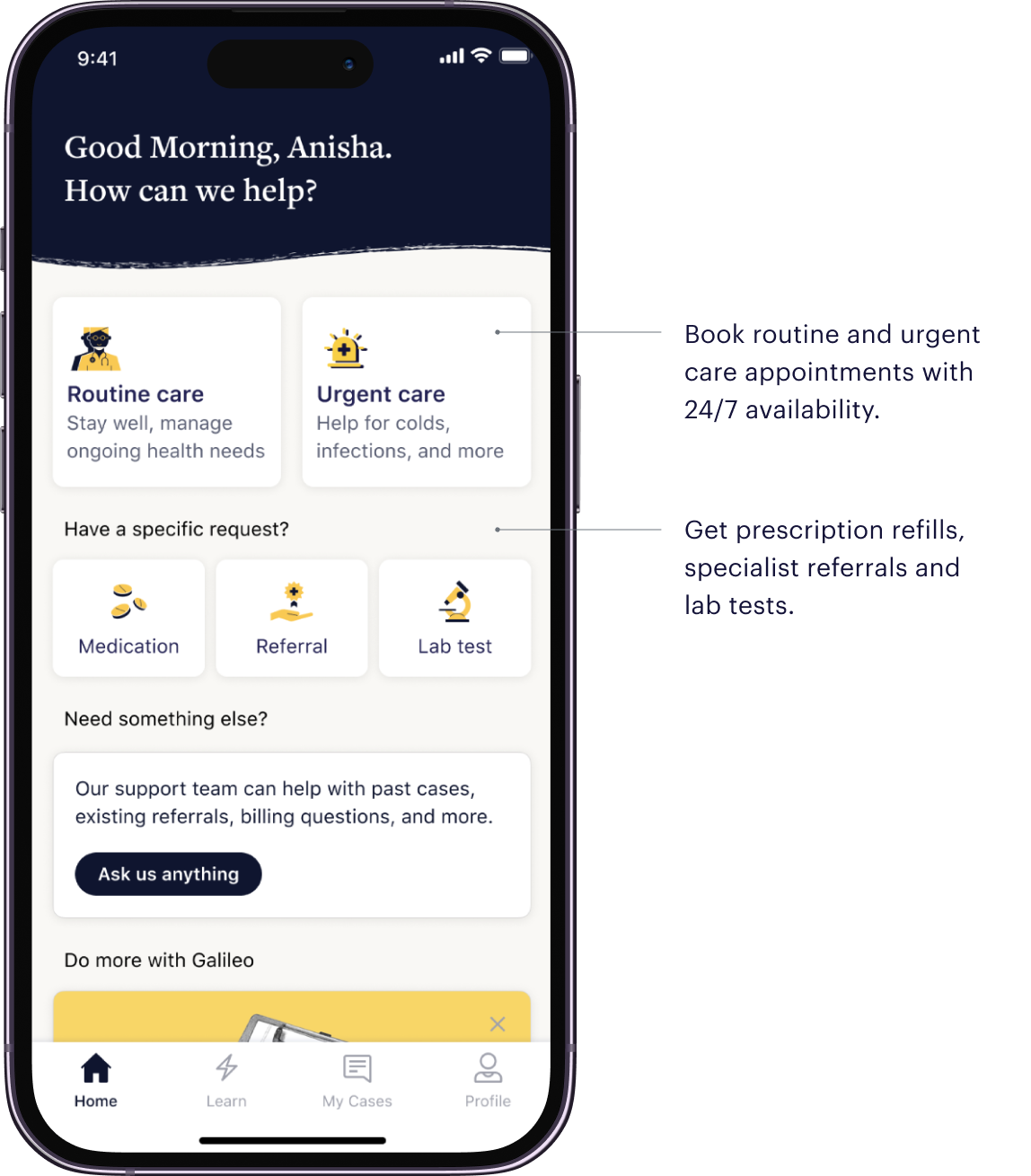
- Advanced primary care (APC) replaces fragmented, reactive care with a team-based model spanning virtual, in-person, and in-home settings around the clock.
- Employers face a sustained benefits cost crisis: large employer health benefit costs are projected to rise by a median of 9% in 2026, building on back-to-back record increases in 2023 and 2024.
- Galileo has demonstrated an 11.5% reduction in total cost of care within six months of implementation, driven by lower downstream utilization and higher member engagement.
- Members who engage with Galileo's model are over 70% less likely to require specialist visits or ER care.
- Advanced primary care differs meaningfully from direct primary care (DPC) and virtual-only models, and understanding these distinctions is essential to selecting the right solution for your workforce.
- Effective APC programs deliver measurable ROI not only through direct medical cost reduction, but through improved productivity, lower absenteeism, and higher workforce retention.
For large employers seeking to reduce healthcare expenditure without compromising employee health, advanced primary care offers a proven, structurally sound path forward. By integrating 24/7 virtual access, coordinated in-person care, and multidisciplinary clinical teams into a single cohesive model, this approach produces better clinical outcomes for employees and quantifiable savings for organizations.
What Is Advanced Primary Care and Why Does It Matter for Employers?
Where conventional primary care is reactive, episodic, and fragmented, advanced primary care brings together a multidisciplinary team of clinicians managing the full spectrum of patient needs, from urgent concerns and chronic condition management to preventive care and behavioral health, within one coordinated infrastructure.
How It Differs from Standard Primary Care
The distinctions between standard and advanced primary care are both structural and clinical:
Under traditional fee-for-service arrangements, fragmented care routinely produces over-reliance on emergency departments and unnecessary specialist referrals. Advanced primary care restructures these incentives, rewarding proactive management that keeps employees healthier and reduces downstream utilization.
Employers evaluating this space will encounter different providers. The critical differentiator across the category is not access alone, but the depth of clinical coordination and the quality of outcomes data a provider can demonstrate.
The Business Case: How Advanced Primary Care Reduces Total Cost of Care
According to the Business Group on Health's 2026 Employer Health Care Strategy Survey, large employers are projecting a median 9% healthcare cost increase for 2026, continuing a trend that has seen cumulative costs rise more than 50% since 2017. Managing this trajectory requires structural intervention, not incremental plan redesign.
Where the Savings Come From
Galileo has demonstrated an 11.5% reduction in total cost of care within six months of working with employers, driven by the operational logic of coordinated virtual primary care: when clinical problems are identified and addressed earlier, downstream costs are structurally lower.
The mechanisms are well-established:
- Reduction in avoidable ER & urgent care utilization. With reliable 24/7 access to a clinical team, low-acuity concerns that would otherwise generate ER or urgent care visits are resolved at a fraction of the cost. Galileo members are over 70% less likely to require specialist appointments or ER and urgent care visits.
- Chronic condition management. Proactive management of conditions such as hypertension, diabetes, and high cholesterol prevents costly acute episodes and hospitalizations.
- Elimination of duplicative services. Coordinated care with unified medical records removes the inefficiencies of repeated diagnostic workups and disconnected specialist referrals.
- High engagement rates. Galileo achieves over 40% engagement in populations where more than half of the members are being treated for chronic conditions, and this engagement directly correlates with better utilization and cost outcomes.
Beyond direct medical expenditure, a high chronic disease burden also carries significant indirect costs: lost productivity, elevated absenteeism, and accelerated turnover. A workforce that consistently engages with primary care produces measurable gains on each of these dimensions.
Key Features That Define High-Quality Advanced Primary Care
Not all advanced primary care programs are structurally equivalent. When evaluating options for your workforce, the following capabilities are clinically and operationally determinative.
24/7 Access Across Multiple Modalities
The best programs provide clinical access via text, video, and phone at any hour. Health concerns do not follow business hours, and the absence of readily available clinical guidance is a primary driver of unnecessary ER utilization. Galileo's bilingual platform ensures employees can reach a clinician whenever they need one, supporting linguistically diverse workforces that traditional provider networks frequently underserve.
Integrated, Comprehensive Medical Records
Care quality is inseparable from information quality. Providers working with incomplete or siloed patient data are more likely to miss relevant history, order duplicative tests, and produce inconsistent clinical assessments. Advanced primary care programs that aggregate data across sources (previous providers, lab results, specialist notes) enable faster, more accurate diagnoses and prevent costly care gaps.
Clinical Intelligence Infrastructure
Leading programs deploy diagnostic and therapeutic intelligence platforms that assist clinicians in delivering consistent, evidence-based care at scale. These tools do not replace clinical judgment; they systematically surface relevant information and reduce the variability that erodes care quality across large populations.
Security and Privacy Standards
Any advanced primary care solution operating within an employer benefits structure must meet rigorous security and privacy requirements. Review certifications, HIPAA compliance infrastructure, and data governance practices carefully before contracting.
Care Delivered Across Multiple Settings
The most effective programs meet employees wherever they are. Galileo's care model delivers across four settings:
- Mobile devices: instant access to clinical teams around the clock for the majority of care needs.
- In the home: specialized clinical teams managing complex and chronic conditions for higher-acuity populations.
- Mobile clinics: community-based access reaching populations that face geographic or mobility barriers.
- Care centers: in-person visits for cases requiring hands-on evaluation.
How Advanced Primary Care Supports Population Health Management
Managing the health of a large workforce requires more than treating individuals one at a time. Population health management takes an aggregate view of clinical patterns, enabling proactive interventions before small problems compound into costly episodes.
From Reactive Treatment to Proactive Intervention
When care flows through a connected, coordinated system, meaningful patterns become visible at the population level. Employers can identify which chronic conditions are most prevalent, where preventive screenings have lapsed, and which sub-populations are at highest risk for avoidable acute events. Advanced primary care programs can then actively reach out with evidence-based reminders, health coaching, and early interventions, including integrated behavioral health support for employees managing stress, anxiety, or depression alongside physical conditions.
Regular screenings and wellness visits identify clinical problems at earlier, less expensive stages of progression. For employers, a well-managed population health program translates identified care gaps into actionable interventions with measurable financial outcomes.
Comparing Advanced Primary Care Models: What to Look For
Large employers evaluating advanced primary care will encounter meaningfully different delivery architectures.
Advanced Primary Care vs. Direct Primary Care
Direct Primary Care (DPC) is a membership-based model in which employees maintain a direct relationship with a primary care physician, typically paying a flat monthly fee outside the insurance system. Advanced Primary Care (APC) is a team-based, technology-enabled model designed for scale, typically delivered through employer benefit plans or health plan partnerships.
DPC suits smaller organizations with geographically concentrated workforces. For large, distributed populations with complex chronic disease burdens, advanced primary care's team-based model and multi-setting flexibility are the stronger fit.
Key Evaluation Criteria for Employer Buyers
When comparing providers, these dimensions warrant particular attention:
- Virtual-first vs. clinic-first architecture. For distributed workforces, virtual-first models typically produce higher engagement and more consistent utilization than clinic-centered approaches.
- Health plan integration. Effective APC programs coordinate seamlessly with existing health plans. Coordination across specialty care, hospitalizations, and ancillary services is critical to realizing the full cost reduction potential of the model.
- Incentive alignment. Per-member-per-month fee structures align provider incentives around keeping populations healthy rather than maximizing visit volume. Total cost of care impact is a more meaningful evaluation metric than direct program fees alone.
- Care team capacity. Evaluate average response times, after-hours availability, and clinical team composition. Team-based care and technology extend clinician capacity well beyond what traditional panel-based practices can offer.
- Referral management. High-performing programs maintain continuity when specialty care is warranted, keeping patients from falling through the cracks between care settings.
The Strategic Case for Advanced Primary Care
With employer-sponsored family premiums reaching nearly $27,000 in 2025 and further escalation projected through 2026, fragmented, reactive care is no longer a viable strategy. Advanced primary care offers a structurally sound alternative, with documented outcomes: lower ER utilization, reduced specialist dependency, and measurable total cost reduction within the first year.
Prioritize providers with demonstrated population health outcomes, transparent cost data, and the flexibility to serve a distributed workforce.
To learn how Galileo can be structured for your organization, contact the Galileo partnerships team.

%20(1)%20(1).webp)

.webp)












%20(1).webp)
%20(1).webp)











.webp)