- Effective claims cost management combines predictive analytics, high-cost claimant programs, stop-loss protection, and early clinical intervention, not any single tactic alone.
- The biggest lever most employers underuse isn't a new point solution. It's an earlier clinical intervention, before a manageable condition becomes a catastrophic claim.
- Across Galileo's employer partnerships, an advanced primary care model built for complex, high-need patients has shown an 11.5% reduction in total cost of care within six months.
- The strongest claims cost management programs are measured by avoided cost and care resolution, not just stop-loss reimbursement volume.
Effective claims cost management identifies high-cost claimants early and intervenes clinically, instead of waiting for stop-loss to absorb the damage.
If you run benefits for a self-funded employer, you already carry the financial risk of every claim your plan generates. Stop-loss insurance caps the worst-case scenario, but it doesn't make claims cheaper, and it pays out after the cost has already been incurred.
The more durable strategy starts upstream of that: identifying who's likely to become a high-cost claimant, and getting an advanced primary care team like Galileo involved before a manageable condition turns into a six-figure claim.
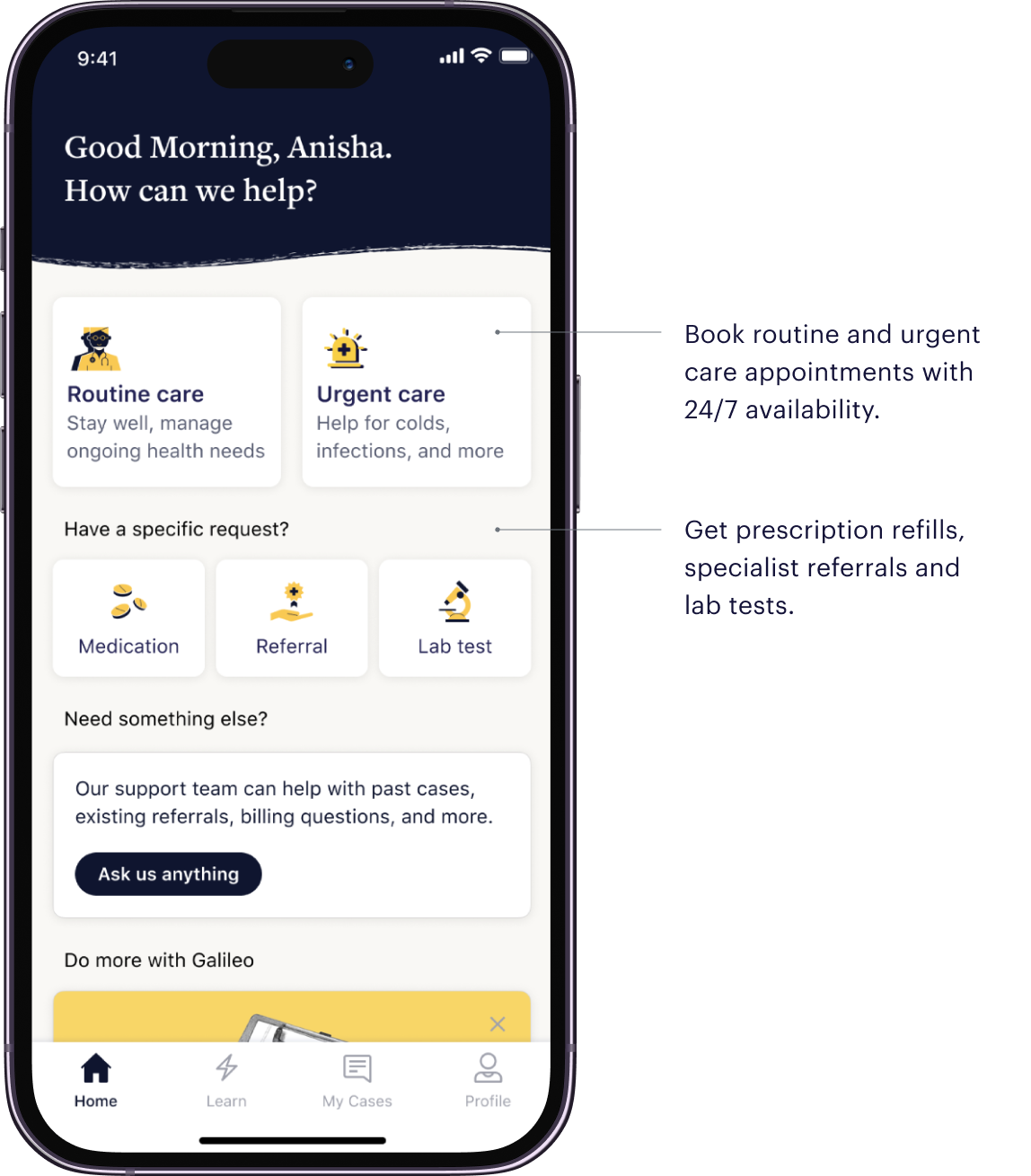
Galileo is the advanced primary care partner built for that upstream work: one accountable, multidisciplinary care team that manages complex, high-need members continuously, virtually, and in person, instead of handling them between vendors. That structure is what lets Galileo act on a risk signal the same day it appears, rather than waiting for a referral to work its way through a fragmented system.
What Claims Cost Management Actually Requires
Claims cost management is the set of practices a self-funded employer uses to predict, prevent, and reduce the cost of medical claims, especially the small share of claims that drive most of the spend. It's not synonymous with stop-loss insurance, and it's not the same as a single-point solution. It's an operating discipline that combines four pieces.
Predictive Analytics and Risk Stratification
Claims and pharmacy data can identify members trending toward high-cost status before they get there: rising utilization, new chronic diagnoses, comorbidity patterns, and gaps in preventive care all show up in the data months before a catastrophic claim does. The value isn't the dashboard. It's whether that signal triggers an actual clinical response.
Galileo's model is built to act on that signal, not just surface it: when the data flags rising risk, a care team reaches out instead of waiting for the member to book a visit.
High-Cost Claimant Programs
A high-cost claimant program targets the relatively small group of members already driving outsized spend, or trending toward it, with case management, care coordination, and closer clinical oversight. Research from the Employee Benefit Research Institute examining 5.8 million employer-sponsored plan members found that 20% of the population accounted for 84% of total health spending, and just 5% accounted for 56% of spending. That concentration is exactly why targeted programs outperform broad-based wellness campaigns on cost.
This is where Galileo concentrates its model, wrapping the highest-need members in one accountable care team that manages the case continuously instead of handing it between vendors.
Stop-Loss as a Backstop, Not a Strategy
Stop-loss insurance caps an employer's exposure once a claim crosses a set threshold, and it's a legitimate, necessary risk management tool. The mistake is treating it as the cost strategy itself. Stop-loss pays the same whether a $400,000 claim was preventable or not. It doesn't ask why the claim happened, and it doesn't reduce next year's risk.
Early Clinical Intervention
This is the piece most claims cost management strategies underweight. Getting a clinical team involved earlier, before a condition escalates, before a member defaults to the emergency room, before a chronic condition goes unmanaged for another quarter, is what actually changes the cost trajectory rather than just paying for it after the fact.
And this is exactly what Galileo is built for: 24/7 access and an easy-to-use platform strip out the friction that usually delays early intervention, so a clinician engages before the condition escalates.
Why High-Cost Claims Keep Getting More Expensive
Two trends are compounding for self-funded employers right now. First, claims have always been concentrated in a small share of the population. Second, that concentrated spend is growing faster than overall claims.
Sun Life's most recent high-cost claims and injectable drug trends report, based on claims from thousands of self-funded employers, found million-dollar stop-loss claims rising sharply year over year, driven by cancer, complex hospitalizations, and high-cost specialty drugs. GLP-1 medications are a specific and growing piece of that trend, with high-dollar claims involving GLP-1s rising 24% over the past year, according to Sun Life's data, often tied to comorbid conditions like diabetes and cardiovascular disease rather than weight management on its own.
This matters because most covered workers, 67% according to KFF's 2025 Employer Health Benefits Survey, are now in self-funded plans. The employer, not an insurance carrier, absorbs this trend directly.
For a self-funded employer, that's exactly where a partner like Galileo earns its keep. An advanced primary care model that manages high-need members continuously can bend that trend before it hits the plan, which is where Galileo's 11.5% reduction in total cost of care comes from.
Tactical Levers That Actually Move the Needle
Most claims cost management programs split these levers across separate vendors. Galileo runs all four through one care team, so they function as a single mechanism shaping the member’s journey before costs escalate.
Care Navigation: Where the Risk Signal First Appears
When a member's journey starts with uncertainty: new symptoms, a confusing diagnosis, a condition that's getting harder to manage. Left alone, that uncertainty defaults to the most expensive option, the emergency room. Galileo's care team is the first call instead, and because it's the same team managing whatever comes next, that call isn't a triage line handing the member elsewhere. It's the start of a relationship that carries through diagnosis, treatment, and follow-up, which is what keeps uncertainty from becoming an avoidable claim.
Clinical Review and Built-In Second Opinions: Before the Treatment Pan Is Set
When a case is complex enough to warrant a second look, Galileo's care team reviews it internally rather than referring the member to a standalone expert-opinion service. Because the reviewing clinician already has the member's full shared record and ongoing relationship, the review happens faster and stays connected to what comes next.
The clinical case for catching things early is well established: a University of Michigan Comprehensive Cancer Center study found that more than half of breast cancer patients who sought a second opinion had their recommended treatment changed, often because specialists read imaging or biopsy results differently. Galileo builds that kind of review into the care relationship itself, not into a separate benefit members have to remember to use.
Advanced Primary Care: Where the Relationship Continues
Once a treatment plan is set, that's typically where point solutions end, handing the member back to a specialist, a pharmacy benefit, or their own follow-through. Galileo's care team stays. The same clinicians who navigated the member in and reviewed their case manage the ongoing relationship, so nothing learned in the first two stages gets lost in a third handoff. Continuity, not any single intervention, is what protects the cost trajectory here.
Chronic Condition Management: Where the Trend Line Bends
For members with chronic conditions, this is where cost trajectories are won or lost, and it's the part of the journey most easily neglected. A GLP-1 prescription, a blood pressure trend, an A1C creeping up over two quarters: none of it generates a claim on its own, but all of it predicts one. Because Galileo's care team already has this member's full history, chronic condition management isn't a separate program to enroll in. It's the same relationship, paying attention over a longer horizon.
Run separately, these are four vendors and four handoffs, each addressing its own piece after the fact. Run through Galileo as one care team, they’re four connected moments in a single relationship, letting a risk signal move to intervention before it becomes a high-cost claim.
The Real Gap: Early Intervention vs. Reactive Catastrophic Claims
Here's the strategic question most claims cost management plans never quite answer: what's the actual cost difference between catching a complex case early and managing it only after it becomes a catastrophic claim?
The honest answer is that most programs are built to respond to the second scenario, not prevent it. A high-cost claimant program that identifies risk but doesn't change the care delivery model is still managing the same reactive system, just with better visibility into it.
Advanced primary care closes that gap by giving complex patients continuous clinical ownership instead of fragmented, episodic care. Across Galileo's employer and health plan partnerships, that model has been associated with members who are over 70% less likely to need a specialist, ER, or urgent care visit.
Building a Claims Cost Management Strategy
Turning that gap into a plan of action means sequencing a few concrete steps rather than adopting a single tool.
- Audit your current high-cost claimant population: Identify who's driving spend now, who's trending toward it, and where current vendors and programs overlap or leave gaps.
- Layer in predictive analytics: Use claims and pharmacy data to flag rising risk before it becomes a catastrophic claim, not after.
- Anchor complex care in one accountable model: Advanced primary care gives high-need members continuity instead of a rotating cast of specialists and urgent care visits.
- Evaluate vendors on outcomes, not activity: A value-based, outcomes-tied arrangement holds a partner accountable for the cost trend it's supposed to influence, not just for delivering a service.
- Treat stop-loss as a backstop, not the plan: Size your stop-loss coverage to your actual risk, and judge it on protection, not on whether it's doing the work your care model should be doing.
- Track avoided cost, not just reimbursement: A claims cost management program that only gets evaluated by how much stop-loss is paid out is being measured backward.
Measuring Whether Claims Cost Management Is Working
Stop-loss reimbursement totals tell you what already happened. They don't tell you whether your strategy is changing what happens next. A more useful scorecard tracks:
- High-cost claimant trend year over year, adjusted for population changes, not just the raw dollar total.
- Time from risk identification to clinical intervention, since the value of predictive analytics depends entirely on how fast the signal turns into action.
- Avoided utilization, including specialist referrals, ER visits, and urgent care visits that a coordinated care model prevented.
- Total cost of care trend across the full population, not just the high-cost segment, since a strategy that only manages the top 5% while ignoring the next 15% will plateau.
- Vendor and partner performance against the outcomes they were hired to move is reviewed on a regular cadence rather than at renewal only.
Treat Claims Cost Like a Clinical Problem, Not Just a Financial One
Claims cost management works best when it stops being treated purely as a finance and underwriting exercise. The data, the stop-loss strategy, and the vendor evaluation all matter, but none of them change a cost trajectory on their own. What changes it is getting clinical attention to the right people earlier than the claims data alone would prompt.
That's the case for building claims cost management around an advanced primary care model instead of bolting another point solution onto the existing stack: it's the difference between identifying a high-cost claimant and actually changing what happens to them next.
Ready to put earlier clinical intervention at the center of your claims cost strategy? Galileo's employer and health plan partnerships are built to identify complex, high-need members and manage their care continuously, before a manageable condition becomes a catastrophic claim.

%20(1)%20(1).webp)

.webp)










%20(1).webp)
%20(1).webp)











.webp)