- A care management program coordinates high-risk members through data-driven identification, a personalized care plan, and a dedicated team, more than a single case manager could handle alone.
- It's broader than disease management (one condition) or utilization management (cost control through prior authorization).
- Just 5% of the population accounts for nearly half of all healthcare spending, which is why targeting the right members matters more than covering everyone the same way.
- Virtual-first models have shown an 11.5% reduction in total cost of care within six months.
- The best programs combine risk stratification with a team employees will actually use; a plan that only looks good on paper doesn’t move outcomes.
Most descriptions of care management read as a features list: risk stratification, personalized care plans, dedicated teams. That list is accurate, but it misses the real question: can the members who need it most reach a care team when something goes wrong, or are they flagged by an algorithm and left to navigate the next step alone?
Employers and health plans have spent years investing in identification tools without matching investment in access. Galileo starts from the opposite premise: identifying risk is table stakes. The value lies in what happens next: whether a multidisciplinary care team can intervene the same day, coordinate across specialists and behavioral health, and resolve the need rather than routing the member elsewhere. That's not a program built to manage high-risk members. It's one built to identify risk, intervene early, and close the loop.
What Is a Care Management Program?
A care management program is a coordinated set of services that helps members manage health conditions and navigate the healthcare system, going beyond simple case management by integrating risk stratification, personalized care plans, and dedicated care teams that address the full spectrum of a member's needs.
The table below shows how this differs from the two approaches it's most often confused with:
Risk stratification sits at the foundation of effective care management. By analyzing claims data, clinical information, and social determinants of health, programs identify which members need the most intensive support. But stratification only answers half the question: it tells a plan who's high-risk. It doesn't get that person in front of a clinician, which is the step that changes a trajectory.
Care coordination ties it together. When a member sees multiple specialists, takes several medications, and manages a behavioral health concern alongside a physical condition, someone has to actively coordinate that care; documentation alone doesn't make the pieces work together.
Quality and accountability matter here too. NCQA's Case Management Accreditation evaluates organizations against standards covering identification and assessment, care planning, care monitoring, and care coordination, giving health plans and employers a benchmark for what a well-run program should look like, independent of any single vendor's marketing claims.
Key Components of Effective Care Management Programs
Building a program that works requires a few tactical elements to work together; no single feature carries a program on its own.
Data-driven Member Identification
Effective programs go beyond simple claims analysis. Predictive modeling can flag members whose chronic conditions are likely to worsen without intervention, and social determinants of health data help pinpoint members facing barriers to access, particularly in Medicaid populations.
None of it matters if identification doesn't lead anywhere. Galileo pairs predictive modeling with a care team that acts on a risk signal the same day it surfaces.
Virtual Primary Care and Care Navigation
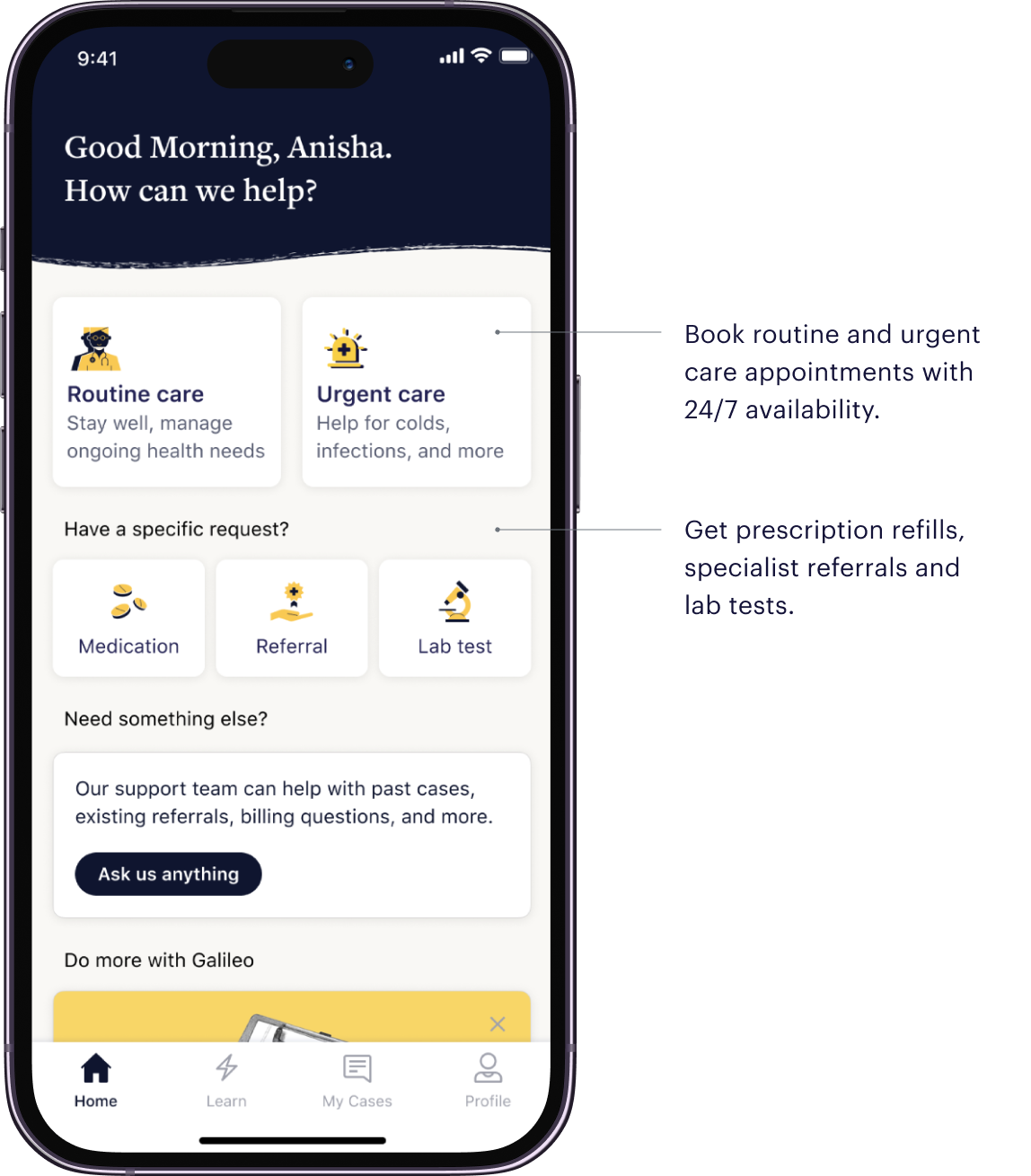
Modern care management relies on virtual care as the delivery channel. 24/7 access to a clinical team through text, video, and phone removes traditional barriers like transportation, work schedules, and geographic limitations. But access is only the front door. Galileo delivers this kind of always-on advanced virtual primary care using integrated medical records and a clinical intelligence platform that surfaces the full clinical picture at the point of care; a virtual visit is part of the same longitudinal record a specialist or behavioral health clinician can also see. That's what lets Galileo resolve a need directly, across primary, specialty, and behavioral health care, instead of routing the member to the next queue.
Chronic Condition and Behavioral Health Management
A chronic care management program targets specific conditions, commonly diabetes, hypertension, congestive heart failure, and COPD, with high-touch, longitudinal support, distinct from population health approaches that span all members with prevention and risk stratification.
Many programs pair this with remote patient monitoring, using connected devices to track vitals like blood pressure or glucose between visits so a care team can intervene before a trend becomes an admission. The most effective programs provide both chronic and population-level support, and behavioral health integration matters enormously here, since mental health conditions often complicate physical health management.
How Care Management Programs Reduce Costs and Improve Outcomes
The business case comes down to measurable impact: when programs work, they reduce utilization of high-cost services while improving outcomes and member satisfaction.
Across Galileo's employer and health plan partnerships, this kind of integrated, always-on model has shown an 11.5% reduction in total cost of care for employers within six months, driven by fewer emergency room visits, reduced hospital admissions, and better chronic condition management.
That reduction tracks with engagement: a program only bends cost if members use it. Galileo reports more than 29% digital engagement and a Net Promoter Score above 80 with partners, real evidence that identification paired with access changes how members actually behave.
This matters most for complex, high-risk populations. Just 5% of the population accounts for nearly half of total healthcare spending, according to AHRQ's most recent analysis of national expenditure data. That concentration is exactly why intensive, dedicated support for the right members moves the total cost of care.
What Sets an Effective Program Apart
Not every care management model is built the same way. The difference usually comes down to whether identification is backed by real access: a program that flags a high-risk member but routes them into a weeks-long specialist queue has identified the problem without solving it.
Traditional care management often stops at identification, or hands the member to a call center for outreach that may or may not land. Galileo is structurally different: the same data and clinical intelligence that stratify risk also connect that member to a 24/7, multidisciplinary care team that acts the same day across primary care, specialty care, and behavioral health, from a single shared record. The technology isn't bolted onto a call center. It's what makes an integrated clinical model possible at scale.
That combination, identification paired with a care team that resolves what it finds, is what a features list doesn't capture.
Ready to move from identifying risk to resolving it? Galileo's care management approach for employers and health plans pairs risk stratification with a 24/7 multidisciplinary care team built to act on what it finds.

%20(1)%20(1).webp)

.webp)










%20(1).webp)
%20(1).webp)











.webp)