- Referral leakage happens when patients are sent out of network for specialist care that could have been resolved or appropriately triaged within primary care, and it drives both higher costs and more fragmented care.
- Referral leakage is a well-documented drain on the broader health care system: one 2026 analysis found that a typical 400-bed health system loses an estimated $6.2 million a year to avoidable referral leakage.
- Most leakage traces back to a handful of causes: limited primary care scope, incomplete medical records, network confusion, and slow access to appointments.
- Advanced primary care models can resolve far more in-house than traditional practices. Galileo's own data shows 87% of care resolved without a referral, alongside an 11.5% reduction in total cost of care for employer partners.
- Reducing referral leakage isn't about eliminating specialist care. It's about making sure every referral is necessary, appropriate, and stays within a coordinated, in-network system.
Every unnecessary referral is a small decision with a high downstream cost. A patient gets sent out of network for something their primary care team could have handled, the claim comes in at a higher rate, and the record doesn't always follow. Multiply that across a workforce, and referral leakage becomes one of the more expensive, more preventable problems in a self-funded employer health plan.
Referral leakage is a symptom of how primary care is built, not an inevitable cost of doing business. That's the lens Galileo applies to it: when a care team has the scope, the tools, and the access to manage more conditions itself, fewer patients need to leave the network in the first place.
What Is Referral Leakage?
The term describes a specific failure point: a patient lands with an out-of-network provider for specialist care that primary care could have handled, or at least triaged, on its own. For HR and benefits leaders managing a self-funded plan, this is often an invisible drain: it rarely shows up as its own line item, but it shapes claims costs, utilization patterns, and the coordination quality behind almost every one of them.
Every time an employee is sent to an outside specialist for something their primary care team could have handled, the visit typically carries a higher reimbursement rate, follow-up gets harder to track, and records don't always transfer cleanly between systems. That last point matters more than it sounds: when a new provider can't see what has already been done, duplicate tests and conflicting treatment plans become common rather than exceptional.
Much of this is preventable. When primary care teams have the scope, the specialist input, and the data to manage a broader range of conditions themselves, fewer referrals happen in the first place, and the ones that do happen are more likely to be necessary.
Why Referral Leakage Matters for Employers
The effects of referral leakage extend well beyond the cost of any single visit. For self-funded employers, it compounds across both claims spend and the quality of care employees experience.
Financial Impact
Out-of-network specialist visits carry higher reimbursement rates on their own, and they often trigger additional imaging, labs, or procedures that a better initial triage might have avoided. One referral leakage analysis found that a typical 400-bed health system loses an estimated $6.2 million a year to avoidable referral leakage, a figure that reflects how much money moves out of a coordinated network when referrals aren't managed well.
For an employer, that same dynamic shows up as higher claims, more emergency room visits when specialist appointments aren't available quickly, and lower satisfaction with the benefits employees are already paying into.
Care Fragmentation
When referrals scatter across unconnected providers, no single clinician holds the complete picture. Consider an employee with diabetes referred to an endocrinologist outside the network: that specialist has no access to the primary care record, orders baseline labs that were run three weeks earlier, and prescribes a medication without knowing about an interaction already flagged in the chart. The employee gets a worse experience, and the employer pays for redundant care that better coordination would have caught.
Cutting referral leakage keeps more of that coordination intact. Galileo's integrated model, which combines 24/7 virtual access with in-home and in-clinic care in select markets, is built specifically to avoid the external referrals and duplicate testing that drive this cost, and employer partners using this model have seen an 11.5% reduction in total cost of care within six months.
Common Causes of Referral Leakage
Most referral leakage traces back to a small number of predictable causes, and each one responds to a different fix.
Limited Primary Care Scope
Traditional primary care practices often work within narrow boundaries. A patient with anxiety gets sent to a psychiatrist when integrated behavioral health could manage it. Someone with well-controlled hypertension gets referred to cardiology for routine monitoring that a primary care team could easily handle. These referrals aren't always clinically necessary; they often reflect practice patterns and resource constraints more than actual need.
Incomplete Medical Records
When a primary care clinician doesn't have access to a patient's full history, including specialist notes, imaging, and medication lists, referring out becomes the cautious choice rather than a confident one. Unified records reduce that uncertainty and give clinicians the information they need to manage more in-house.
Network Complexity
Employees often don't know which specialists are in network, and primary care offices don't always have current directories to point them to. The result is patients landing with out-of-network providers because the in-network options weren't clear or easy to find.
Access Barriers
In-network specialist appointments often take weeks to schedule, with the American Academy of Family Physicians reporting average wait times of around 21 days for acute or chronic concerns, so employees look elsewhere. Extended hours, virtual options, and same-day availability at the primary care level keep more care in-house before a referral becomes necessary at all.
Strategies to Reduce Referral Leakage
A few strategies consistently reduce referral leakage without adding friction to the referrals that are genuinely needed.
Expand Primary Care Capabilities
The most effective lever is resolving more conditions at the primary care level in the first place. That means building care teams that include behavioral health, chronic disease management expertise, and access to specialist e-consults, so a primary care clinician can get real-time input from a cardiologist or dermatologist without sending the patient out. Advanced primary care models built around this approach can meaningfully outperform traditional practices on resolution: Galileo's own model resolves 87% of care without a referral.
Invest in Comprehensive Medical Records
Unified records give clinicians the confidence to manage more conditions themselves. When a primary care team can see every specialist note, lab result, and imaging study in one place, they make sharper decisions about what genuinely requires a referral and what they can resolve directly.
Build 24/7 Access
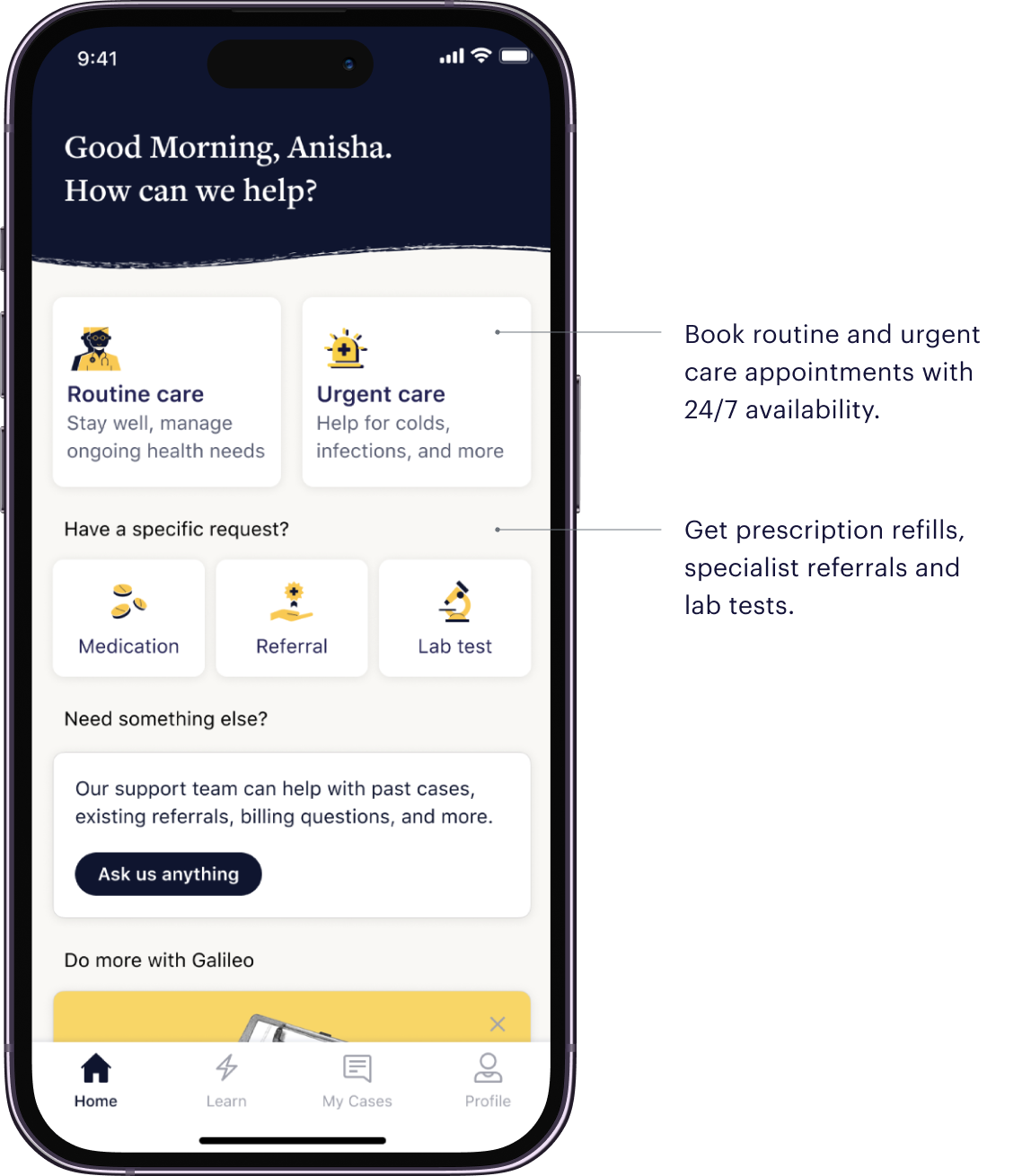
Many unnecessary referrals start when a patient can't reach their primary care team when they need it, so they go to urgent care or the ER instead, which then refers them on. Extended and same-day availability keeps that from happening, with virtual visits handled by a multidisciplinary care team and in-person or in-home visits in select markets. What matters is what sits behind that availability: the clinician a patient reaches at 9 p.m. is working from the same record, with behavioral health and specialty input on the same team, so the visit ends in a resolution rather than a referral. Galileo sees more than 29% digital engagement across partner populations, which is the difference between access that exists and access that gets used.
Use Referral Leakage Analytics
Tracking where referrals go, which stay in network, and which conditions drive the most leakage helps an organization target the right interventions instead of guessing. Look for patterns by diagnosis, by referring provider, and by geography. Galileo's care team acts on those patterns; it doesn't just surface them.
How Advanced Primary Care Reduces Unnecessary Specialist Referrals
The traditional primary care model, built around fifteen-minute visits and a narrow scope of practice, made sense when it was the only scalable option. It also made frequent referrals the default response to almost anything outside that narrow scope. Advanced primary care takes a different approach.
Galileo's model reduces unnecessary specialist referrals by resolving more in-house. Multi-specialty clinicians, clinical intelligence tools, and comprehensive shared records work together, so the referrals that do happen are the ones that genuinely need to leave the primary care setting.
That works because the care team itself is built differently. When a practice includes clinicians across internal medicine, family medicine, behavioral health, and chronic disease management, a patient managing both depression and diabetes doesn't need two separate specialists.
One well-equipped team can manage both conditions together, using shared data and coordinated workflows rather than routing the patient among disconnected providers. Clinical intelligence tools support that team by synthesizing patient data, flagging emerging issues, and surfacing evidence-based options, which leads to more confident in-house management and fewer referrals made out of caution rather than clinical need.
Traditional Referral Process vs. Advanced Primary Care Coordination
Fewer Unnecessary Referrals Start With a Different Kind of Primary Care
Referral leakage isn't just an operations problem. It's a strategic one that touches employer health care costs, employee experience, and the quality of care people receive. Fixing it doesn't mean restricting access to specialists. It means building primary care that resolves more on its own, so the referrals that do happen are the ones that were genuinely necessary.
Galileo's model is built around that resolution rate rather than around referral volume: multi-specialty clinical teams, shared records, and working together so fewer employees fall through the gap between a primary care visit and a specialist's office.
If referral leakage is showing up in your claims data, talk to Galileo's employer team about what a care model built to keep more of that care in-network could look like for your workforce.