- AI's most immediate value in healthcare may be less about replacing clinical judgment and more about reducing the administrative work surrounding it. Physicians spend substantial time on EHR and desk work alongside direct patient care, creating an opportunity for AI to give some of that time back.
- A 2025 meta-analysis of AI-assisted documentation tools found a moderate reduction in clinician workload across 23 studies, suggesting that documentation is one of the clearest near-term applications of AI in clinical practice.
- At Galileo, AI supports specific operational and clinical workflows, including clinical intake summarization, ambient documentation, ICD-10 search assistance, document processing and routing, and a non-clinical patient chatbot.
- AI is only one part of the technology behind effective care delivery. Galileo also uses clinical intelligence, automation, workflow logic, and integrated care teams to identify needs and coordinate care. Those capabilities should not all be described as AI.
- Human judgment remains central. AI can organize information and reduce repetitive work, but clinicians remain responsible for the decisions that affect patient care.
The most useful application of AI in healthcare today is not replacing clinical judgment. It is returning time and information to the clinicians who exercise it, primarily by reducing the administrative work that surrounds every patient encounter.
Galileo treats AI as one tool inside an integrated model of Advanced Primary Care, not as a program in its own right. Care quality comes from a multidisciplinary clinical team, a shared medical record, clinical intelligence, and the ability to resolve a member's needs rather than route them elsewhere. AI earns a place in that model where it gives clinicians more time and better information at the point of care.
For leaders building an employer health care strategy, that distinction is practical. Technology does not improve care on its own. It improves care when a clinical team is positioned to act on what the technology surfaces, and when claims about it can be traced to evidence rather than assumed.
How AI Reduces Administrative Burden
Administrative burden is the most well-documented problem AI is currently positioned to address. It is also the problem most directly tied to how much attention clinicians can give patients.
A widely cited time-and-motion study in Annals of Internal Medicine observed 57 physicians across family medicine, internal medicine, cardiology, and orthopedics. During the office day, they spent 27.0% of their time on direct clinical face time and 49.2% on EHR and desk work. That works out to nearly two hours of EHR and desk work for every hour spent with patients.
AI documentation tools are starting to shift the balance. A 2025 systematic review and meta-analysis included 23 studies and pooled results from 14 of them. It found a moderate reduction in documentation workload and related burnout.
The practical implication is straightforward. Time returned from note-writing can be redirected toward the member conversation, the follow-up, and the review of a colleague's input. AI does not remove the need for that work. It changes how much of a clinician's day the surrounding administrative tasks consume.
How Galileo Applies AI Today
Galileo uses AI in a small number of applications that can be substantiated in production today. Each is aimed at reducing administrative burden or improving the information available to clinicians, and none is positioned as a substitute for clinical judgment.
Ambient Documentation and Intake Summarization
Ambient documentation drafts visit notes from the clinical conversation, which is designed to reduce the time clinicians spend writing after an encounter. Clinical intake summarization condenses what a member shares at intake, so a clinician can see the relevant context quickly.
ICD-10 Search and Document Routing
ICD-10 search assistance helps clinicians locate the appropriate diagnosis code without manual lookup. Document processing and routing helps organize incoming documents and direct them to the appropriate part of the workflow.
Non-Clinical Patient Support
Galileo's patient chatbot handles non-clinical questions. Clinical questions and clinical decisions remain with the care team.
What Is and Is Not AI in Galileo's Care Model
Care-gap identification and proactive outreach are among the most visible parts of coordinated care, and they are often assumed to be AI. At Galileo, they rely on a combination of technology, clinical intelligence, automation, and workflow logic across the platform. Not all of that is AI.
AI-involved functions:
- Visit documentation: Ambient documentation drafts the note for clinician review.
- Pre-visit context: Clinical intake summarization.
- Diagnosis coding: ICD-10 search assistance.
- Incoming documents: Document processing and routing.
- Non-clinical member questions: Patient chatbot.
Not attributed to AI:
- Care-gap identification and proactive outreach: Clinical intelligence, automation, and workflow logic across the platform.
- Clinical decisions and treatment: The multidisciplinary care team.
The distinction matters because identification is the easier half of the problem. The value lies in intervention: a clinical team with a shared record and specialty depth that can resolve what has been identified, inside an Advanced Primary Care model, rather than routing the member to another program.
Can AI Improve Patient Safety Without Replacing Clinicians?
Yes, when human oversight is designed into how a tool is used rather than added afterward. The evidence on AI-enabled medical devices shows why.
A 2026 analysis in JAMA Network Open followed 903 FDA-authorized AI-enabled medical devices through August 2024. Of those, 43 (4.8%) were recalled after a median of 458 days. Devices with missing information about supporting clinical studies had a higher hazard of recall. Devices with use-related problems were also associated with elevated recall hazards.
The study concerns regulated medical devices, not documentation or administrative tools, so it should not be stretched beyond that scope. Its lesson still applies. How a tool is used, and whether qualified people are checking that use, matters as much as how the tool performs in isolation.
Galileo's use of AI follows that logic. AI supports the work, and clinicians remain responsible for the record and for care decisions.
What AI in Healthcare Means for Employer-Sponsored Health Plans
For HR and benefits leaders, the relevant question is not whether a vendor uses AI. It is whether the care model behind the technology resolves needs and reduces avoidable utilization.
Integrated Care, Not Another Layer of Software
Fragmented care is costly in ways that often stay invisible until claims are reviewed. Providers duplicate testing when they cannot see prior work, and follow-ups are missed when no one owns a referral through to completion. Software placed on top of a fragmented system can track those gaps, but it cannot close them.
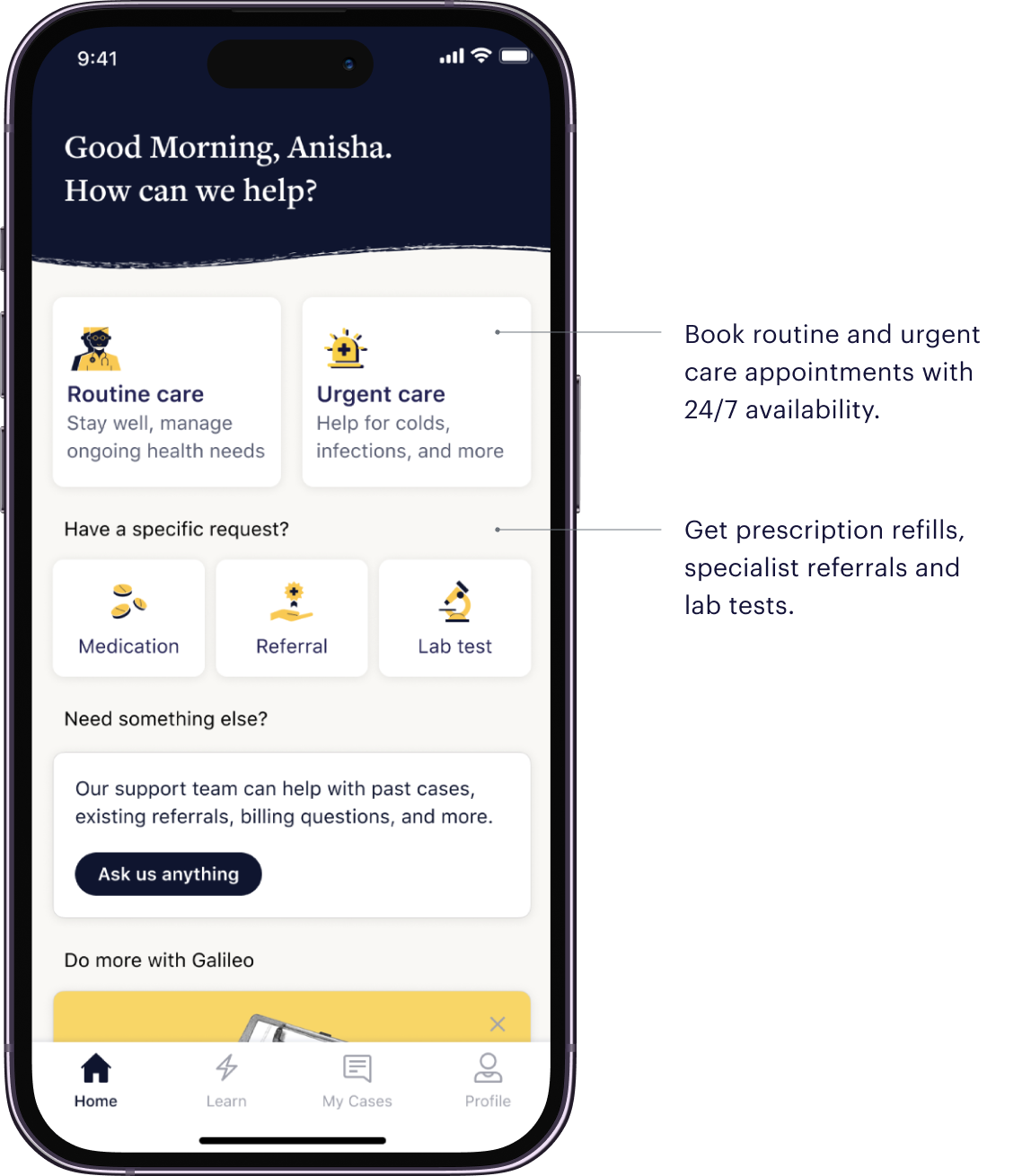
Galileo addresses the problem at its structure. A multidisciplinary clinical team, a shared medical record, and clinical intelligence operate on one platform built around how clinicians deliver and coordinate care. Virtual, in-person, and in-home care function as one model. That is the difference between an integrated model and a portfolio of point solutions.
What the 11.5% Result Reflects
Galileo has demonstrated an 11.5% reduction in total cost of care within six months of working with employers. That result reflects the integrated care model as a whole: 24/7 access, a multidisciplinary clinical team, unified records, and coordination across specialties.
Galileo does not attribute that result to AI. AI is one of the tools that helps its clinical teams operate more effectively, chiefly by reducing administrative burden.
Questions to Ask Any Vendor About AI
A short set of questions separates substantiated capability from positioning.
- Which AI capabilities are in production today, and which are planned?
- Where does a clinician review AI output before it affects a member's care?
- Which proactive functions depend on AI, and which depend on automation, clinical intelligence, or workflow logic?
- What outcome evidence exists for the tool itself, as opposed to the broader care model?
- When a need is identified, can the vendor's clinical team resolve it, or does it route the member elsewhere?
The fifth question is often the deciding one. A care management program is only as effective as the team able to act on what it identifies.
Making Great Care Teams More Effective
The AI in healthcare conversation that matters right now is not about whether a model can replace a clinician. It is about whether your care model gives clinicians the time, information, and team they need to resolve problems before they become expensive.
Galileo applies AI where it can be substantiated today, in documentation, intake, coding, document workflows, and non-clinical member support, and it does so in service of a clinical team that owns the outcome.
If you are evaluating how AI fits into your health care strategy, connect with the Galileo team to see how an integrated care model puts these tools to work for your team.